The need for cutting edge, mission critical messaging options is arising in a variety of contexts: it is a key component to interoperable ‘smart grid’ frameworks, as well as ‘cloud’ solutions.
OASIS adopts AMQPv1: An Open Standard for Smart Grid and Cloud
Development Release: Elementary OS 0.2 Beta 1
Cassidy James has announced the availability of the first public beta release of elementary OS 0.2, a beginner-friendly desktop Linux distribution based on Ubuntu 12.04 and featuring a custom GNOME Shell called “Pantheon”: “Developers and testers, today we are happy to announce the first beta release of elementary….
Gartner: “Scant Growth” In Global Enterprise IT Spending This Year, But 2.5% Rise Projected For 2013

A deterioration in the global economic outlook this year is leading to scant overall growth in enterprise IT spending, according to Gartner. However the analyst says its third quarter outlook points to “more substantial growth†next year — assuming what it calls “significant fiscal crises†are avoided in the U.S. and Europe. Its view is that enterprises have cut IT spending so much they have little room to reduce it further. It’s forecasting a 2.5 percent increase on projected 2012 spending of $2.603 trillion next year — taking enterprise IT spending to a total of $2.679 trillion in 2013.
“The global economic outlook has deteriorated in 2012, leading to scant overall growth in enterprise IT spending,†said Kenneth Brant, research director at Gartner in a statement. “However, our third-quarter outlook points to more substantial growth in 2013, if significant fiscal crises are avoided in the US and Europe, and in subsequent years. Most organisations have already significantly cut discretionary IT spending growth over the past several years and, barring a global economic catastrophe and significant contraction of operations, they have little room to reduce IT spending further over the long run.â€
Microsoft Updates its Windows Embedded Roadmap; Embedded 8 Handheld is Alive
Microsoft has provided yet another update to its Windows Embedded roadmap. Many products have been renamed. And a new version of Embedded Handheld is coming.
Service Level Management – A Conversation with Zenoss
Traditional systems, converged infrastructure and cloud computing are being brought together to support ever more complex workloads. Floyd Strimling of Zenoss discusses the company’s newest release of software and why hybrid environments are becoming commonplace.
94 Percent of the World’s Top 500 Supercomputers Run Linux
It’s already no secret that Linux tends to dominate as the operating system of choice on the world’s fastest supercomputers, but the release on Monday of the 40th edition of the twice-yearly Top500 List of the world’s top supercomputers made that connection more clear than ever.
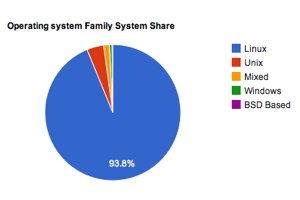
A full 469, or 94 percent, of the top 500 supercomputers now run Linux, according to the Top500 November report, compared with 462 in the June edition of the twice-yearly evaluation. Just 457, or 91.4 percent, of the top machines ran Linux a year ago.
Meanwhile, only three of the world’s top supercomputers in this latest report — ranking at No. 132, 165 and 183, respectively — run Windows, compared with just two in June and one a year ago.
The Top500 list is compiled by Hans Meuer of the University of Mannheim, Germany; Erich Strohmaier and Horst Simon of Lawrence Berkeley National Laboratory; and Jack Dongarra of the University of Tennessee, Knoxville.
Speed and Efficiency
Taking the crown for the No. 1 spot in this latest list is Titan, a Cray XK7 system installed at the Oak Ridge National Laboratory by the U.S. Department of Energy. Titan achieved 17.59 petaflops on the Linpack benchmark using 261,632 of its Nvidia K20x accelerator cores.
Interestingly, Titan is also one of the most energy-efficient systems on the list, consuming a total of 8.21 megawatts and delivering 2,143 megaflops per watt.
Slipping to the No. 2 spot in this latest report, meanwhile, was Lawrence Livermore National Laboratory’s Sequoia, an IBM BlueGene/Q system that was top of the list in June. With 1,572,864 cores, Sequoia is the first system to top one million cores.
Rounding out the top five systems are Fujitsu’s K computer installed at the RIKEN Advanced Institute for Computational Science (AICS) in Kobe, Japan (No. 3); a BlueGene/Q system named Mira at Argonne National Laboratory (No. 4); and a BlueGene/Q system named JUQUEEN at the Forschungszentrum Juelich in Germany (No. 5), which is now the most powerful system in Europe.
Intel in the Lead
Looking at the data in geographical terms, the United States is the leading consumer of high-performance computing (HPC) systems, with 250 of the 500 systems on the list. Asia comes next, with 124 systems, followed by Europe, with 105.
Regarding vendors, meanwhile, Intel continues to provide the processors for the largest share of the Top500, accounting for 75.8 percent of the list. A full 84 percent of the systems included use processors with six or more cores; 46 percent tap eight or more cores. A total of 62 systems on the list use accelerator/coprocessor technology.
Full details on the new report can be found on the Top500 site. To mark the 20th anniversary and the 40th edition of the list, a special poster display is being featured at the SC12 conference (Booth 1925) this week in Salt Lake City.

Buyers Surprised By Coolness of Linux Powered Refrigerator
The Linux powered refrigerator is alive, and wants to run all your internet-enabled apps. Samsung has developed a custom Busybox Linux for their $3500 refrigerator.
Queen Gets Galaxy Note 10.1, Not iPad, for Royal Collection
The Royal Collection includes a host of other digital products, including PCs and DVDs. [Read more]
Google Named 2nd Best Company to Work For in the World
The search giant took second place among the top global workplaces, according to a new report. [Read more]
Intel Capital And Red Hat Invest In 10Gen, Bringing Total To $76M For The NoSQL Database Company
Intel Capital and Red Hat have invested in 10Gen bringing the total raised by the company to $76 million. 10Gen is the sponsor for MongoDB, the popular open source NoSQL database.
An exact amount of the investment was not disclosed, but according to CrunchBase and other sources, 10Gen had raised $73.4 million prior to today’s news. That would peg this new investment at $2.6 million between the two companies. In May of this year, New Enterprise Associates led a $42 million round with existing investors. In-Q-Tel followed in September with an undisclosed round.
The Series E investment will go toward product development and worldwide community development.