
Home Blog Page 2189

Why You Should Attend LinuxCon Europe: My Top Five Sessions

Earlier this week we published the full schedule for LinuxCon Europe and Embedded Linux Conference Europe. In many ways, I think the technical content for LinuxCon Europe may be the best collection of speakers we’ve ever had. I wonder if the location in Barcelona has anything to do with that….

Here are my top five favorite sessions:

— The Linux Kernel Report from LWN.net editor Jon Corbet. Get a peak into the future of the kernel from Jon. 

— “Don’t Play Dice with Random Numbers” from Intel’s H. Peter Anvin. Linux contains a sophisticated system to make randomness available to the kernel and applications, but it has limitations.  This talk will examine the applications of random numbers, the Linux random number subsystems, how to correctly write an application that requires random numbers, and how to configure a system to avoid random-number-related security or performance problems.

— “Trawler: A New Approach to SSD Caching” from Hannes Reinecke of SUSE Labs. In this talk Hannes will present a new approach for SSD caching by using a filesystem on the SSD and filesystem notifications via fanotify to maintain consistency with the underlying filesystem.

— “Scaling an Open Source Community: How we grew Open Stack” from Monty Taylor of HP. OpenStack started off as one of the fastest growing Open Source projects around. While that’s extremely exciting, it’s also the type of growth that can derail projects if they aren’t prepared for it. From day one,  we had to set up for success and plan for problems before the arose. How we did it is interesting enough, but understanding why we made the choices we made will go a long way to understanding how to grow other projects through similar times.

— “Optimizing File System Performance When Memory is Tight” from Google (and Linux Foundation fellow) Ted Ts’o. File systems benchmarks are often run on a system with nothing else is running, and when there is plenty of memory available.  Unfortunately,this is often not how file systems are used in many systems — in particular, in virtualization and/or in “”cloud servers””, were a largenumber of virtual machines or jobs are packed onto a single physical server in order to make the utilization numbers required by a typicalcloud business plan.

Our keynote line up is varied and strong this year with talks from the CTO of Evernote, the CEO of Eucalyptus, the founder of Ubuntu, the CTO of Red Hat and more. I didn’t list it in my top five but of course it is: a conversation between Linus Torvalds and Intel’s Dirk Hondel. These two friends and long term collaborators will make for a lively conversation. Afterwards, we should also have fun exploring the streets of Barcelona. Here’s another top ten list we may find handy. If you register before tomorrow it’s only $350 to attend both conferences (plus the CloudOpen Summit). Hope to see you all there! 


Asia IT Leaders More Certain of Cloud Needs

CIOs in the region have moved out of the experimental phase with cloud computing; and now have the company’s commercial and legal support to purchase cloud services.

Read more at ZDNet News

Intel Ports Android Jelly Bean to x86, but Rollout Date Remains Murky

The company has reportedly got Android 4.1 working on its architecture, although it is unclear when those who have picked up handsets such as the Orange San Diego will get the upgrade.

Read more at ZDNet News

Open Source Cloud News Roundup, Week of Sept. 10

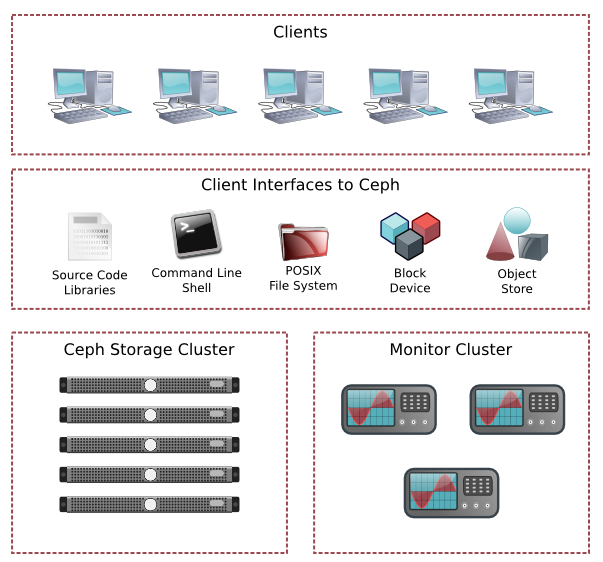
Ceph DiagramMark Shuttleworth’s $1 million investment in open source cloud storage company InkTank leads the open cloud headlines this week.  Also included is a rosy forecast on the public cloud services market from IDC, a collection of quotes on the definition of the open cloud from industry leaders, an interesting Google+ hangout chat on the open source cloud and a white paper from Intel on how to speed a cloud services deployment with open source software. 

Open Source Champ Mark Shuttleworth Invests $1M in Ceph Storage Startup

GigaOM

Canonical founder Mark Shuttleworth made a big vote in open cloud this week with his investment in InkTank. The startup is the enterprise services arm of the open source Ceph storage system — an object, block, and file storage platform, often used to provide storage for virtualization.  It has a compatible API to Amazon S3 and Swift, so companies can build on any cloud stack or hypervisor. (For more on Ceph, see our July 31 profile.)

IDC Expects Maturing Cloud Services to Generate $100 Billion in Revenue in 2016

ZDNet

IDC’s study on the potential market for the public cloud isn’t specific to open source cloud. But it gives a good indication of why so many large IT vendors are rushing to provide cloud services, and getting behind open source development to compete with existing public cloud providers such as Amazon.  

10 Insights from Linux Leaders in the Open Cloud

Linux.com

We’ve compiled quotes on the open cloud from industry leaders including Intel, IBM, HP, Rackspace and SUSE. Their responses illustrate a diverse set of opinions on how companies define the open cloud.

White Paper: Intel IT Best Practices: Open Source Cloud

Intel

This new white paper from Intel discusses how to accelerate cloud deployment using open source software. 

Video: A Conversation on Open Cloud – Google+ Hangout

YouTube

Tech commentator Ben Kepes leads a discussion on the definition of the open source cloud, the role of APIs, the development of specifications, cloud innovation and the cloud marketplace with cloud computing analyst Krishnan Subramanian and Rackspace Cloud co-founder Jonathan Bryce.  

https://www.youtube.com/watch?v=av90HZzVzhc” frameborder=”0″ width=”560


Canonical Releases Updated Enterprise Management Solution for Ubuntu Linux

Landscape Compliance Reporting Screenshot

Ubuntu Linux, which started with the tagline “Linux for human beings,” was originally an easy to use Linux distribution for desktop users. Canonical picked what they considered to be the best of breed applications from the many thousands available in the Debian Linux distribution, put on a healthy dose of polish, and released their own version. They then repeated this release process every six months. Six months is slightly too frequent a release schedule for many users — especially companies that might look to standardize on Ubuntu Linux — so Canonical declared that every fourth release would be a “Long Term Support” version, with three of support.

At the same time that Canonical was pushing Ubuntu for the desktop, they also released a Server edition, with five years of support in LTS releases. Ubuntu’s ease of use made it, unsurprisingly, very popular. The synchronicity between the desktop and server releases made Ubuntu a very attractive development target, and many organizations used it as their web tier. As Ubuntu’s usage has increased, it has slowly penetrated the traditional enterprise segment. To succeed there, robust management tools are required.

In 2006, Canonical released their Landscape product to provide centralized systems management. Like Red Hat’s Satellite and SUSE’s Subscription Management Tool, Landscape aims to provide management and monitoring capabilities to a large fleet of Ubuntu systems — servers, desktops, and cloud images — from a single interface. Today Canonical is announcing a major update to Landscape with a host of new features.

The big new features include robust compliance reporting — which are especially important for industries regulated by HIPAA or PCI DSS — integration with Ubuntu’s metal-as-a-service, and a thorough API

 
Read more at TechCrunch

Distribution Release: Zentyal 3.0

José Antonio Calvo has announced the release of Zentyal 3.0, a major new version of the project’s Ubuntu-based distribution for small business servers: “The Zentyal development team proudly presents Zentyal 3.0, a new stable version of the Linux small business server. This version introduces significant new features. 


Read more at DistroWatch

Watch Intel Running Valve’s L4D2 On Mesa Driver

The GStreamer Conference 2012 videos have been uploaded for those that weren’t out at this technical event recently in San Diego. The Intel Linux presentation is arguably the most interesting talk…


Read more at Phoronix

Oracle VM VirtualBox 4.2 Officially Released

After several test releases, VirtualBox 4.2 was officially released this morning…


Read more at Phoronix

NVIDIA Performance: Windows 7 vs. Ubuntu Linux 12.10

With a largely shared driver code-base across platforms, the binary graphics drivers offered by AMD and NVIDIA perform at roughly the same speed for OpenGL between Linux and Windows; that’s traditionally been the case and what Phoronix benchmarks in prior years have shown for NVIDIA and AMD. However, the OpenGL performance difference between operating systems is beginning to widen due to compositing window managers and other factors now affecting the results to a greater extent. In this article are benchmarks of the proprietary NVIDIA graphics driver from Microsoft Windows 7 and then development snapshots of Ubuntu 12.10 with Unity and KDE desktops.


Read more at Phoronix

Qt 4.8.3 Tool-Kit Update Released

While all of the exciting Qt tool-kit development work is centered around the forthcoming Qt 5.0, which is currently in beta, the Qt Project has today released version 4.8.3 of their popular open-source multi-platform tool-kit…


Read more at Phoronix