
Home Blog Page 2875

Edit the Windows Registry from a Linux Thumb Drive

Add Registry repair and editing to the list of Windows repairs you can make with a live Linux system, even if you can’t boot into Windows. An Ubuntu Forums member shows how to make specific registry tweaks and fixes from inside Ubuntu. More »

Read more at Lifehacker
How to fix the software ecosystem for greater business and personal profits

{readmore}


It may seem foreign but stay with me on this thought. Each software company and development team has some very notable strengths and definite weaknesses, to maximize their business profits they need to drop the products and research in their weak categories and increase investment in their strengths. It is apparent that all the the companies want is market dominance in one or more sectors for heightened profit, but by sharing the pie they stand to increase profit and drive technological innovation further for their own long term benefit.


I do not have any statistics to quote, but that is because I don’t really care about them, I only wish to give my recommendation of the directions that vendors should take and how it would be better for them and the consumers.


To start off we should look at examples of companies that have limited development scope and a high volume of open source community support while still remaining profitable.


Google

Google is openly dependent on open source technologies and contributes back to the community but is still highly profitable. Some companies may question how it can be possible, it is simple, their free software and beta statuses. Google’s use of free software and the beta tag are a reflection of a product that they do not yet consider suitable or stable enough for business solutions, but by giving these products away in the early phase they can get maximum testing and brand recognition in preparation to sell the finished stable solutions to consumers and businesses alike. 

On the same note they are also using community testing, development and input to get their mobile operating system ironed out and sold to the masses. In this case they are giving the community access through proper open source licenses to openly contribute to their evolution and success. This choice of contributions and leveraging outside skills has given them greater brand recognition, high utilization, increased development evolution and a very open port to point consumers to their primary products.


RedHat

RedHat is an older Linux and open source based company that has contributed massively to the open source community, but they did it in a way that has strengthened their marketed solutions. Most notably is their RedHat Enterprise OS and the community driven Fedora Project. The Fedora project is a very active community driven project that creates a free open source solution that basically creates ideas for products and solutions that are needed, plans them, develops them and pushes the final product to a a large consumer base for testing. The contributions from the Fedora project are then incorporated into the RedHat Enterprise family of operating systems which are then sold for a reasonable profit.

RedHat has also made significant kernel contributions including the KVM virtualization system, which is given away for free but is also sold as a final solution. The benefit they have gained for adding KVM to the kernel is open testing and open source developer contributions, they them profit from selling the final support and implementation in the enterprise sector.


Recently other companies have tried to find ways to utilize the open source community for their benefits without being truly open. The greatest issue with that approach is the failure to go all in, the failure results in loosing one or more of the benefits which may in fact completely eliminate any potential for success.


My general recommendation to many companies is to go open source for development and then sell the polished stable product and related support for profit. But in many cases those same companies can further profit and their customers can also benefit from the stated companies deciding to drop development on components and instead relying on open source solutions.


The only company I will only focus on is Microsoft with my recommendations on their best course, that is due to market dominance and my assessment of their numerous recent flaws, but the same concepts can be slightly modified for other software vendors.


Recommendation for Microsoft

Microsoft is a very profitable closed source company, but their recent push to try to catch open source developers is a reflection that they are leaning towards trying to utilize the open source development model and the related developers. I have a nice set of recommendations that can help you to survive and profit in this changing environment.


  1. Move to free (open source) community editions and paid corporate editions or software. This will push the open source developer community to embrace, develop and test your software, while still leaving the potential to sell stabilized solutions to enterprise and paid home users.
  2. Drop the windows kernel and registry, these have been notable failures marked with unnecessary issues. By moving onto standards driver community based solutions you drop your cost while benefiting from currently active communities.
  3. Build your services to work on top of the Linux Kernel and Xorg server, if you want additional capabilities from the kernel or GUI server contributing to the projects will accept your potential while driving the community to advance the ideas. This would render the additional benefit of being able to sell your solutions to users on Linux and BSD based systems, thus enhancing your potential customer market.
  4. Build the desktop productivity software to work on Linux and open source components, this will enhance your potential customer base by allowing the paid software to be sold to and used on a plethora of systems.
  5. Drop the mobile operating system development, the lack of standards use has made it far more difficult to develop on than the competition, it is destined to failure. It would be far more profitable to develop components for other standardized phone OSs that would increase business use and allow better communications with your products. If the products were sold/licensed to smart phone manufacturers it would make a clear differentiation between business and consumer models.
  6. Once the MS/Windows components have been built to work on top of open components you can still sell a final OS/distro solution to consumers and businesses, ideally the only major differences they will experience will be greater hardware and software support.
  7. Sell additional business support and setup solutions, thus keeping your pulse on your target customers and supporting their specific needs.
  8. Give away a free (Beta) open source version of your products to the community for testing and development, just make sure to use a license that restricts business use to purchased versions only.


As you may have noticed moving the core components to open solutions and moving the distribution model to open source/free and paid versions will help to bug test software while still allowing the real users to point the products in the direction that they need. In addition the open sourced code can help to allow the enterprise sectors to hire internal developers to adapt the products for their needs, correct bugs they notice and push the modified code back into the core for cheap updates and corrections.


What would these changes mean to software developers?

Many may fear that greater dependence in open source software may be a negative for the quality of living for software developers, in fact this change can have the opposite effect. Increasing reliance of open source solutions can give each company the capability to modify the source code for the software they use, but to make these changes they will need internal programmers (you). By having the potential for every company to hire professional programmers rather than just the major software firms, it will increase the amount of available positions and allow a developer to stay in the markets that they know best such as having medical software developers work for the medical institutions themselves.

This would also allow new developers to make a name and resume for themselves by making notable contributions to open source products that they are interested in, thus establishing their worth in the market they wish to work in.


What about small software development firms?

The small firms would still standard to profit just as much as the large firms for open sourcing their solutions. They would also have the potential for more consulting work, expanded solutions and the same resume/portfolio building.


In the end for this concept to benefit you, you will have to be willing to embrace it and do the work. Slacking off, stealing code and getting work off of false pretenses would not be possible. For a real developer to profit and accept these changes they must truly be willing to show their worth in real work, not just words, so it is expected than some of the lazier developers and development companies will not like this idea and will right it tooth and nail.


As always these are only my recommendations, if you feel that there are issues with my recommendations or want to add anything else feel free to leave a comment.


3Crowd Launches Cloud Management Platform CrowdDirector To The Public

3Crowd, a startup that provides management tools for cloud-based services, is announcing the public availability of its platform, CrowdDirector.

Founded by BitGravity co-founder Barrett Lyon, 3Crowd’s management tools give enterprises greater controls over content delivery and other cloud services, enabling them to use multiple services at once.

CrowdDirector serves as a content load balancer on a network, allowing enterprises and content owners to manage their sites across multiple CDNs, cloud services, and web servers. The offering allows users to implement rule based load balancing, monitoring and analytics and interoperability with various cloud environments.

Read more at TechCrunch

Analyzing Apache Logs interactively from the terminal with GoAccess

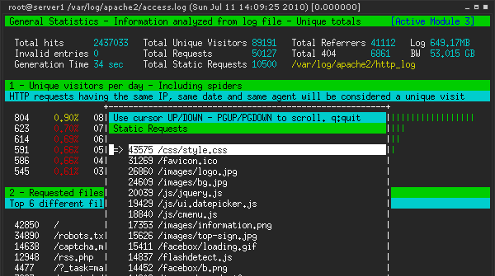
I have always been analyzing my Apache logs with the popular tail -f, which to a certain point is quite neat that you can see the whole request in real time. However, there is a point where you may be interested to know more details about your web logs.

Here it is where I find really interesting GoAccess. Whilst Awstats, Analog, Webalizer all generate HTML statistics, this application will let you analyze your Apache Web server logs straight from the terminal. It generates statistics really fast and it displays them in a nice ncurses interface.

More information about this project at: http://goaccess.prosoftcorp.com/

Fujitsu the Latest to Jump On Android Smartphone Bandwagon

Fujitsu, former iPad trademark owner and soft-spoken tech manufacturer, is jumping into the Android smartphone game. It will be the company’s first smartphone since it stopped selling the multifaceted devices back in 2007.

Read more at Gizmodo

Priceless

I was at the mall today, looking at all the fancy new games (and old ones) on the Wii. I found pretty ridiculous that some 3 year old games were at the same price as some of this year’s.

Back in high school and college, I used to “invest” in video games (both money and time), more than I did today. But even then, I don’t remember spending that much money. I have a Xbox at home – not the 360 one, the old brick. It sits in the basement, acting as a media center these days. I recall buying old games on it at ridiculously low prices – the lowest being 2$. But from the looks of thing, I don’t think I’ll be doing that on the Wii – unless I end up with some mini game compilation.

It makes me think of how much it costs to like Star Trek. I remember shopping for the Voyager series – about 60$ per season. And there are 7 of them. Let me say, at that price, the lure of torrents is very strong. I can resist, but for many, resistance is futile. I mean, it takes a lot of motivation to spend that much on a TV show that started in 1995, even if I loved it.

I instead turned my eyes on music – I got the soundtracks of The Elder Scrolls III and IV (Morrowind and Oblivion for the quick ones). For about 16 bucks, I’d say it was a pretty good deal. The music is just great – if you liked the game and its music, you’ll certainly love the soundtrack.

That being said, there seems to be some cool items in the linux.com store – I’ll have to check that back some day. People stopping by to ask you about fresh kernels? Priceless.

openSUSE Weekly News, Issue 131 is out!

We are pleased to announce:
Issue 131 of openSUSE Weekly News is out! [0]

In this week’s issue:

# openSUSE Wiki – Episode II: A new hope
# KDE Desktop Tricks
# ownCloud in a box
# My favorite Firefox extensions for Firefox
# openSUSE 11.3 delivers spit, polish and niggles

For a list of available translations see this page:
http://wiki.opensuse.org/Weekly_news#Translations

[0] http://news.opensuse.org/?p=3725

DuckDuckGo: A New Search Engine Built from Open Source

DuckDuckGo is a new search engine focused on relevant results and respecting user privacy. Actually a mash-up of several other sites like Wikipedia, About, Bing, and Yahoo, DuckDuckGo also uses it’s own web crawler, the DuckDuckBot. DuckDuckGo uses what it calls Zero-click search results to try to guess what you are looking for and give it to you directly in your search results. I’ve been using DuckDuckGo for a few weeks now, and I’m impressed. What further impresses me is that the entire site is built on open source tools, ranging from FreeBSD for the operating system to good old-fashioned Perl for the logic.

According to DuckDuckGo’s developer, Gabriel Weinberg, the stack looks like this:

  • Web Server: Nginix
  • Cache: Memcached and Solr
  • Database: PostgreSQL
  • Primary Language: Perl
  • Operating System: FreeBSD for the main site or Ubuntu for Amazon EC2 failover imagesIt’s like the evolution of the LAMP stack that has served so many sites so well for many years. Too bad there isn’t a snappy acronym like LAMP for it. Maybe we can call it the Duck stack.
 
Read more at Ostatic

5 things you didn’t know about Java performance monitoring

Blaming bad code won’t help you find performance bottlenecks and improve the speed of your Java apps, and neither will guessing. This article directs your attention to tools for Java performance monitoring, Here’s five tips for using Java 5’s built-in profiler, JConsole, to collect and analyze performance data.

Customizing MediaWiki the Wikipedia wiki Engine

The MediaWiki application is probably best known for being the engine behind Wikipedia.This article will show you how to create different types of extensions for MediaWiki: wiki variables, special pages, and new tags. You’ll also get a quick overview of what you’ll need to do to create skins for MediaWiki.