Home Blog Page 414

First Linux-Based RISC-V Board Prepares for Take-Off

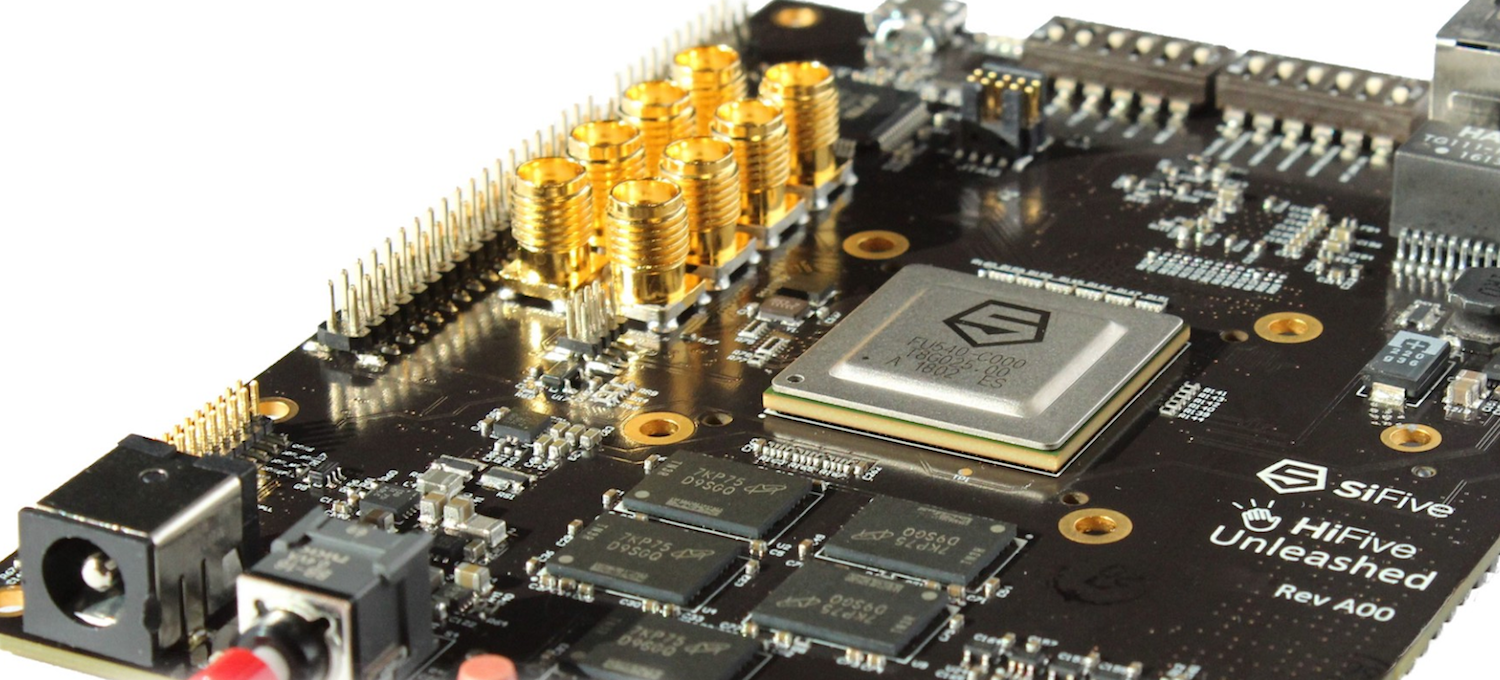
It’s been two years since the open source RISC-V architecture emerged from computer labs at UC Berkeley and elsewhere and began appearing in soft-core implementations designed for FPGAs, and over a year since the first commercial silicon arrived. So far, the focus has primarily been on MCU-like processors, but last October, SiFive announced the first Linux-driven RISC-V SoC with its quad-core, 64-bit Freedom U540 (AKA U54-MC Coreplex). A few days ago at FOSDEM, SiFive opened pre-sales for an open source HiFive Unleashed SBC that showcases the U540.

The $999 HiFive Unleashed is available on Crowd Supply, with shipments due on June 30. The 28nm fabricated U540 SoC that drives the SBC is not only the first multi-core and Linux-ready RISC-V processor, but the first to provide cache coherence. In addition to the four 1.5GHz U54 RV64GC CPU cores, the SoC includes an E51 RV64IMAC management core with Sv39 virtual memory support.

Each CPU core provides a five-stage in-order pipeline, along with 32KB L1 instruction and data caches, and there’s also a shared, coherent 2MB L2 cache. Because both the L1 instruction and L2 caches can be configured into high-speed deterministic SRAMs, the SoC can be used for real-time applications.

What you won’t find is a GPU or VPU. However, third parties are encouraged to integrate them. Silicon developers can tap an open source TileLink interface bus to build peripheral IP. The TileLink bus’ scalable cache-coherent fabric is further enabled with bridge adapters for legacy bus protocols such as AXI4, AHB-Lite, and APB.

The open spec HiFive Unleashed board integrates a U540 SoC, 8GB of DDR4 RAM, and 32MB quad SPI flash. The only other major features include a microSD slot, a Gigabit Ethernet port, and an FMC connector for future expansion. A SiFive rep confirmed to Linux.com that the board will be open source hardware, with freely available schematics and layout files.

The feature set may be pretty limited for $999, but you’re really paying for the novel SoC and a chance the get a head start on what could potentially become a major new computing platform.

RISC-V jumps out to a fast start

It’s too early to say whether RISC-V will ever rival ARM or x86, let alone match the reach of fading architectures such as MIPS and PowerPC. So far, however, there has been a surprising willingness on the part of major computer and semiconductor vendors to experiment with the new ISA. RISC-V Foundation Platinum members include heavy hitters like Draper, Google, Hewlett Packard Enterprise, IBM, Microsemi, Oracle, Microsoft, Nvidia, and Qualcomm. 

The widespread interest is partially due the fact that RISC-V has a free and permissive license that enables third parties to use the ISA to develop proprietary implementations. The expectation, however, is that most RISC-V SoCs will follow the early players’ leads in providing open source implementations.

RISC-V’s timing seems to be right, as the growing acceptance of open source software and hardware logically leads to a desire to open up of the processor. Opaque chip designs often create obstacles and blind spots — not only for open source projects, but also semiconductor vendors. Conceivably, hidden issues such as Intel’s Spectre and Meltdown security problems might have come to light more quickly in the open source spotlight.

There’s also a sense that the dominance of two closed source architectures — ARM and Intel x86 — is limiting innovation, slowing time to market, and increasing cost. In addition, RISC-V advocates claim that both ARM and x86 platforms are burdened by legacy code. By comparison, RISC-V is starting with a clean slate of modern components.

SiFive was founded by RISC-V inventors including Yunsup Lee, Andrew Waterman, and Krste Asanovic, based in part on two earlier open source RISC ISAs: SPARC and OpenRISC. In 2014, Asanovic and fellow UC Berkeley professor David Patterson, who coined the term RISC, posted a white paper on RISC-V, and development progressed rapidly from there.

SiFive has been the major RISC-V hardware player, while Microsemi has led the way in developing soft-core implementations that can run on FPGAs for prototyping. In Nov. 2016, SiFive announced an open source, Arduino compatible HiFive1 development board for its Freedom E300 — an MCU-like RISC-V design with an E31 Coreplex core designed to run FreeRTOS. Developers could also use Microsemi’s soft-core SmartFusion 2 SoC FPGA to develop for the E300.

The HiFive1 was followed last May by an Arduino Cinque board based on the HiFive1, jointly developed by SiFive and Arduino. The key addition was an Espressif ESP32 SoC that supplies WiFi and Bluetooth.

SiFive and Microsemi aren’t the only vendors invested in RISC-V. Andes, Bluespec, Codasip, and Cortus sell RISC-V core IP that can be used to develop MCU-like SoCs. (SiFive also sells IP in addition to silicon and development services.) Like Microsemi, Rumble and Development and VectorBlox offer soft cores that run on FPGAs.

According to a recent summary of RISC-V developments posted on Electronic Design by Microsemi’s Ted Marena, Vice Chair of the RISC-V Foundation’s RISC-V Marketing Committee, software support is also evolving. In the Linux realm, RISC-V support was added to the GNU/GCC and GNU/GDB toolchains last May. In addition, writes Marena, “several flavors of Linux are supported, including Yocto,” based on Linux 4.6. RISC-V support appears to be headed for a merge into kernel 4.14, which “means RISC-V will soon be a mainline platform in Linux.”

The HiFive Unleashed Crowd Supply page does not have much to say about software aside from noting Linux compatibility, and SiFive did not respond to our queries for more details. When the U540 SoC was announced, however, SiFive said the SoC would be supported by “a rich SDK with demo software and an easy-to-install binary toolchain.” Standard development and debug tools such as OpenOCD, GDB, and an Eclipse IDE, were also said to be in the works.

Performance questions should be partially answered when the HiFive Unleashed appears this Spring. According to an EETimes story posted in October, the “single issue” U54 core is expected to lag the performance of the “dual issue” Cortex-A53. Marena, however, claims that “the modularity of the RISC-V ISA design enables implementations to be more efficient than legacy ISAs such as x86 or ARM.”

In conjunction with the Embedded Linux Conference + OpenIoT event to be held in Portland, Oregon on Mar. 12-14, SiFive will host the first hackathon for the HiFive Unleashed. Registered SiFive Developers will be able to attend the Portland event to try out the SBC. (More information may be found on the HiFive Unleashed product page.) The ELC conference itself includes a presentation by Comcast’s Khem Raj called OpenEmbedded Yocto on RISC-V — New Kid on the Block.

Registration is now open for the Embedded Linux Conference and OpenIoT Summit, to be held Mar. 12-14 at the Hilton Portland in Portland, OR. Linux.com readers can register now with discount code, LINUXRD5, for 5% off the attendee registration.
Kubernetes vs Docker Swarm: A Comparison of Cloud Container Tools

Put simply, Kubernetes is a tool allowing the IT manager to run multiple containers in parallel. Think of it as a container dashboard; if your containers are musicians, then Kubernetes is the conductor.

Docker is a container platform with a panoply of management options for any type of cloud set-up, providing fine control over applications independent of infrastructure. The tool we are interested in is Docker Swarm, a flexible container storage platform which some consider more straightforward to use than Kubernetes.

Let’s get into the differences, overlap and how to choose between them.

Read more at CBROnline

One Million Linux and Open-Source Software Classes Taken

Want to get a job in IT? Then, you need to know Linux and open-source software. While nothing beats hands-on experience, classes are a great way to get started. So, it comes as no surprise that The Linux Foundation recently announced would-be IT staffers have now taken a million Linux and open-source software classes.

The Linux Foundation has been able to reach so many students because of its partnership with edX. EdX is the non-profit online learning platform from Harvard University and Massachusetts Institute of Technology (MIT). 

Read more at ZDNet

How to Minimize the Meltdown Patch Performance Penalty

The saga of the cross-industry side-channel attack (Meltdown and Spectre) is not yet over. Turmoil continues as CPU vendors release new microcode and recall previous ones. To understand the extent of the work that still needs to be done, consider the language Linus Torvalds usesabout the patches sent by elite open source kernel developers to deal with Spectre — specifically “Indirect Branch Restricted Speculation.”

Development teams are left to sit back and watch as vendors struggle to decrease the performance impact of these fixes. For example, AWS claims “we have not observed meaningful performance impact for the overwhelming majority of EC2 workloads,” yet most big data workloads are heavily impacted.

Read more at The New Stack

A History of Low-Level Linux Container Runtimes

At Red Hat we like to say, “Containers are Linux—Linux is Containers.” Here is what this means. Traditional containers are processes on a system that usually have the following three characteristics:

1. Resource constraints

When you run lots of containers on a system, you do not want to have any container monopolize the operating system, so we use resource constraints to control things like CPU, memory, network bandwidth, etc. The Linux kernel provides the cgroups feature, which can be configured to control the container process resources.

Read more at OpenSource.com

Who Really Contributes to Open Source

New data debunks several myths around which companies lead in open source contributions.

Microsoft has been nipping at the top open source contributor position for years, but a new analysis by Adobe developer Fil Maj puts Microsoft into a whole other universe of contributions. Or, at least, of contributors.

Using the GitHub REST API to pull public profile information from all 2,060,011 GitHub users who were active in 2017 (“active” meaning ten or more commits to public projects), Maj was able to pull the total number of corporate contributors to GitHub, with results that might surprise you.

Read more at InfoWorld

3 Ways to Extend the Power of Kubernetes

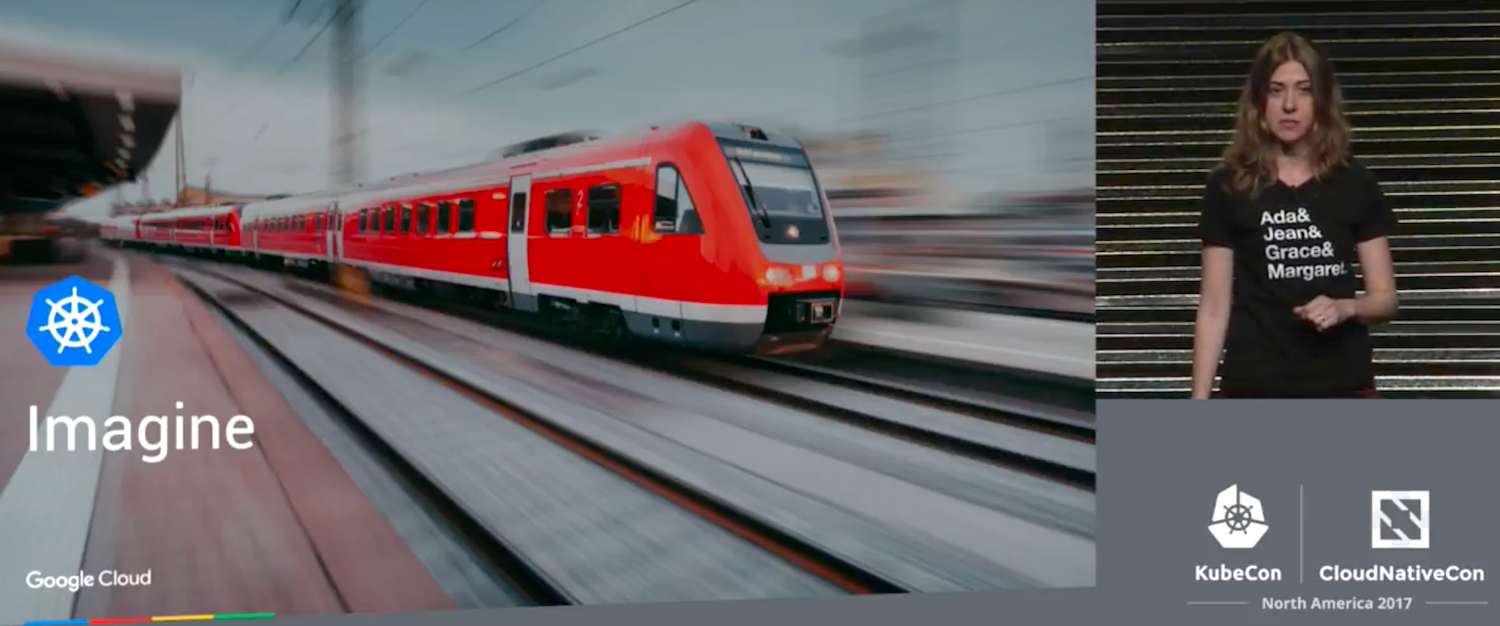
The ability to extend Kubernetes is its secret superpower, said Chen Goldberg, Director of Engineering at Google, speaking at the recent KubeCon + CloudNativeCon in Austin.

In the race to build tools that help engineers become more productive, Goldberg talked about how she once led a team that developed a platform that did just that. Despite the fact the platform initially worked, it was not extensible, and it was also difficult to modify.

Fortunately, said Goldberg, Kubernetes suffers from neither of these problems. To begin with, Kubernetes is self-healing system, as it uses controllers that implement what is called a “Reconciliation Loop.” In a reconciliation loop, a controller observes the current state of the system and compares it to its desired state. Once it has established the difference between each of these two states, it works towards achieving the desired state. This makes Kubernetes well-adapted to dynamic environments.

3 Ways to Extend Kubernetes

Goldberg then explained that to build the controllers, you need resources, that is, you need to extend Kubernetes. There are three ways to do that and, from the most flexible (but also more difficult) to the easiest they are: using a Kube aggregator, using an API server builder, or creating a Custom Resource Definition (or CRD).

The latter allows to extend Kubernetes’ functionality even with minimal coding. To demonstrate how it is done, Goggle Software Engineer Anthony Yeh came on stage and showcased adding a stateful set to Kubernetes. (Stateful sets objects used to manage stateful applications, that is applications that need to store the state of the application, keeping track of, for example, a user’s identity and their personal settings.) Using catset, a CRD implemented in 100 lines of JavaScript in one single file, Yeh showed how you can add a stateful set to a Kubernetes deployment. A prior extension that was not a CRD, required 24 files and over 3,000 lines of code.

Addressing the issue of reliability of CRDs, Goldberg said Kubernetes had started a certification program that allows companies to register and certify their extensions for the Kubernetes community. In one month over 30 companies had signed up for the program.

Goldberg went on to explain how the extensibility of Kubernetes was a hot topic in this year’s KubeCon, and how Google and IBM were building a platform to manage and secure microservices using CRDs. Or how some developers were bringing machine-learning to Kubernetes, and others were demonstrating open service broker and the consumption of services on hybrid settings.

In conclusion, Goldberg said, extensibility is about empowerment. And, the extensibility of Kubernetes makes it a general purpose and easy to use platform for developers, which allows them to run any application.

You can watch the entire video below:

Open Source and Standards Team: How Red Hat Measures Open Source Success

Red Hat is a testament to the success of open source, but it still benefited from some organization and goal-setting in its community efforts.

“The Open Source and Standards office, or what some would refer to as an open source program office, was established six years ago to create a consistent way to support communities which Red Hat is actively participating. We created a centralized organization of expertise and resource to support our goals by flanking the considerable upstream engineering efforts ,” explained Deborah Bryant, senior director, Open Source and Standards, in the office of the CTO at Red Hat.

Read more at The Linux Foundation

Here’s What Developers Really Think about AWS, Microsoft Azure, and Google Cloud

Platform providers lack adequate support resources for developers, according to an Accenture report.

  • Only 23% of developers strongly agree that adequate support is readily available from their platform provider.— Accenture, 2018
  • Amazon Web Services (AWS) was named the most developer-friendly platform. — Accenture, 2018

Developers must rely on their platform provider as a base for their work, but most lack adequate support resources for them, according to a new report from Accenture.

The report surveyed more than 750 US-based developers to determine what they look for in a platform provider—particularly key given the critical role developers play in a platform’s adoption and ultimate success, Accenture noted.

Read more at TechRepublic

Crossing a New Milestone in NFV: Open Source Verification of Commercial Products

As we kick off 2018, the OPNFV Compliance & Certification committee—the members driven body within OPNFV that defines recommendations to the Board for policies and oversight for compliance and certification—is pleased to announce the launch of the OPNFV Verified Program (OVP). The program is designed to simplify adoption of NFV in commercial products by establishing an industry threshold based on OPNFV releases. The fact we are using an open source platform as referent to measure compliance of commercial products—not necessarily based on its source code—is a new and innovative step for the industry.

The OPNFV Verified Program facilitates both vendor self-testing and third-party lab testing using the Dovetail test suite. 

Read more at OPNFV