Home Blog Page 494

For Fun and Profit: A New Book on the History of Linux and Open Source

Twenty-six years ago this month, a geeky student in Finland released the Linux kernel to the world. Today, hundreds of millions of people are using Linux. Why? That’s a question I try to answer in my new book For Fun and Profit: A History of the Free and Open Source Software Revolution.

Linux historySure, you can explain Linux’s popularity today in terms of factors that exist in the present its technical features, the dynamism of the open source community, the corporate backing that Linux enjoys today, and so on.

But, to understand what really launched Linux into the position it enjoys today, however, you need to know the history of Linux  as well as the history of the larger free and open source software universe.

You have to look at some big questions about Linux’s past, such as:

  • Why did Linux beat out much bigger and better-funded kernels, like GNUs and BSDs, to become probably the most important open source software project in history?

  • Why did Linus Torvalds, the student who created Linux, decide to give his code away for free?

  • Why did Linux programmers succeed in producing a feature-rich kernel so quickly, while so many other free software projects in the early 1990s struggled to get a working kernel up and running?

For Fun and Profit

I explore these questions and more in the book, which was published this month by MIT Press. This book isn’t about just Linux, though. It’s about the history of free and open source software writ large. However, explaining the what, why, and how of the Linux kernel’s history is a major focus of the book. The book tells the story of how Linux came to be what it is today. It not only explains the major events and personalities that shaped the kernel, but also considers why Linux followed the specific historical path that led to today a path that no one could have foreseen back when Torvalds announced Linux on the Minix Usenet group in August 1991.

Other key topics covered in the book include the origins of Unix and Unix’s role in laying the foundation for the free software movement, the birth and evolution of Richard Stallman’s GNU project and the creation of open source Web platforms like Apache.

The book also critically reevaluates some of the traditional ways of thinking about the history of free and open source software. I argue, for example, that Stallman and GNU have been a lot more pragmatic historically speaking, at least than they receive credit for. Stallman may be a polarizing figure but measured from an historical perspective, neither he nor GNU are as dogmatic as they are sometimes portrayed. I also note that Torvalds doggedly opposed charging any money for Linux when he created the kernel a fact that is easy to forget today, when Linux helps to sustain billion-dollar companies.

I explore, too, the complicated and controversial questions of whether projects like Ubuntu and Android have remained true to the original goals of the free software movement that helped create them or whether these platforms engender more problems and distractions for free software hackers than they are worth. Through discussion of issues like these, the book brings the history of free and open source software up to the present day.

Why I Wrote this Book

It’s easy to find summaries online (and sometimes even in man pages) of the history of various free and open source software projects. But no one has told their story comprehensively or tried to explain why free and open source software was created, how the philosophies and practices associated with it have evolved over time, why some projects flourished while others fizzled in short, why we live today in a world dominated by free and open source software, which few people would have predicted even just a decade ago.

The book is based on extensive research with original sources things like Usenet archives, old mailing lists, and lots and lots of historical Slashdot threads. It is also informed by discussions with Torvalds, Stallman, and other important figures in the history of the free and open source software community.

Sample Chapter and Further Reading

If any of the above sounds interesting, you can read a sample chapter from the book or learn more about the book in general.

The Need for Connection: Building Habit-Forming Open Source Products

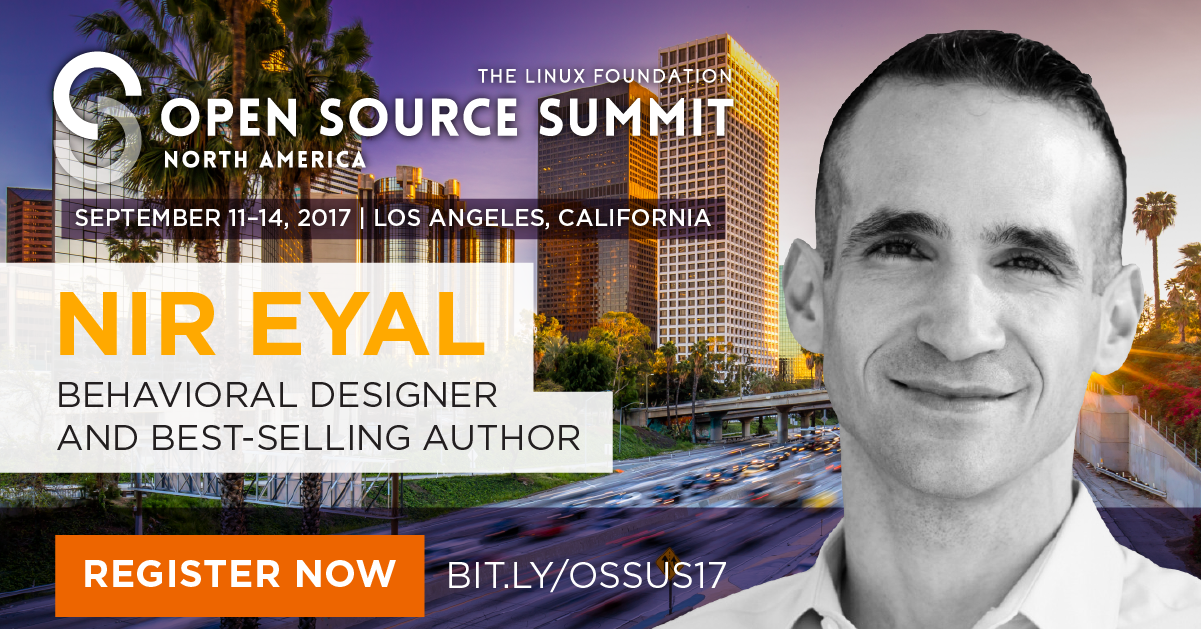
With the increasing use of connected devices and the growing presence of online distractions, it’s important to understand the ideas behind habit-forming technologies. Nir Eyal, author of the best-selling book, Hooked: How to Build Habit-Forming Products, will be delivering a keynote presentation based on his book at Open Source Summit in Los Angeles.

Eyal is a frequent contributor to publications such as Forbes, TechCrunch, and Psychology Today, where he writes about the intersection of psychology, technology, and business. In this interview, he explains more about the concepts and behaviors behind habit-forming products and how they can be applied to open source.

Linux.com: What was the inspiration behind writing the book and what are the areas that you will be touching upon in your book?

Nir Eyal: I’ve started two tech companies, one in the advertising and one in the gaming industry. I learned a lot of techniques that are applied today to change people’s behaviors and influence their behaviors and persuade their behaviors. What I wanted to do is to take these lessons from the world’s leading companies who are experts in this process of changing user behavior. Those companies are the usual suspects of Facebook and Twitter and Instagram and Slack and WhatsApp. I wanted to dive into how those companies do what they do from a psychology perspective.

They don’t need my book, but there are countless companies out there who are trying to influence people’s behavior for good who do need my book. The companies out there that are trying to improve people’s lives, helping them be more efficient at work, helping them connect with people in their lives, helping them exercise more, save more money. All of these folks need to influence human behavior and it would behoove them to understand the psychology behind how we influence behavior. That’s really what my book is about, is the principles around what makes a product habit forming. Then, how can you use those principles to make your own product something that people come back to again and again.

Linux.com: What differentiates one product from another?

Eyal: The focus of the book is this hooked model, which is this four-step process from a trigger, an action, a reward, and an investment. What I found in my research was that products that build for habit, the ones that people use time and time again, come back to on their own without spammy advertising, without lots of email spam, are the ones that have this hooked model built into it. Again, the four steps are the trigger, the action, the reward, and investment. It’s through successive cycles, through these hooks, that our preferences are shaped, that our tastes are formed, and that these habits take hold.

Linux.com: Is there any difference between habit forming, vendor lock, or addictive products?

Eyal: Can one be seen as bad for a healthy society where others can be good? There’s a big difference between addiction and habit formation. Habits are behaviors done with little or no conscious thought, and we have good habits as well as bad habits. Addictions, however, are always bad. Addictions are persistent, compulsive, dependencies on a behavior or substance and they always harm the user.

My book is really all about how to build habit-forming products, not about addictive products because, frankly, the problem out there is not that a few companies like Facebook and Twitter and Instagram have figured out how to suck us in. The real problem is that far too many products out there suck. That’s my job is to help people out there who are working on products and services that would really improve people’s lives if they only used it. That’s really my challenge. I didn’t write my book for the Facebooks and Instagrams and WhatsApp and Slacks of the world. I wrote this book for people who are struggling to build technology products that people would actually use but it is very difficult to change customer behavior. I wrote this book to educate product designers, entrepreneurs, technologists, who have wonderful, new inventions and solutions, but for lack of good product design, people aren’t using their products. That’s really why I wrote it.

Linux.com: Open source is more about people and building communities than the product or technology itself. Does this help in any way in building a successful product?

Eyal: Well, certainly communities are a way to form habits around products that aren’t used as frequently as some other habit forming products. Building on a community, if you think about it. Many communities out there are around technologies. If you think about the Hacker News community or the Stack Overflow community or the open source community, the community itself is the product, is why people like to engage. This is an age old desire that human beings have. For the past 200,000 years, people have needed to connect with one another. That’s what I call a variable reward. It’s called a reward of the tribe. Connecting, cooperating, sometimes competing with other people is what brings people back to an experience. That’s at the core of many habit-forming products.

Linux.com: Can you provide some examples of successful habit-forming products versus failed ones?

Eyal: The companies that are able to form consumer habits are the ones that can capture a market. Google has well over 85 percent market share for searches compared to Bing. Why do they have dominant market share? It’s not because the product is so much better. In fact, if you think about Google versus Bing, third-party studies have found the products are the same. People, in fact, can’t tell the two apart once you strip out the branding.

It’s not necessarily the best product that wins; it’s the product that captures the monopoly of the mind — the product that we go to first with little or no conscious thought. That’s the company that is going to capture the market. Habits are super, super important to me. If you think about the success of companies like Facebook, Google, Amazon, or Apple. All of these companies depend upon repeat engagement. It’s not the best product that wins. It’s not the best technology. It’s the product that can capture the monopoly of the mind and form that consumer habit.

Linux.com: How can open source communities or companies that deal with open source benefit from your advice or talk?

Eyal: My work is really focused around the product level, so the person who is working on the user experience, who is working on how to get people to change a particular behavior, those are the folks that would benefit from my talk. Not just a one time behavior, but how do we get people to change a repeat behavior? How do we form a habit around a particular action so that people can do the things they want to in life, whether that’s in the enterprise setting or in the consumer webspace? Anybody who’s trying to create repeat user engagement would benefit from understanding the psychology of behavioral design.

Check out the full schedule for Open Source Summit here. Linux.com readers save on registration with discount code LINUXRD5. Register now!

Navigating Cloud Foundry

This open source platform-as-a-service cloud platform bridges the gap between legacy applications and cloud services.

For all the talk about the cloud, many applications continue to run on traditional servers. Hybrid architectures are sometimes the right option, but if you want to move corporate applications onto the Internet, you don’t want to start from scratch. Cloud Foundry, a platform-as-a-service (PaaS) cloud platform, enables enterprises to move older software to the cloud and build new cloud-centric programs using familiar tools and programming languages.

In buzzword-heavy terms, it delivers continuous integration using a highly scalable and available architecture. In this article, I explain its purpose in more techie language.

According to Pivotal, which offers one of six certified distributions of Cloud Foundry, more than half of Fortune 500 companies currently use the platform. They include six of the 10 largest carmakers, seven of the top 10 banks, and five of the 10 largest insurance companies.

Read more at HPE

What Developers Need to Consider When Exploring Machine Learning

This is the first article in a five-part series that covers the steps to take before launching a machine learning startup. The complete report, available here, covers how to get started, choose a framework, decide what applications and technology to use, and more. 

While artificial intelligence (AI), machine learning and deep learning are often thought of as being interchangeable, they do in fact relate to very different concepts. It all began in the 1950s with AI and the idea that a computer could be made to simulate human learning and intelligence.

A subclass of that is machine learning, whereby a computer can take large amounts of data and use it begin to recognize patterns, make predictions on new data, and essentially ‘learn’ for itself. The drawback is that machine learning requires that parameters be set for what the computer needs to recognize, and those inputs can be time-consuming. And so we go one step further, into deep learning.

Read more at insideHPC

Red Hat Secures Networking Flaws in OpenStack, the Linux Kernel

Red Hat has fixed an important vulnerability in the OpenStack subsystem that’s used to manage network connectivity to and from virtual machines. If left unpatched, it could allow an attacker to access network resources from virtual machines.

The vulnerability, tracked as CVE-2017-7543 in the Common Vulnerabilities and Exposures (CVE) database, is located in openstack-neutron, a “pluggable, scalable and API-driven” component of the Red Hat OpenStack Platform that’s used to provision networking services to virtual machines.

Read more at The New Stack

Docker Commands for Development to Deployment

The objective of this article to understand the end to end flow of container development to deployment in the target environment and list the Docker commands needed for every action.

1. Introduction

The overall process consists of developing a container image with your code, dependent software, and configurations, running and testing the container in a development environment, publishing the container image into Docker Hub, and finally, deploying the Docker image and running the container in the target environment. This article assumes that you have installed Docker engine in the development and target environment. Please refer to 6.3 for installation instructions.

2. Develop Container Image

To build the container image, we have to create a dockerfile which will contain all the necessary information. Please refer here to develop the dockerfile.

Read more at DZone

Securing Kubernetes Cluster Networking

Network Policies is a new Kubernetes feature to configure how groups of pods are allowed to communicate with each other and other network endpoints. In other words, it creates firewalls between pods running on a Kubernetes cluster. This guide is meant to explain the unwritten parts of Kubernetes Network Policies.

This feature has become stable in Kubernetes 1.7 release. In this guide, I will explain how Network Policies work in theory and in practice. You can directly jump to kubernetes-networkpolicy-tutorial repository for examples of Network Policies or read the documentation.

What can you do with Network Policies

By default, Kubernetes does not restrict traffic between pods running inside the cluster. This means any pod can connect to any other pod as there are no firewalls controlling the intra-cluster traffic.

Read more at Ahmet Alp Balkan

Git Helpers – Simplify Your Git Workflow

Being a Git lover, I got tired of typing same commands over and over again. This motivated me to build some alias for my git workflow I use every day. Most of the alias was inherited from Nicholas C. Zakas’s gist. I took that a step further by creating more alias which I use every time I contribute to open source projects like Eslint.

Commands

Actual code for all the commands is here

Work on an issue

When you plan to work on an issue on an open source project, you will want to create a new branch on your project and then start work on it. 

Read more at Dev.to

The Internet of Underwater Things: Open Source JANUS Standard for Undersea Communications

Open standards exist for all manner of wireless and terrestrial communications, but so far none has emerged for underwater communications. Below the waves, submarines, autonomous underwater vehicles (AUVs), and undersea sensor stations use a hodgepodge of incompatible proprietary technologies including acoustic, radio, and optical modems.

Manned submarines and many automated subs can surface to communicate over the air, where the bandwidth is much higher, and some submersible AUVs and research stations can  be tethered to floating wireless buoys. Yet, there are times when neither option is feasible, and with the huge expansion in AUVs, there’s a growing need for a universal undersea communication standard for persistent mobile communications.

Internet of Underwater Things

Enter NATO, which has a keen interest in reliably communicating beneath the waves, both for military and emergency response purposes. The multinational defense organization recently announced it has adopted a new JANUS digital communications standard for underwater acoustic modems. Deployed as an official NATO standard called STANAG 4748 (PDF), JANUS will be implemented on all NATO vessels.

As detailed by IEEE Spectrum, the open source, GPL-licensed JANUS standard uses acoustic modems. Acoustic technology has a much longer range than higher-bandwidth optical systems, which top out at 100 meters, and RF radios, which can’t do much better.

JANUS, which is named after the Roman god of gateways, has been tested at 900Hz to 60kHz frequencies at distances of up to 28 kilometers. However, it’s optimized for sending data underwater at up to 10 km.

JANUS assigns the 11.5 kHz band for initial discovery, and defines a procedure for handshaking, synchronization, and 80bps data transmission using 56-bit packets. Once synchronized, the systems can then switch to a different frequency or protocol shared by both parties, depending on bandwidth, distance, or security requirements.

JANUS includes a standard modulation encoding scheme called Frequency-Hopped Binary Frequency Shift Keying (FH-BFSK) that describes how acoustic waveforms are encoded. It also provides redundancy checking for reducing errors caused by interference from varying water temperatures, currents, and Doppler effects caused by motion. JANUS can also communicate with wireless enabled buoys to extend the network.

The technology was developed by a team led by NATO principal scientist João Alves at NATO’s Centre for Maritime Research and Experimentation (CMRE) in La Spezia, Italy and is sponsored by NATO’s Allied Command Transformation group.

IEEE Spectrum quotes Chiara Petrioli, a researcher and JANUS project collaborator at La Sapienza, the University of Rome, as saying that JANUS could evolve into an “Internet of Underwater Things” — a network of sensor systems, AUVs, and buoys that could connect the underwater world.

The NATO announcement cites potential JANUS applications including harbor protection, maritime surveillance, mine detection, archaeology, and surveys for offshore wind farms and pipelines. Other examples include search and rescue operations and real-time underwater sensor networks, as well as enabling AUVs to more quickly report oil leaks. JANUS modems are also sufficiently small and affordable to be worn by scuba divers.

BeagleBone drives first JANUS acoustic modem

Linux is found in many AUVs, such as the SeaBED and Bluefin-21, so we wondered if it might be involved in the JANUS, as well. As it turned out, one of the first JANUS acoustic modems was built around Linux code running on a BeagleBone Black. The hacker board, which came in fifth place out of 98 in our recent open-spec SBC reader survey is the controller behind the first commercial, JANUS-compatible acoustic modem: the SeaModem.

One of the early JANUS tests conducted by Petrioli and other La Sapienza researchers is described in this research paper (PDF). The researchers used the SeaModem, developed by AppliCon, a spinoff of the University of Calabria, connected to a BeagleBone running Linux-based JANUS code.

The SeaModem consists of a power board with an amplifier and ceramic transducer, among other circuitry, as well as a DSP board with a digital signal processor, real-time clock, and audio codec. The device communicates via a UART interface with the BeagleBone, which is here augmented with a second audio codec module. GPIO connections between the boards enable improved signal-to-noise ratio.

The Linux stack included JANUS compatible networking software called Sunset, developed by La Sapienza and a spinoff called WSENSE. Sunset, which also runs on ARM modules such as Gumstix boards, can seamlessly switch between the JANUS acoustic link and a higher-bandwidth proprietary modulation scheme.

The system was tested in San Diego aboard a highly modified Sea Robotics USV-2600 autonomous catamaran called the Gemellina USV. The sensor-laden catamaran navigates using an Ubuntu-driven computer.

The La Sapienza team added a module mounted under the Gemellina’s hull comprising the SeaModem, BeagleBone, audio codec, and other gear packed inside a waterproof aluminum case. The experiment tested JANUS communications and handoffs to proprietary links between the Gemellina and three stationary underwater JANUS nodes. La Sapienza concluded that JANUS could be used as “as a reliable robust channel to exchange short control messages,” and can capably switch to a faster communication protocol.

One problem with acoustic communications is the potential risk to marine animals. Yet, NATO claims that biologists were consulted in JANUS’ development to ensure limited interference.

Even if JANUS is safe to marine life, there is no guarantee that underwater communications vendors will sign on. Still, the large scope of potential NATO contracts is already ramping up commercial development. The technology is relatively affordable, and in most cases, it’s not intended to replace other technologies, but to augment them. Vendors can therefore add JANUS as an optional link for emergency rescue and collaborative projects.

In other words, it’s likely JANUS will emerge as the forerunner of an underwater Internet. It’s also likely that Linux will play a large role in making it happen.

Connect with the embedded community at Embedded Linux Conference Europe in Prague, October 23-25. Register now!

Future Proof Your SysAdmin Career: Looking to the Cloud

Sysadmins will always need core competencies such as networking and security, but increasingly, they can differentiate themselves by mastering new platforms and tools. Previously in this series, we’ve provided an overview of essentialsevolving network skills, and securityIn this article, we’ll look at how experience with open cloud computing platforms such as OpenStack can make a difference in your sysadmin career. 

The cloud advantage

Experience with emerging cloud infrastructure tools and open source technologies can make a substantial compensation difference for sysadmins. According to a salary study from Puppet, “Sysadmins aren’t making as much as their peers. The most common salary range for sysadmins in the United States is $75,000-$100,000, while the four other most common practitioner titles (systems developer/engineer, DevOps engineer, software developer/engineer, and architect) are most likely to earn $100,000-$125,000.”

If you search recruitment sites for sysadmin positions that demand cloud skills, opportunities abound. There are many positions that require strong cloud monitoring skills, and jobs that demand facility with both open source and popular public cloud platforms.

future proof ebook

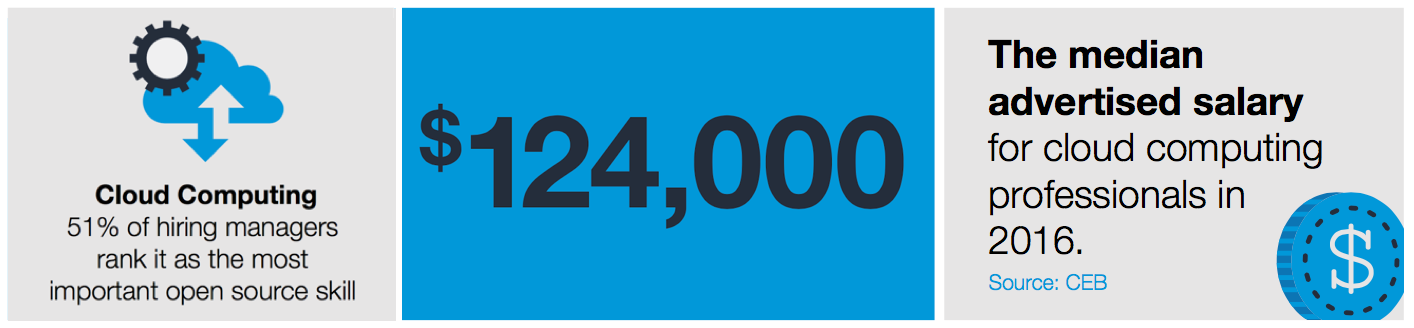
Certification also makes a difference. The value of cloud-centric certification is being driven by shortages in the number of skilled cloud-skilled professionals. CEB, a company focused on best practices in technology, recently provided Forbes with the results of a database dive on cloud computing hiring trends. It found shortages in expertise surrounding many cloud computing platforms, and it also called out a strong job market for skilled professionals. In fact, $124,300 was the median advertised salary for cloud computing professionals in 2016, according to the database.

Some sysadmins are blogging about their experiences in adding OpenStack skills to their arsenals. For example, Michalis Giannos, writing for Stackmasters, said, “As an old-school system administrator, what impressed me about OpenStack is that it extends resource management over to storage and network — that is, going beyond the CPU and memory management options that you get with the typical virtual machine offerings. Having a unified view of your computing resources utilization, and having the ability to manage it from a single place is a very powerful feature. And it’s especially mind blowing, even to an old hat like me, raised up on the CLI, that you can access all that power from an easy to use web-based UI.”

Giannos also said, “The ease of creating images and customized flavors of your virtual machines allows you to deploy a new server in minutes without having to repeat trivial configurations all over again. Heck, you can literally create an HTTP Load Balancer AND the back-end service farm for it in just a few minutes.”

Indeed, OpenStack, CloudStack, Nextcloud, and some other open cloud platforms automate and streamline many tasks that old school sysadmins may be most familiar with. With all of this in mind, providing cloud platform training aimed directly at sysadmins is on the radar at technology vendors focused on the cloud and at independent training organizations.

The Linux difference

Fluency with Linux can make a big difference for sysadmins, which should be no surprise. Several salary studies have shown that Linux-savvy sysadmins are better compensated than others. With that in mind, note that Linux is the bedrock for the majority of cloud deployments, according to The OpenStack Foundation.

This leads to a multi-faceted career path that many sysadmins can take to differentiate themselves from the pack. In fact, Tom’s IT Pro has called this path “the triple threat career path to IT success.” Specifically, it involves obtaining certification as a Linux-savvy sysadmin, as a project manager, and as a cloud administrator.

Training options for Linux-focused sysadmins are expanding accordingly. For professional certification, CompTIA Linux+ is an option, as are certifications from Linux Professional Institute. The Linux Foundation’s Linux Foundation Certified System Administrator (LFCS) training and certification is another good choice.

Earning the title of Red Hat Certified System Administrator in Red Hat OpenStack demonstrates that you have the skills needed to create, configure, and manage private clouds using Red Hat OpenStack Platform. Red Hat’s training for this certification covers configuring and managing images, adding compute nodes, and managing storage using Swift and Cinder.

Mirantis and other vendors also offer certified OpenStack administrator curriculum. The Linux Foundation offers an OpenStack Administration Fundamentals course, which serves as preparation for certification. The course is available bundled with the COA exam, enabling students to learn the skills they need to work as an OpenStack-skilled administrator and get the certification to prove it. A unique feature of the course is that it provides each participant with a live OpenStack lab environment that can be rebooted at any time. Customers also have access to the course and the lab environment for a full 12 months after purchase. Like the exam, the course is available anytime, anywhere. It is online and self-paced — definitely worth looking into.

The OpenStack Foundation works directly with The Linux Foundation to make the Certified OpenStack Administrator (COA) exam available, and getting certified is a rock solid credential for many sysadmins. The Guide to the Open Cloud 2016 from The Linux Foundation also includes a comprehensive look at other cloud platforms and tools that many sysadmins would be wise to pick up skills for, including tools that orbit the open cloud ecosystem.

Clearly, sysadmins interested in adding meaningful skills and credentials to their arsenals should not ignore the cloud. Training and certification opportunities are proliferating, and widespread skills shortages are well documented. Next time, we’ll take a closer look at configuration and automation.

Learn more about essential sysadmin skills: Download the Future Proof Your SysAdmin Career ebook now.


Read more:

Future Proof Your SysAdmin Career: An Introduction to Essential Skills 

Future Proof Your SysAdmin Career: New Networking Essentials

Future Proof Your SysAdmin Career: Locking Down Security

Future Proof Your SysAdmin Career: Looking to the Cloud

Future Proof Your SysAdmin Career: Configuration and Automation

Future Proof Your SysAdmin Career: Embracing DevOps

Future Proof Your SysAdmin Career: Getting Certified

Future Proof Your SysAdmin Career: Communication and Collaboration

Future Proof Your SysAdmin Career: Advancing with Open Source