Home Blog Page 501

Automotive Grade Linux Moves to UCB 4.0, Launches Virtualization Workgroup

The Linux Foundation’s Automotive Grade Linux (AGL) project released Unified Code Base (UCB) 4.0 (“Daring Dab”) for Linux-based in-vehicle infotainment (IVI) systems, and added seven new members. The open source group also launched a new virtualization working group that will enable new UCB profiles for telematics, instrument clusters, and head-up-displays (HUDs). In other Linux automotive news, Ubuntu has been spotted in an Uber self-driving car trial (see below).

The new AGL members bring the total membership to over 100. The newcomers are Brison, Karamba Security, Lear Corp., Luxoft, Thundersoft, SafeRide Cyber Security, and Wipro Ltd. The announcement follows an April expansion of six new members.

UCB 4.0, which follows a UCB 3.0 “Charming Chinook” version that appeared in January, arrived a little over a month after AGL revealed that the 2018 Toyota Camry will be the first car to fully adopt AGL’s Yocto Project based UCB distribution later this summer. After the debut, AGL’s UCB will roll out to most Toyota and Lexus vehicles in North America.

UCB 4.0 adds major new features such as SmartDeviceLink integration, speech recognition APIs, and secure Over-the-Air Updates (SOTA). Daring Dab also makes improvements to the App Framework and Software Development Kit (SDK).

New features in AGL UCB 4.0 include:

  • Update to Yocto 2.2

  • Application Framework improvements

  • Application Services APIs for Bluetooth, audio, tuner and CAN signaling

  • AGL API version 2 using OpenAPI specification format

  • CAN signaling, secure signaling and notifications

  • SDK improvements with new application templates  

  • SmartDeviceLink ready, ease of integration with SDL

  • Default board support tunings across Intel, ARM32 and ARM64 architectures  

  • Added board support for the Renesas R-Car 3 and Qualcomm Snapdragon 820

SmartDeviceLink (also called SDL) is a technology developed at Ford and hosted by the GENIVI Alliance that enables an automatic sync between IVI systems and mobile phones. The spec aims to be an OS-agnostic alternative to Android Auto or Apple’s CarPlay.

An open source version of Ford’s proprietary AppLink technology, SmartDeviceLink lets developers add extensions to mobile apps so they work over compliant IVI systems. With Toyota announcing support for SmartDeviceLink in early January, along with QNX, it is not surprising that AGL would support the spec as well.

UCB 4.0’s new R-Car 3 support appears to refer to the R-Car M3 SoC announced last year as an upgrade to Renesas’ earlier R-Car M2 SoC. The M3 features dual 1.5GHz ARM Cortex-A57 cores and four Cortex-A53 cores, and provides a “dual lock-step” Cortex-R7 MCU and PowerVR 6XT GX6250 GPU. The SoC offers optimizations for both AGL and the rival GENIVI Alliance spec, which seems to have lost some momentum as the more open source AGL has gained ground.

Unlike the M3, the other newly announced BSP — for the Snapdragon 820 — has not yet appeared on UCB 4.0’s BSP list. The list also includes the R-Car M2-based Porter board, the MinnowBoard Max (Intel Atom), the Raspberry Pi 3 (Broadcom BCM2387), and TI’s Vayu (Jacinto 6). It’s unclear if this is the Snapdragon 820 or Qualcomm’s almost identical, automotive focused Snapdragon 820A, which similarly offers four Cortex-A72-like “Kyro” cores, clocked at up to 2.2GHz, plus an Adreno GPU and other coprocessors.

Virtualization project expands AGL beyond IVI

The announcement of a new Virtualization Expert Group (EG-VIRT) is the first major step toward AGL’s long promised expansion from IVI into telematics, instrument clusters, and HUDs. Virtualization is required because these more safety-critical functions need to be walled off from less secure infotainment applications.

The EG-VIRT will “identify a hypervisor and develop an AGL virtualization architecture that will help accelerate time-to-market, reduce costs and increase security,” says the AGL. This would suggest the group will adapt an existing hypervisor technology rather than build its own.

The upcoming virtualization architecture will implement resource partitioning to enable consolidation of infotainment, cluster, HUD, and rear-seat entertainment applications on a single multicore SoC. In addition to protecting core technologies like the CAN bus from interference or potential malware infestations from the IVI realm, virtualization will also cut costs by enabling multiple applications and OSes to run on a single SoC, says the AGL. Virtualization will play a key role in technology being developed by the recently launched AGL Cockpit Architecture group. 

“Automotive Grade Linux (AGL) is gaining an increasing influence across the automotive industry,” stated Larry Geng, CEO of new AGL member Thundersoft. “As one of the world’s leading smart device operating system and platform technology provider, Thundersoft can provide OEMs and Tier1 suppliers with our advanced smart cockpit solutions to improve driving experience.”

Ubuntu spotted in Uber self-driving launch

AGL plans to eventually move into self-driving car technology where other Linux distributions are already at work in several prototypes. OMG! Ubuntu! spotted the Ubuntu GUI in a Mashable report on Uber’s limited expansion of its self-driving car project to the general public in Pittsburgh. Uber is rolling out 14 customized Ford Fusions equipped with radar, camera, GPS, and other equipment. The cars will offer free service to customers.

OMG! Ubuntu! may have jumped the gun a bit since the interface is running on a laptop that connects to the car computer to present and record data on road and traffic conditions, according to Mashable. However, we would not be surprised if the onboard computer runs Ubuntu as well. Alphabet’s Waymo unit, which took over Google’s self-driving tech, is suing Uber over claims that a former employee stole key technology when he jumped ship for Uber. Google’s earlier self-driving prototypes incorporated Ubuntu computers, and some form of Linux is likely used by Waymo in its newer models. Tesla’s IVI and self-driving tech is also based on Ubuntu.

“We’ve all seen enough shaky cam screen grabs to know that Linux is the engine of choice being used under the hood of the automotive industry’s self-driving experiments,” wrote OMG! Ubuntu!’s Joey Sneddon.

Learn more about embedded Linux at Open Source Summit North America — Sept. 11-14 in Los Angeles, CA. Linux.com readers receive a special discount. Use LINUXRD5 to save an additional $47.

How to Compete With the Cloud

While it was once a controversial statement, more and more software projects are acknowledging that their primary competition is not another software project, but cloud platforms offering similar functionality as a service. The directness of the threat varies, depending on whether a major cloud vendor has targeted a given market yet, but it’s rare that there are businesses – or open source projects, for that matter – for whom the accelerating adoption of cloud services doesn’t have significant implications over a reasonable planning horizon.

The advantages of cloud providers are many. Most obviously, economics are clearly in their favor. Not only are the largest cloud providers in Amazon, Google and Microsoft better capitalized than stand alone providers, the breadth at which they operate generates enormous and daunting economies of scale.

Read more at RedMonk

Setting Up a Docker Registry with JFrog Artifactory and Rancher

For any team using containers – whether in development, test, or production – an enterprise-grade registry is a non-negotiable requirement. JFrog Artifactory is much beloved by Java developers, and it’s easy to use as a Docker registry as well. To make it even easier, we’ve put together a short walkthrough to setting things up Artifactory in Rancher.

Before you start

For this article, we’ve assumed that you already have a Rancher installation up and running (if not, check out our Quick Start guide), and will be working with either Artifactory Pro or Artifactory Enterprise.

Read more at Rancher Labs

Evolving Team Leadership

There is much written about the changing roles of Development and Operations staff when organisations undergo agile/devops transformations. But what about the changing role of the Team Leader?

In pre-agile environments, as a Team Lead, your role is one of structure and co-ordination; it is through you that work routes. You know the skills and capacity of your team and are regularly making decisions about what can and can’t be done.

But as your team starts to work in an agile way, the need for you to keep them busy is reduced, as this is now a responsibility of the product owner and agile team itself.

You may find yourself with increased responsibility during this transition, as you may be asked to initially take on the role of the product owner. This first step fits in well with the current structure, But over time, that may change. As the business matures and identifies more appropriate product owners the responsibilities will shift.

Read more at Cevo

Container Developers Viewed as New Security Attack Targets

Developers are often viewed as the aggressors when it comes to online security. But participants at a Black Hat USA session argued that developers were actually the new targets of attacks. This is increasingly coming to light as container developers become a bigger part of enterprise operations.

Sagie Dulce, senior security researcher at Aqua Security, said developers in charge of microservices and container deployments have become a prime target by their peers of security attacks.

Dulce said most developers are not paid to “think security” when working on platforms. This leads to developers taking short cuts when initially setting up a container or Docker deployment in an attempt to speed up work, but at the expense of security down the road.

“It’s not secure, but you might do it anyway because it helps to get things done,” Dulce said. “A single developer can lead to all containers being infected.”

Read more at SDx Central

Long Live Gopher: The Techies Keeping the Text-Driven Internet Alive

Gopher, an protocol for distributing documents and files over the internet, has a lot of similarities to the web, but also some major differences: For one thing, a gopher server is organized around a set hierarchy, akin to mixing a text document and a file server together.

That’s unlike the web, whose hierarchy is fluid, driven more by the structure of HTML files. Additionally, features like search and the ability to connect to other protocols, like FTP (File Transfer Protocol), were often baked into its structure, rather than offered using separate tools, like Google. In practice, this made Gopher servers much more lightweight than web servers.

But Gopher was a largely text-driven medium in a graphical world, and it faded from view not long after its 1993 peak.

That said, not everyone gave up on it. There is still a Gopher scene. It’s not like Twitter. It’s its own thing, with its own partisans and fans.Here’s where Gopher has been, along with where it’s going.

Read more at Flipboard

Hadoop MapReduce

Hadoop MapReduce Introduction

MapReduce is the processing layer of Hadoop. MapReduce is a programming model designed for processing large volumes of data in parallel by dividing the work into a set of independent tasks.  You just need to put business logic in the way MapReduce works and rest things will be taken care by the framework. Work (complete job) which is submitted by the user to master is divided into small works (tasks) and assigned to slaves.

MapReduce programs are written in a particular style influenced by functional programming constructs, specifical idioms for processing lists of data. Here in map reduce we get input as a list and it converts it into output which is again a list. It is the heart of Hadoop. Hadoop is so much powerful and efficient due to map reduce as here parallel processing is done.

 MapReduce – High-level Understanding

Map-Reduce divides the work into small parts, each of which can be done in parallel on the cluster of servers. A problem is divided into a large number of smaller problems each of which is processed independently to give individual outputs. These individual outputs are further processed to give final output.

Hadoop Map-Reduce is highly scalable and can be used across many computers. Many small machines can be used to process jobs that normally could not be processed by a large machine.

Read More At Data Flair

The Case for Open Source Software at Work

Open source has entered the limelight at work. Not only is it frequently being used in businesses – but it’s helping people build their professional reputations, according to the recently released 2017 GitHub Open Source Survey.

Notably, half of the 5,500 survey GitHub contributors say that their open source work was somewhat or very important in getting their current role. 

The survey found nearly all (94 percent) employed respondents use open source at least sometimes professionally (81 percent use it frequently), and 65 percent of those who contribute back do so as part of their work duties.

Also striking is the fact that most respondents (82 percent) say their employers accept – or encourage – use of open source applications and dependencies in their code base (84 percent), although some said their employers’ policies on use of open source are unclear (applications: 13 percent; dependencies: 11 percent).

The survey also found that nearly half (47 percent) of respondents’ employers have an IP policy that allows them to contribute to open source without permission, while another 12 percent can do so with permission. There is also a grey area here: 28 percent say their employer’s IP policy is unclear and another 9 percent aren’t sure how a company’s IP agreement handles open source contributions.

Large Companies Are On Board

The attention open source is receiving is no doubt helped by the fact that it is, well, open, allowing anyone to participate, regardless of the company they work at, enabling a variety of different perspectives. Some of the world’s largest companies – including Walmart, ExxonMobil, and Wells Fargo — are using the software as well as open sourcing their own code. The government has taken notice, too. In 2016, the Obama administration released its first official federal source code policy, which stipulates that “new custom-developed Federal source code be made broadly available for reuse across the Federal Government.”

TechCrunch recently released an index of the top 40 open source projects occurring in enterprise IT. They include IT operations; data and analytics, including tools for artificial intelligence and machine learning as well as databases; and DevOps, which includes projects involving containerization.

Some of the attributes of open source software clearly contribute to its increasing use on the job; the survey revealed stability and user experience are “extremely important” to 88 percent of respondents and “important” to 75 percent. Yet, these same attributes don’t make open source a superior option — only 36 percent said the user experience is better, and 30 percent find it more stable than proprietary options. However, open source software remains the preferred option for 72 percent of respondents who say they gravitate toward it when evaluating new tools.

Access to the software code makes developing with open source a “no-brainer,” writes Jack Wallen in a TechRepublic article on the 10 best uses for open source software in the business world. Among the other compelling use cases he cites for open source: big data, cloud, collaboration, workflow, multimedia, and e-commerce projects.

Typically, when an issue is discovered in open source, it can be reviewed and addressed quickly by either internal or third-party software developers. Contrast that with using proprietary software, where you are beholden to the software vendor or partner to provide software updates, and their timing may be different from yours. Additionally, if a bug is found, is it more likely to be identified and resolved faster when the source code is readily available, avoiding issues that occur when closed, proprietary systems are used.

The GitHub survey’s 5,500 respondents were randomly sampled and sourced from more than 3,800 open source repositories on GitHub.com, and more than 500 responses were from a non-random sample of communities who work on other platforms.

Connect with the open source development community at Open Source Summit NA, Sept. 11-14 in Los Angeles. Linux.com readers save on registration with discount code LINUXRD5. Register now!

OS Summit Europe Keynotes Feature Jono Bacon, Keila Banks, and a Q&A with Linus Torvalds

Open Source Summit Europe is not far away! This year’s event — held Oct. 23-26 in Prague, Czech Republic — will feature a wide array of speakers, including open source community expert Jono Bacon, 11-year-old hacker Reuben Paul, and Linux creator Linus Torvalds.

At OS Summit Europe, you will have the opportunity to collaborate, share, learn, and connect with 2,000 technologists and community members, through keynote presentations, technical talks, and many other event activities.  

Confirmed keynote speakers for OS Summit Europe include:

  • Jono Bacon, Community/Developer Strategy Consultant and Author

  • Keila Banks, 15-year-old Programmer, Web Designer and Technologist, with her father Phillip Banks

  • Mitchell Hashimoto, Founder of HashiCorp and Creator of Vagrant, Packer, Serf, Consul, Terraform, Vault, and Nomad

  • Neha Narkhede, Co-founder & CTO, Confluent

  • Sarah Novotny, Program Manager, Kubernetes Community, Google

  • Reuben Paul, 11-year-old Hacker, CyberShaolin Founder and Cyber Security Ambassador

  • Imad Sousou, VP, Software Services Group & GM, Open Source Technology Center, Intel Corporation

  • Linus Torvalds, Creator of Linux and Git in conversation with Dirk Hohndel, VP, Chief Open Source Officer, VMware

  • Jim Zemlin, Executive Director, The Linux Foundation

The full schedule will be published in the next few weeks, and applications are now being accepted for diversity and needs-based scholarships.

Registration is discounted to $800 through August 27, and academic and hobbyist rates are also available. Linux.com readers receive an additional $40 off with code LINUXRD5. Register Now!

Future Proof Your SysAdmin Career: New Networking Essentials

In this series, we’re looking at some important considerations for sysadmins who want to expand their skills and advance their careers. The previous article provided an introduction to the concepts we’ll be covering, and this article focuses on one of the fundamental skills that every sysadmin needs to master: networking.

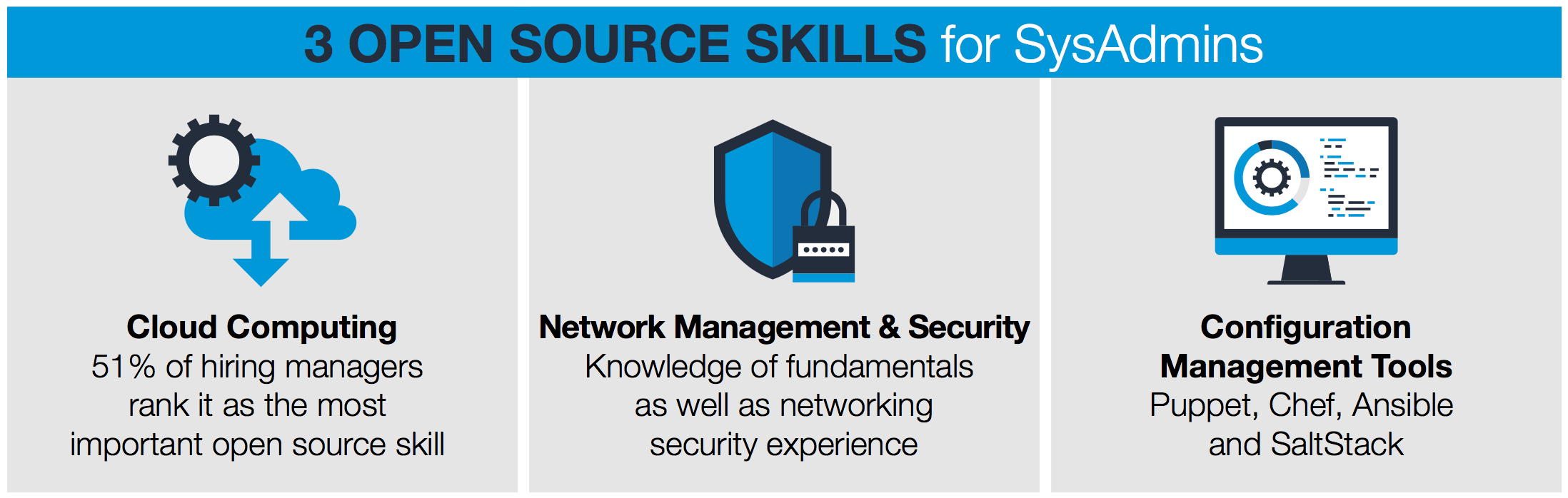
Networking is a complicated but essential core competency for sysadmins. A good sysadmin understands:

  • How users connect to a network, including managing remote connections via a Virtual Private Network (VPN)

  • How users authenticate to a network, ranging from standard two-factor authentication, to custom authentication requirements

  • How switching, routing and internetworking work

  • Software-Defined Networking (SDN)

  • End-to-end protocols

  • Network security

Fundamentals

TCP/IP (Transmission Control Protocol/Internet Protocol) forms the basis of how devices connect to and interface with the Internet. Sysadmins understand how TCP/IP packets address, route, and deliver data across a network.

future proof ebook

A good sysadmin also knows how domain name servers (DNS) and resource records work, including understanding nameservers. They typically are fluent with DNS query tools such as dig and nslookup, as well topics such as sender policy framework and NOTIFY.

With large-scale security threats continuing to emerge, there is now a premium on experience with network security tools and practices. That means understanding everything from the Open Systems Interconnect (OSI) model to devices and protocols that facilitate communication across a network. Locking down security also means understanding the infrastructure of a network. Securing a network requires competency with routers, firewalls,VPNs, end-user systems, server security, and virtual machines.

Additionally, knowledge of a platform like OpenStack can effectively expand any sysadmin’s networking clout, because OpenStack, CloudStack, and other cloud platforms essentially expand the perimeter of what we think of as “the network.”

Likewise, the basics of software-defined networking (SDN) are increasingly important for sysadmins to understand. SDN permits admins to programmatically initialize, control, and manage network behavior dynamically through open interfaces and abstractions of lower-level functionality. This, too, is a category where familiarity with leading open source tools can be a big differentiator for sysadmins. OpenDaylight, a project at The Linux Foundation, is an open, programmable, software-defined networking platform worth studying, and OpenContrail and ONOS are also on the rise in this space.

Additionally, many smart sysadmins are working with open configuration management tools such as Chef and Puppet. Julian Dunn, a product manager at Chef, writes: “System administrators have got to stop thinking of servers/disk/memory/whatever as ‘their resources’ that ‘they manage.’ DevOps isn’t just some buzzword concept that someone has thought up to make sysadmins’ lives hell. It’s the natural evolution of both professions.” See our list of  relevant, open configuration management tools here.

Training courses

For sysadmins who want to learn more about networking, the good news is that training in this area is very accessible and, in some cases, free. Furthermore, excellent free and open source administration and configuration tools are available to help boost any sysadmin’s networking efficiency.

Training options for Linux-focused sysadmins include a variety of networking courses. For sysadmins, CompTIA Linux+ offers solid training options, as does the Linux Professional Institute. The Linux Foundation Certified System Administrator (LFCS) course is another good choice. The Linux Foundation offers the LFS201 basic course and LFCS exam. Many vendors in the Linux arena also offer networking-focused training and certification for sysadmins, including Red Hat.

It’s also worth checking out O’Reilly’s Networking for Sysadmins video training options. These videos cover TCP/IP basics, OSI, and all the essential components within a network’s infrastructure, ranging from firewalls to VPNs to routers and virtual machines. The information is comprehensive, with some of the individual videos requiring a full day to complete and digest. Additionally, the curriculum is available on demand, so it can be used as reference material for networking essentials.

Additionally, Lynda.com offers an array of online network administration courses taught by experts. Sysadmins can quickly get through courses such as Linux File Sharing Services and Identity and Access Management.

Even as sysadmins focus on moving up the technology stack with their skillsets, networking basics remain essential. Fortunately, training and education are more accessible than ever. Next time, we’ll look at important security requirements to consider when advancing your sysadmin career.

Learn more about essential sysadmin skills: Download the Future Proof Your SysAdmin Career ebook now.


Read more:

Future Proof Your SysAdmin Career: An Introduction to Essential Skills 

Future Proof Your SysAdmin Career: New Networking Essentials

Future Proof Your SysAdmin Career: Locking Down Security

Future Proof Your SysAdmin Career: Looking to the Cloud

Future Proof Your SysAdmin Career: Configuration and Automation

Future Proof Your SysAdmin Career: Embracing DevOps

Future Proof Your SysAdmin Career: Getting Certified

Future Proof Your SysAdmin Career: Communication and Collaboration

Future Proof Your SysAdmin Career: Advancing with Open Source