
Home Blog Page 589

What If Mesos Metrics Collection Was a Snap?

https://www.youtube.com/watch?v=DbBC5zkwLd4?list=PLbzoR-pLrL6pLSHrXSg7IYgzSlkOh132K


This talk covers the basics of Mesos metrics collection, introduces Snap — a powerful, open source telemetry framework for modern infrastructures — as well as an open source plugin for Snap developed specifically to collect Mesos cluster metrics.
What If Mesos Metrics Collection Was a Snap?

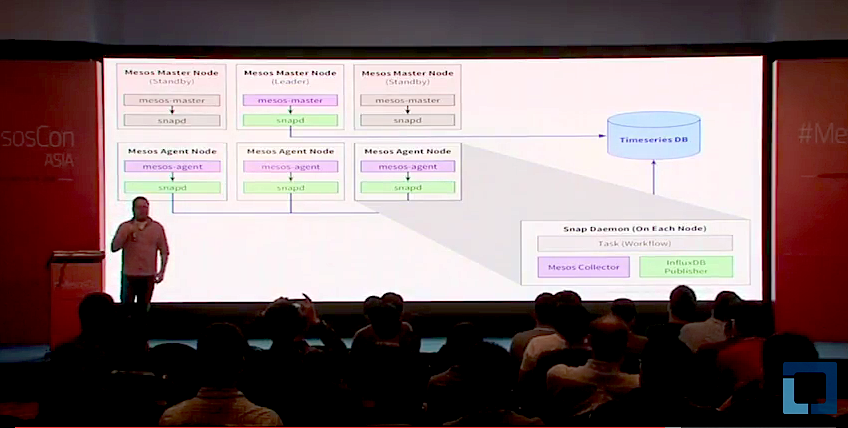
Roger Ignazio, tech lead at Mesosphere, introduces the Snap plugin for Apache Mesos at MesosCon Asia 2016. Snap is an open telemetry framework that simplifies the collection, processing, and publishing of system data through a single API. It collects hundreds of metrics from Mesos masters and agents and helps you can make sense of this mass of data so that you can monitor your cluster operations.

Ignazio presents Snap in the context of day two operations. “Day two operations is everything that comes after day one,” says Ignazio. “So, what does that mean? Everything that happens after you provision a Mesos or a DC/OS cluster falls into day two operations. That’s logging, that’s debugging, that’s metrics collection. Really, anything that you need to do to operate and ensure the health of a cluster.”

There are many Mesos metrics APIs that you can potentially use, and Ignazio describes some fo them. “The first one is the redirect endpoint. In a Mesos cluster you commonly have three or five or seven masters, for a production highly available deployment. The redirect endpoint returns a HTTP 307 redirect to the leading master, and this is important because you never want to query the non-leading master for its metrics.”

“The next is this metrics snapshot endpoint, and that’s a summary of the masters metrics. Kind of a high level and operations view. It’s things like how long it’s taking to query the Mesos internal registry, and how many messages are being sent back and forth between the frameworks.” Other metrics APIs include state and state summary endpoints, which provide either a high level or a detailed view of cluster states, and metrics about running containers, container IDs, CPU, memory, and disk usage.

Snap separates the collection of all of this data from publishing it. “You can filter, you can add context, you can type metrics, you can aggregate them, and then ultimately publish them onto your message queue or to a time-series database, and you can visualize them with your tools of choice.” The Grafana dashboard is a popular choice for creating a visual representation of your Snap data.

Watch the full presentation (below) to learn more about Snap’s architecture and to see some examples of how to use it.

https://www.youtube.com/watch?v=DbBC5zkwLd4?list=PLbzoR-pLrL6pLSHrXSg7IYgzSlkOh132K

Interested in speaking at MesosCon Asia on June 21 – 22? Submit your proposal by March 25, 2017. Submit now>>

Not interested in speaking but want to attend? Linux.com readers can register now with the discount code, LINUXRD5, for 5% off the attendee registration price. Register now to save over $125!

Litebook Launches $249 Linux Laptop

A company called Litebook has released a new Linux laptop that is priced to compete with Chromebooks — if not as cheap as the $89 Pinebook. That’s because the Pinebook is bare-boned when it comes to specs, using an ARM CPU, 2GB of RAM, and 16GB of built-in storage. The Litebook, on the other hand, uses an Intel Celeron processor (the N3150), twice as much memory, and a 512GB hard drive. (An extra $20 gets you a 32GB SSD in addition to the hard drive to help speed up boot-ups.) 

The Litebook ships with the Elementary OS flavor of Linux, though you can install an alternate that uses the Linux kernel 4.8.

Read more at ZDNet

802.Eleventy What? A Deep Dive into Why Wi-Fi Kind of Sucks

Just as everybody got used to the idea that 802.11b sucked, 802.11g came along. Promising 54 screaming Mbps, 802.11g was still only half the speed of Fast Ethernet, but five times faster than original Ethernet! Right? Well, no. Just like 802.11b, the advertised speed was really the maximum physical layer data rate, not anything you could ever expect to see on a progress bar. And also like 802.11b, your best case scenario tended to be about a tenth of that—5 Mbps or so—and you’d be splitting that 5 Mbps or so among all the computers on the network, not getting it for each one of them like you would with a switched network.

802.11n was introduced to the consumer public around 2010, promising six hundred Mbps. Wow! Okay, so it’s not as fast as the gigabit wired Ethernet that just started getting affordable around the same time, but six times faster than wired Fast Ethernet, right? Once again, a reasonable real-life expectation was around a tenth of that. Maybe. On a good day. To a single device.

Read more at Ars Technica

Top 4 JavaScript Code Editors

JavaScript is everywhere, and its ubiquitous presence on the web is undeniable. Every app uses it in one form or another. And any developer who is serious about the web should learn JavaScript. If you already know it, be sure to continue learning new frameworks, libraries, and tools, because JavaScript is a living, evolving language.

The JavaScript community has a great open source environment, and that has led to some excellent open source JavaScript IDEs (Integrated Development Environments). The open source movement is strong, and there are many IDEs that you can use to code your JavaScript program.

Read more at OpenSource.com

Google’s Microservices Protocol Joins Kubernetes in Cloud Foundation

Google’s gRPC protocol was originally developed to speed up data transfer between microservices, proving faster and more efficient than passing around data encoded in JSON.

Yesterday the Cloud Native Computing Foundation (CNCF), which oversees the development of Kubernetes, announced it would also become the home for gRPC’s development.

Read more at InfoWorld

IBM Adds New API to Quantum Computing Cloud Service

IBM announced today that it was updating its Quantum Experience cloud with a new API that it hopes will increase the abilities of researchers and other interested parties to build more sophisticated applications with its experimental quantum computing system.

Last May, IBM opened up its 5 qubit computer in its NY state labs to the public in the form of a cloud service. The hope was that by providing interested parties with a working quantum computing model, it would help advance the technology, which remains very much in the preliminary stage of development.

Read more at TechCrunch

How to Upgrade Kernel to Latest Version in Ubuntu

Periodically new devices and technology coming out and it’s important to keep our Linux system kernel up-to-date if we want to get the most of out it. Moreover, updating system kernel will ease us to take advantage of new kernel fuctions and also it helps us to protect ourselves from vulnerabilities that have been found in earlier versions.

Ready to update your kernel on Ubuntu 16.04 or one of their derivatives such as Debian and Linux Mint? If so, keep reading!

Step 1: Check Installed Kernel Version
To find the current version of installed kernel on our system we can do:

Read more at Tecmint

Tax Your Brain: Open Source Takes on Government Black Box Economics

Federal agencies are required by law to justify their proposals before codifying them into active laws. And for good reason: changes in tax policy, for example, can affect the entire economy. However, “justification” typically comes in the form of estimates based on numbers crunched deep within the sunless bowels of places such as the Office of Tax Analysis. There, nameless bureaucrats calculate outcomes using undisclosed statistical models based on assumptions that the rest of us, including the lawmakers writing these laws, do not get to see.

Thanks to the Open Source Policy Center, however, the citizens of this great nation may now get a glimpse into the data, and the methods used to derive and analyze that data, that drive public policy and the creation of new laws. In short, this DC-based nonprofit organization seeks to let a little open source sunshine into the black box of government data modeling.

Read more at The New Stack

Hyperledger Nears Release of Its First Production-Ready Blockchain

The Hyperledger project, a cross-industry open source blockchain group led by the Linux Foundation, plans to release its first production-ready distributed ledger code base by the end of the month, as projects involving the nascent technology begin to mature.

Hyperledger Fabric is a type of blockchain designed be used as a foundation to build distributed applications. The team of software developers involved in the project is finalizing the first version of Fabric that could be used by large businesses to build applications and plans to release by the end of March, according to the blog post.

“Our hope is that it is code that people can put into serious production,” Brian Behlendorf, Hyperledger’s executive director, told Reuters.

Read more at Reuters