Home Blog Page 61

Why Do Enterprises Use and Contribute to Open Source Software

When people find out I work at the Linux Foundation they invariably ask what we do? Sometimes it is couched around the question, As in the Linux operating system? I explain open source software and try to capture the worldwide impact into 20 seconds before I lose their attention. If they happen to stick around for more, we often dig into the question, Why would enterprises want to participate in open source software projects or use open source software? The reality is – they do, whether they know it or not. And the reality is thousands of companies donate their code to open source projects and invest time and resources helping to further develop and improve open source software.

How extensively used is open source software

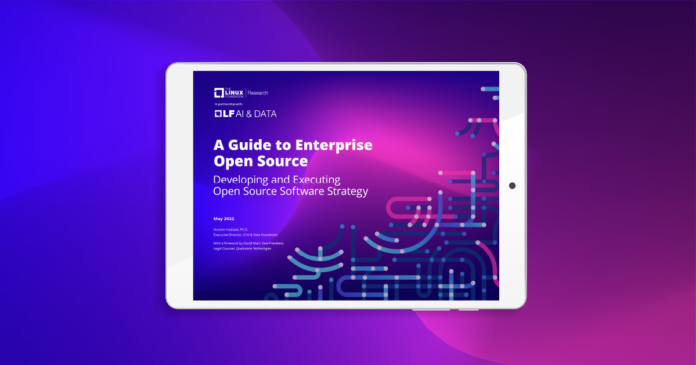
To quote from our recently released report, A Guide to Enterprise Open Source, “Open source software (OSS) has transformed our world and become the backbone of our digital economy and the foundation of our digital world. From the Internet and the mobile apps we use daily to the operating systems and programming languages we use to build the future, OSS has played a vital role. It is the lifeblood of the technology industry. Today, OSS powers the digital economy and enables scientific and technological breakthroughs that improve our lives. It’s in our phones, our cars, our airplanes, our homes, our businesses, and our governments. But just over two decades ago, few people had ever heard of OSS, and its use was limited to a small group of dedicated enthusiasts.”

Open source software (OSS) has transformed our world and become the backbone of our digital economy and the foundation of our digital world.

But what does this look like practically:

In vertical software stacks across industries, open source penetration ranges from 20 to 85 percent of the overall software used
Linux fuels 90%+ of web servers and Internet-connected devices
The Android mobile operating system is built on the Linux kernel
Immensely popular libraries and tools to build web applications, such as: AMP, Appium, Dojo, jQuery, Marko, Node.js and so many more are open source
The world’s top 100 supercomputers run Linux
100% of mainframe customers use Linux
The major cloud-service providers – AWS, Google, and Microsoft – all utilize open-source software to run their services and host open-source solutions delivered through the cloud

Why do companies want to participate in open source software projects

Companies primarily participate in open source software projects in three ways:

They donate software they created to the open source community
They provide direct funding and/or allocate software developers and other staff to contribute to open source software projects

The question often asked is, why wouldn’t they want to keep all of their software proprietary or only task their employees to work on their proprietary software?

The 30,000-foot answer is that it is about organizations coming together to collectively solve common problems so they can separately innovate and differentiate on top of the common baseline. They see that they are better off pooling resources to make the baseline better. Sometimes it is called “coopetition.” It generally means that while companies may be in competition with each other in certain areas, they can still cooperate on others.

It is about organizations coming together to collectively solve common problems so they can separately innovate and differentiate

Some old-school examples of this principle:

Railroads agreed on a common track size and build so they can all utilize the same lines and equipment was interchangeable
Before digital cameras, companies innovated and differentiated on film and cameras, but they all agreed on the spacing for the sprockets to advance the film
The entertainment industry united around the VHS and Blu-Ray formats over their rivals

Now, we see companies, organizations, and individuals coming together to solve problems while simultaneously improving their businesses and products:

Let’s Encrypt is a free, automated, and open certificate authority with the goal of dramatically increasing the use of secure web protocols by making it much easier and less expensive to setup. They are serving 225+ million websites, issuing ~1.5 million certificates each day on average.
The Academy Software Foundation creates value in the film industry through collectively engineering software that powers much of the entertainment, gaming, and media industry productions and open standards needed for growth.
The Hyperledger Foundation hosts enterprise-grade blockchain software projects, notably using significantly fewer energy resources than other popular solutions.
LF Energy is making the electric grid more modular, interoperable, and scalable to help increase the use of renewable energy sources
Dronecode is enabling the development of drone software so companies can use their resources to innovate further
OpenSSF is the top technology companies coming together to strengthen the security and resiliency of open source software
Kubernetes was donated by Google and is the go-to solution for managing cloud-based software

These are just a small sampling of the open source software projects that enterprises are participating in. You can explore all of the ones hosted at the Linux Foundation here.

How can companies effectively use and participate in open source software projects?

Enterprises looking to better utilize and participate in open source projects can look to the Linux Foundation’s resources to help. Much of what organizations need to know is provided in the just-published report, A Guide to Enterprise Open Source. The report is packed with information and insights from open source leaders at top companies with decades of combined experience. It includes chapters on these topics:

Leveraging Open Source Software
Preparing the Enterprise for Open Source
Developing an Open Source Strategy
Setting Up Your Infrastructure for Implementation
Setting Up Your Talent for Success
Challenges

Additionally, the Linux Foundation offers many open source training courses, events throughout the year, the LFX Platform, and hosts projects that help organizations manage open source utilization and participation, such as:

The TODO Group provides resources to setup and run an open source program office, including their extensive guides
The Openchain Project maintains an international standard for sharing what software package licenses are included in a larger package, including information on the various licensing requirements so enterprises can ensure they are complying with all of the legal requirements
The FinOps Foundation is fostering an, “evolving cloud financial management discipline and cultural practice that enables organizations to get maximum business value by helping engineering, finance, technology, and business teams to collaborate on data-driven spending decisions.”
The Software Data Package Exchange (SPDX) is an open standard for communication software bill of materials (SBOMs) so it is clear to every user which pieces of software are included in the overall package.

Again, this is just a snippet of the projects at the Linux Foundation that are working to help organizations adapt, utilize, contribute, and donate open source projects.

The bottom line: Enterprises are increasingly turning to open source software projects to solve common problems and innovate beyond the baseline, and the Linux Foundation is here to help.

The post Why Do Enterprises Use and Contribute to Open Source Software appeared first on Linux Foundation.

Getting started with RHEL 9, interpreting system log files, and more sysadmin tips

Check out Enable Sysadmin’s top 10 articles from May 2022.

Read More at Enable Sysadmin

Test API interactions with Mockoon

Use this open source tool to develop and test API operations on your local machine.

Read More at Enable Sysadmin

Happy third anniversary, Enable Sysadmin!

In just three years, this community site “by sysadmins, for sysadmins” has given millions of people information to help them do their work better.

Read More at Enable Sysadmin

How to configure chrony as an NTP client or server in Linux

Maintaining accurate time is critical for computers to communicate, run system components, and more, and chrony can help.

Read More at Enable Sysadmin

Asian American And Pacific Islander Heritage Month

This article originally appeared on the Open Mainframe Project’s blog. The author, John Mertic, is Director of Program Management at The Linux Foundation. 

One of the big things I celebrate about open source is the vast diversity of individuals that come together to build amazing technologies. A core belief that I have – and also that those at the Linux Foundation share – is that a diverse group of people coming together brings better outcomes, bigger innovations, and a more sustainable project. We at the Open Mainframe Project are truly fortunate to have such a global and diverse community, and with our hosted projects and working groups thriving, we see the impact of that diverse collaborative effort.

As many of you know, three of my children come from an Asian background – South Korea and China. I’ve shared in the past the joy they bring my wife and me, as well as those around us, but also the challenges and struggles of growing up in a culture different from where they were born.

Nowadays though, I worry about their safety and struggles even more – as there has been a rise in Asian American and Pacific Islander (AAPI) hate and crime. According to Stop AAPI Hate, from March 19, 2020 to December 31, 2021, a total of 10,905 hate incidents against AAPI persons were reported across the nation. This is sickening to me.

I was discussing this with a good friend recently and they shared that so much of diversity and inclusion is changing how you think about people, situations, and how you engage with others. This hits home for me now more than ever. I think about that with my children and me as a parent; seeing the world through their eyes has given me a new perspective on others and taught me empathy and understanding. But it has also given me an appreciation for others; who they are, where they come from, and what experiences and ideas they have.

In open source projects, it’s not a zero-sum game but a positive-sum game – open source development is based on the idea that, collectively, we are smarter than any one of us. That mindset is strong in our communities, and helps create that welcome space for all.

As we celebrate the last day of May and AAPI Heritage Month, I want to thank those Asian American and Pacific Islanders from our communities who have made a great impact. In fact, two of our members recently shared personal stories about their journeys. Thank you to Maemalynn Meanor, Senior Public Relations & Marketing Manager at the Linux Foundation, and Alex Kim, Technology Business Development Executive/OSS Incubator Advocate at IBM T.J. Watson Research Center, for offering a look into their personal and professional lives. You can read their blogs here:

Where my journey started and where it’s going – Alex Kim, IBM
Lesson Learned: Always listen to my mom – Maemalynn Meanor, The Linux Foundation

I thank everyone from those backgrounds for their great contributions to not only our projects, but open source in general, and hope that we can continue to make our communities a safe and inclusive place for all.

The post Asian American And Pacific Islander Heritage Month appeared first on Linux Foundation.

Software-Only Setup to Diagnose QEMU SCSI Passthrough and Multipath Failover

Illustrating how to diagnose QEMU SCSI P

Click to Read More at Oracle Linux Kernel Development

Where My Journey Started and Where It’s Going

This blog post originally appeared on the Open Mainframe Project’s blog. They invited Open Mainframe Projects community members, contributors, and leaders to share their stories in honor of Asian Americans and Pacific Islanders (AAPI) Heritage Month.  The author, Alex Kim, Open Mainframe Project Mentor, Zowe contributor and Technology Business Development Executive/OSS Incubator Advocate at IBM T.J. Watson Research Center, shares about how his family has influenced his life.  

Watching a recent TV show “Pachinko,” I was truly impressed by how the directors used screen arts and music.  Based on the New York Times bestseller, this show chronicles the hopes and dreams of a Korean immigrant family across four generations as they leave their homeland in an indomitable quest to survive. It was relatable and magical and wonderful to see how they focused on how three generations of a family dealt with biggest challenges of their times. After watching the first season,  I couldn’t help thinking about my parents and my own family here in U.S.

My dad was born in mid 1930’s from the Southern region of Korea, when Korea was still under Japanese colonial territory. His family endured a lot of hardships, loss and scary moments because they had to survive through the Korean War. In fact, one of his stories that he tells often is about how, when he was just 12-years old, he and his brother escaped a massacre that happened at their small town.

My dad when he was in army building peace house near DMZ in 1960s

Photo: My dad when he was in army building peace house near DMZ in 1960s.

Like most of the community, my dad’s family was very poor and couldn’t afford to have “normal” food. Young children were living on eating dregs from the liquor factory in the town.

The poverty, however, couldn’t stop my dad from learning and advancing . Eventually he went to naval academy and had a successful career where he then retired as an Army Corporal. He said he was the first person to ‘escape’ the poor rural town and successfully landed a job in Seoul, the capital of South Korea. He later oversaw the building of Panmunjom in 1965 – buildings in Joint Security Area near DMZ – a very famous landmark that you might even remember from when President Trump met with Kim Jong-un a few years ago.

Photo of recent Panmunjom – you can see they still have the buildings from when my dad used to work to build them in 1960s

Photo of recent Panmunjom – you can see they still have the buildings from when my dad used to work to build them in 1960s

My dad endured a lot in his life but what always stayed strong was his drive to survive and succeed, which is what he instilled in me.

In August 1999, I landed at New York’s JFK airport with one big luggage (called ‘E-Min Gah Bang’, meaning ‘immigration bag’) and two large carton boxes. My destination was somewhere in Brooklyn, where I was supposed to start attending Brooklyn Polytech for a graduate study. Sometimes, when I look back,  I am not sure how I did it.  I didn’t have any friends. I didn’t know the language well and I didn’t really know the country itself.

If I’m honest, it was a little scary, but my heart was filled with excitement. I would survive and succeed – just like my dad did. I could learn anything and become what I wanted. (Also, I still can’t forget the taste of Junior’s Cheesecake – where my roommate took me to celebrate my first night in the US.)

I was truly lucky that I got so much help from many people, as for one I  got to join a research lab for Professor Ramesh Karri, where his team was implementing AES candidates into circuits. I implemented the Rijndael algorithm, which was selected as ‘the standard’ in 2000. This experience later led to a job opportunity at IBM Poughkeepsie where designed the first AES engine in hardware format within the company.

Photo of IBM 4758 – which was replaced with IBM 4764 that I worked on. Learn more – IBM CryptoExpress HSM.

Photo of IBM 4758 – which was replaced with IBM 4764 that I worked on. Learn more – IBM CryptoExpress HSM.

When I visited Korea after I got the job offer, my dad was proud of me. He reflected how me going to New York was the same as him leaving the small town he grew up. I didn’t realize much at the time what it means leaving families and going abroad for my own goals. I was just happy about the fact that I made my parents proud for the small success I could achieve. Thinking back now, my generation was still in this ‘make your parents proud’ lifestyle – it seemed very common in many Asian cultured families.

More than 20 years have passed since my first day at work. I have been through different jobs and different companies.  I got married and have my own family now. When my children were born and as they grew older, I had to face something that I didn’t realize I was going to miss.

I am the youngest of four siblings – so I never felt lonely growing up. We always had extended family members visiting during holidays and had big family events like weddings and New Years parties. Now, with my children in New York and far from my family in Korea, I am a little sad that I can’t give them the festive feelings and experiences that I was given. My wife and I celebrate with them as best we can but it is a little different when it’s a small family of four compared to an extended family with lots of cousins, aunts, uncles and grandparents.

Recent family gathering in Korea celebrating ‘Parents Day’ on May 8th 2022.

Photo: Recent family gathering in Korea celebrating ‘Parents Day’ on May 8th 2022.

I feel bad that I haven’t given them this opportunity yet – an opportunity to have days filled with fun, noisy family gatherings over the holidays. An opportunity to have a fight with cousins and rumble around the house screaming.

This is why, I am taking my kids to Korea this summer. It’s a little challenging as COVID is still a bad situation there but this will be a short trip. I hope I can give some of those ‘extended family’ memories to my kids as we visit with family.

I want to spend more time with my dad – I hope I can ask him how he felt when I was growing up. I want to ask him if he was worried like me. I want to ask him if it was hard for him sending me abroad and not being able to see me for many years.

Although I chose this career path and I love it – I don’t think I had enough thoughts about what my (and my own family’s) life would be like if I live abroad. I don’t regret on any of my choices – I rather feel I am truly blessed. However, growing up with the culture where ‘Hyo(filial duty)’ is one of the most important virtue in Korea – I am not doing it right as I can’t live near my parents and help them when they needed me.

I think many Asian cultures have this deep rooted family foundation in which the children take care of the parents when they get older. But for those of us who dreamed big and moved out of the countries we grew up in to search for a new life, an opportunity to build a better life, this is hard.

Yesterday I was talking to my mom and she told me my dad fell on the steps outdoor and hurt his leg. I wished I could run back to their house and help him visit a doctor’s office – but I can’t.  All I could do was make a few phone calls.

These thoughts and feelings never came up when I was younger. They were probably planted in my heart long ago when I was a still kid – but it took more than 30 years to grow and finally bloom into a more mature, grown-up heart.

Recent photo of my family

Photo: Recent photo of my family

Now, I wonder how my kids will feel when they get to my age. How will they feel growing up in America as second generation Asian American immigrants? Will they fit in here? Will they want to know more of their Korean family?

I will probably never understand their feelings – but I hope they ask me their own questions about life as they grow up. I hope they remember all of the short visits to Korea and remember where their parents came from. I hope they aspire to visit Korea themselves someday with their families. It makes me smile thinking about these things. I think I am getting old now… I am thankful that we all are in this journey together.

My journey started with my dad in a small town in Korea and continued when I put roots down in Brooklyn. I can’t wait to see what happens next.

The post Where My Journey Started and Where It’s Going appeared first on Linux Foundation.

Google Cloud, Société Générale, American Express, Point72, Mirantis, and The Digital Dollar Project Join FINOS, as Open Source Collaboration Becomes Increasingly Critical Across the Global Financial Ecosystem

The Fintech Open Source Foundation continues to expand support across all constituents and geographies with increased buy-side, cloud and financial technology representation

New York, NY – May 31 – The Fintech Open Source Foundation (FINOS), the financial services umbrella of the Linux Foundation, announced today the addition of six new corporate members, including Google Cloud, Société Générale, American Express, Point72, Mirantis, and The Digital Dollar Project. Building upon its 19 new Members in 2021 and its recent addition of Wellington Management Company to its Governing Board, FINOS now has 57 corporate members ushering a new era in open collaboration across the global financial services industry. 

These new members, as well as the entire FINOS ecosystem will meet in London on July 13 at its annual Open Source in Finance Forum

This addition of new members reinforces FINOS’ position as the arena of choice to build the next generation of financial technologies on common standards and open source components for financial institutions on both the sell-side and buy-side, fintechs, cloud companies, regulators, industry consortia and individual contributors. FINOS continues to see growth in the number and diversity of its corporate members across the world, with more than a 35% increase in the number of members year-over-year, fueling a community of more than 1,200 active contributors. This announcement is particularly significant as the engagement of cloud vendors and new buy-side firms signals widespread reception of open source return on investment across the technology value chain as a whole.

“We are at a pivotal moment in our evolution as a Community, where literally every constituent of the industry has come to the realization that open source collaboration has the concrete potential to bring to life the vision of a highly efficient, interoperable and developer-friendly global financial technology stack,” said Gabriele Columbro, Executive Director of FINOS. “From cloud and open source leaders heading the charge to some of the historically most conservative firms in the world now rolling out Open Source Program Offices (OSPOs), we are incredibly proud to see global recognition of the value in open source and of the role FINOS played in this evolution.” 

Meet the new members 

Google Cloud becomes the first global cloud service provider joining FINOS as a Gold member. Google Cloud will contribute to critical efforts for cloud deployments in financial services like the FINOS Open RegTech and Compliant Financial Infrastructure initiatives, aimed at driving adoption of FINOS open source projects in the cloud. 

“For more than 20 years, Google has helped shape the future of computing with its technology leadership and support across the open source ecosystem,” said Zac Maufe, Director, Financial Services, Google Cloud. “We are thrilled to join FINOS and its community of companies and people dedicated to open source. As the financial services industry accelerates its adoption of cloud technologies, FINOS open source projects will deliver valuable support to both our customers and the financial services tech community at large.”

Société Générale (SocGen), a French multinational investment bank and financial services company, joins FINOS as a Gold member, representing an important addition to the European sell-side representation in FINOS. This comes on the heels of the Linux Foundation amplifying its global focus with the recently announced inaugural European World of Open Source: 2022 Europe Spotlight Survey, a testament to the truly global nature and potential of the open source Community.

“Société Générale implemented an ‘Open Source First’ policy in 2017 and established it’s Open Source Program office (OSPO) in 2020,” said Alain Voiment, CIO for Group digital foundations and corporate functions, Société Générale. “Over the years, our focus has been to evolve in the open source journey by deriving benefits from infrastructure layer to applicative layer to business value add while engaging our developers’ community. As we become a more ‘tech enabled’ company leveraging the power of IT, digital, and data, we continue to foster our innovation capacity in bringing added value for our clients. Collaboration with FINOS is the right step in this direction and there couldn’t be a better time to embark on this journey.”

Our third Gold member, American Express, is dedicated to delivering digital products and services that enhance the lives of their customers, and believe open-source is a key component in supporting innovative growth across the industry. 

“Our technology philosophy focuses on delivering increased scale and efficiency, improved speed to market, high-quality, and security, while always keeping our customer at the center of all we do,” said Hilary Packer, Executive Vice President & Chief Technology Officer, American Express. “We’re excited to join FINOS because of the opportunities it will provide to collaborate with and contribute to the community, while supporting our ongoing adoption of open-source software, standards, and best practices, which in turn will help drive the continued success and growth of our company.”

FINOS also continues to expand the open source technology footprint among buy-side institutions to deliver innovation among the investment and asset management industries. Firms now have the ability to leverage open source connectivity, through projects like FDC3 that bolster interoperability with the sell-side, to access the market quickly in a vendor agnostic fashion. Newest Silver member Point72, a global asset manager which invests in multiple strategies and asset classes, was the first buy-side firm to join FINOS earlier in 2022, signaling their leadership and strong focus on the use of open source in this industry sector.

“Open source has emerged as an increasingly important driver of innovation in leading technology organizations within financial services,” said Mark Brubaker, Chief Technology Officer at Point72. “Our decision to join FINOS reflects our belief that open source collaboration raises all boats, benefiting all organizations and technologists.”

Mirantis, an established open source leader and cloud management platform that helps organizations easily ship code on public and private clouds, also joined FINOS as a Silver member.

“We are proud and excited to join FINOS,” said Andy Wild, Chief Revenue Officer of Mirantis. “With the rapid adoption of Cloud Native Technologies driven by Kubernetes in the financial industry, Mirantis understands that collaboration is the fastest path to innovation, and our open source based products and services have helped to drive innovation and growth for our financial customers for years. Joining FINOS, we look forward to having the opportunity to further align with the needs of the financial industry.”

FINOS also welcomes its latest Associate member, The Digital Dollar Project, a leading private-public partnership advancing the study and exploration of a potential U.S. Central Bank Digital Currency (CBDC), an initiative FINOS recently announced its support for in Davos.

“New advances in financial technology, including CBDCs, have the power to transform economies and connect people, governments, and businesses, locally and globally,” said Jennifer Lassiter, Executive Director of The Digital Dollar Project. “We know that experimentation and information sharing are critical to innovation, which is why we are thrilled to contribute to open source solutions as a new addition to the vibrant FINOS community.”

The addition of new Gold, Silver and Associate members marks continued forward momentum of FINOS’ mission to drive mass open source adoption across all facets of the financial services industry, strengthening its position as the leading organization supporting the industry as they collaborate on vital areas, such as interoperability, data standards, and open source security.

To learn more about joining FINOS as a member, visit the Membership Benefits page. Meet the FINOS team in London on July 13 at its annual Open Source in Finance Forum

About FINOS

FINOS (The Fintech Open Source Foundation) is a nonprofit whose mission is to foster adoption of open source, open standards and collaborative software development practices in financial services. It is the center for open source developers and the financial services industry to build new technology projects that have a lasting impact on business operations. As a regulatory compliant platform, the foundation enables developers from these competing organizations to collaborate on projects with a strong propensity for mutualization. It has enabled codebase contributions from both the buy- and sell-side firms and counts over 50 major financial institutions, fintechs and technology consultancies as part of its membership. FINOS is also part of the Linux Foundation, the largest shared technology organization in the world. Get involved and join FINOS as a Member.

Media Contact:
Catharine Rybeck 
Caliber Corporate Advisers 
catharine@calibercorporateadvisers.com 

The post Google Cloud, Société Générale, American Express, Point72, Mirantis, and The Digital Dollar Project Join FINOS, as Open Source Collaboration Becomes Increasingly Critical Across the Global Financial Ecosystem appeared first on Linux Foundation.

How to enable live kernel patching on Linux

Kernel live patching is a great way to keep your infrastructure updated while minimizing manual work and avoiding system restarts

Read More at Enable Sysadmin