Home Blog Page 633

Automotive Grade Linux Moves to UCB 3.0

The Linux Foundation’s Automotive Grade Linux (AGL) project has released version 3.0 of its open source Unified Code Base (UCB) for automotive infotainment development. Unlike AGL’s UCB 2.0, which was released in July, UCB 3.0 is already being used to develop in-vehicle infotainment (IVI) products, some of which will ship in cars this year.

The AGL also announced Daimler AG as its 10th carmaker member of the group, and the first German manufacturer. Daimler, which “will actively contribute to developing the Unified Code Base,” is known for divisions including Mercedes-Benz Cars, Daimler Trucks, Mercedes-Benz Vans, and Daimler Buses.

The addition of Daimler AG is significant considering the automotive manufacturer’s longtime partnership with Microsoft and its Windows Embedded Automotive platform. The AGL membership does not necessarily mean it’s dropping Windows, however. In September, Microsoft and Daimler announced an effort called “In Car Office” to bring Office 365 to the car environment.

The AGL is not saying which companies will ship products first, but notes that UCB 3.0 “has several strong supporters and contributors including Toyota, Mazda, Aisin AW, Continental, Denso, Harman, Panasonic, Qualcomm Technologies, Renesas and many others.” More than 40 new companies have joined AGL in the past year, bringing the member total to more than 80. In addition to Toyota and Mazda, AGL automotive manufacturer members include Ford, Honda, Jaguar Land Rover, Mitsubishi Motors, Nissan, Subaru, and as of last month, Suzuki.

UCB is currently focused on in-vehicle infotainment, where the goal is to provide 70-80 percent “of the starting point for a production project,” according to the AGL. “This enables automakers and suppliers to focus their resources on customizing the other 20-30 percent to meet their unique product needs.”

“Sharing a single software platform across the industry decreases development time which enables automakers and suppliers to bring new products to market faster so they can stay ahead of new advances in mobile technology,” stated Dan Cauchy, Executive Director of Automotive Grade Linux.

Future versions will expand to more comprehensive digital cockpit and assisted driving technology. Several Linux-friendly, automotive focused system-on-chips that span all these applications have been announced in recent months, including the Intel Atom A3900, Renesas Electronics R-Car H3, and NXP i.MX8 Quad (see farther below).

The previous UCB 2.0 added a new rear seat display, video playback, and audio routing support, as well as a comprehensive application framework. UCB 3.0 refines these features while adding instrument cluster integration, rear-camera support, and an improved SDK, among other enhancements.

The AGL UCB 3.0 spans technologies for navigation, communications, safety, security, and connectivity, with features including:

  • New home screen and window manager 

  • Improved application framework and application launcher

  • New SDK for rapid application development

  • Reference applications including media player, tuner, navigation, Bluetooth, WiFi, HVAC control, audio mixer and vehicle controls

  • Integration with simultaneous display on instrument cluster

  • Smart Device Link for mobile phone integration

  • Rear view camera and rear seat entertainment on MOST ring

  • Wide range of hardware board support including Renesas, Qualcomm Technologies, Intel, Texas Instrument, NXP and Raspberry Pi

Testimonials were supplied by Toyota, Renesas, Denso, Panasonic, and Qualcomm. “We support the AGL UCB 3.0 and plan to integrate it into our vehicles in the future,” stated Ken-ichi Murata, Group Manager, Connected Strategy & Planning, Connected Company of Toyota Motor Corp. “By adopting open source software, we can focus more on developing new features and contiguously creating better user experiences for our customers.”

Toyota may well be the first car company to ship with AGL UCB inside. The company has scheduled a press conference, available via livestream, for this Wednesday at 4PM. Like most major car companies, Toyota has numerous high tech projects going on, such as self-driving car technologies, so it won’t necessarily involve UCB. The presentation will “highlight the critical importance of User Experience (UX) in the development of highly automated vehicles and robots.”

The AGL is hosting an AGL Demonstration Showcase to demonstrate UCB 3.0 during the January 4-7 CES show this week in Las Vegas. The showcase will include an AGL Demo Suite held on January 5-6.

Linux-Ready Automotive SoCs Offer New Options

AGL is maturing at a time when automotive technology is increasingly driving the high-end, SoC market. In announcing its new line of Atom E3900 “Apollo Lake” embedded SoCs, Intel tipped a similar Atom A3900 automotive variant that will ship in Q1 2017. The A3900 will enable “a complete software defined cockpit solution,” says Intel. Earlier this year, Intel acquired Yogitech, which makes safety tools for autonomous car chips, and its Wind River unit bought Arynga, which offers Linux-based OTA for cars.

In the ARM world, Renesas recently released several third-generation R-Car starter kits that are optimized for both AGL and the rival GENIVI Alliance spec, which similarly focuses on open source Linux IVI development. The kits, one of which includes a newly announced R-Car H3 SoC, are designed for ADAS, infotainment, reconfigurable digital clusters, and integrated digital cockpits.

TI also plays a big role in automotive IVI with its Jacinto 6 SoCs. Nvidia, meanwhile, has pivoted the bulk of its Tegra development resources toward automotive, including its Drive PX 2 solution for self-driving cars.

Qualcomm has been slower to shift to automotive, but earlier this year, the company announced an automotive-focused Snapdragon 820a SoC, and then followed up with a wireless-studded Qualcomm Connected Car Reference Platform. Many believe that Qualcomm’s pending, $38 billion acquisition of NXP is largely intended to boost its automotive business. NXP will also help it with IoT devices, which are expected to interact with smart cars, for example via smart garages and fuel stations.  

NXP recently announced an automotive-focused i.MX8 Quad SoC with four Cortex-A53 cores, two Cortex-M4F cores, and two GPUs. Upcoming QuadPlus and QuadMax versions will add one or two -A72 cores, respectively.

Then there’s Tesla, which continues to use a custom Linux build in its automotive technology, but has yet to comply with GPL licensing. The company recently announced that “all Tesla vehicles produced in our factory — including Model 3 — will have the hardware needed for full self-driving capability.” The capability won’t be activated, however, until the company has completed “millions of miles of real-world driving” tests.

All these platforms support Linux, which is increasingly well positioned in automotive against its two main rivals:  QNX and Microsoft Windows Embedded Automotive. It remains unclear to what extent Google will turn Android Auto into a full automotive spec like AGL or GENIVI. Last January at CES, Google announced an Open Automotive Alliance with Audi, GM, Honda, Hyundai, and Nvidia, to standardize Android IVI systems.

We can expect a lot more automotive computing news at this week’s CES show, which is increasingly focused on the topic. Nine automotive manufacturers, 11 tier-one auto suppliers, and more than 300 vehicle tech-related exhibitors will be in attendance at CES, says Business Insider. Already, Fiat Chrysler Automobiles and Google announced that they will unveil the latest version of FCA’s Android based infotainment system, now based on Android 7.0 “Nougat.”
Why Machine Learning Is Hard to Apply to Networking

Machine learning is becoming a buzzword—arguably an overused one—among companies that deal with networking. Recent announcements have touted machine learning capabilities at GoogleHewlett Packard Enterprise (HPE), and Nokia, for instance.

But machine learning isn’t being applied to networking itself. Why is that? 

The intersection of machine learning and networking is where David Meyer, chief scientist at Brocade, has been working. After serving a term as the first chairman of the OpenDaylight Project’s Technical Steering Committee (TSC), Meyer shifted his work into the realm of artificial intelligence.

Read more at SDxCentral

Does the Container Ecosystem Need a Map?

At last month’s KubeCon in Seattle, members of the Cloud Native Computing Foundation put forth a chart depicting the various projects, both commercial and open source, that either individually or collectively contributed to its perception of the “cloud native” ecosystem. You might call it, for lack of a more original phrase, a new stack.

It’s being called the Cloud Native Landscape (CNL), its version number of 0.9.2 suggesting it’s close to finished, but not quite. It looks like a chart one might print up of the various vendors at a gaming conference, or of the vendor charts at one of the early computer shows. Remember when hotel meeting rooms were divided into aisles, and the first software developers shouted over one another to get attention?

Read more at The New Stack

Expect Deeper and Cheaper Machine Learning

Supercharged hardware will speed up deep learning in everything from tiny devices to massive data centers.

Last March, Google’s computers roundly beat the world-class Go champion Lee Sedol, marking a milestone in artificial intelligence. The winning computer program, created by researchers at Google DeepMind in London, used an artificial neural network that took advantage of what’s known as deep learning, a strategy by which neural networks involving many layers of processing are configured in an automated fashion to solve the problem at hand.

Unknown to the public at the time was that Google had an ace up its sleeve. You see, the computers Google used to defeat Sedol contained special-purpose hardware—a computer card Google calls its Tensor Processing Unit.

Read more at IEEE Spectrum

The DevOps Engineer Is An Optical Illusion

IT pros and developers can’t be excellent at everything. Instead, embracing specialization and empowering collaboration in your organization can achieve meaningful and lasting DevOps progress.

Building a collaborative and lightning-quick DevOps organization is a complex but critical business mission today. The technology industry is filled with a host of best practices that promise to help companies achieve this objective. Some of these suggestions make a great deal of sense. But many of the recommendations lead to mediocre results, and organizations simply can’t afford to be half-good when it comes to DevOps.

Read more at InformationWeek


6 Container Themes to Track in 2017

The container craze will turn four next year. Yes, Linux containers have been around longer than that, but the rise of Docker—first released to the public on March 20, 2013—has sparked the surge of interest we’re riding right now.

It’s a fascinating adolescent phase, as containers not only roll into production but also get acclimated to enterprise needs and bigger-money investors. Here’s a glance at the major themes that surrounded containers in 2016 and are likely to continue into 2017.

Scheduler ‘Wars’

Some players are rushing to crown Kubernetes as the de facto standard for container orchestration. Others are just getting started with Kubernetes alternatives.

Read more at SDx Central

What You’ll Learn at Cloud Native/Kubernetes 101 Roadshow: Pacific Northwest!

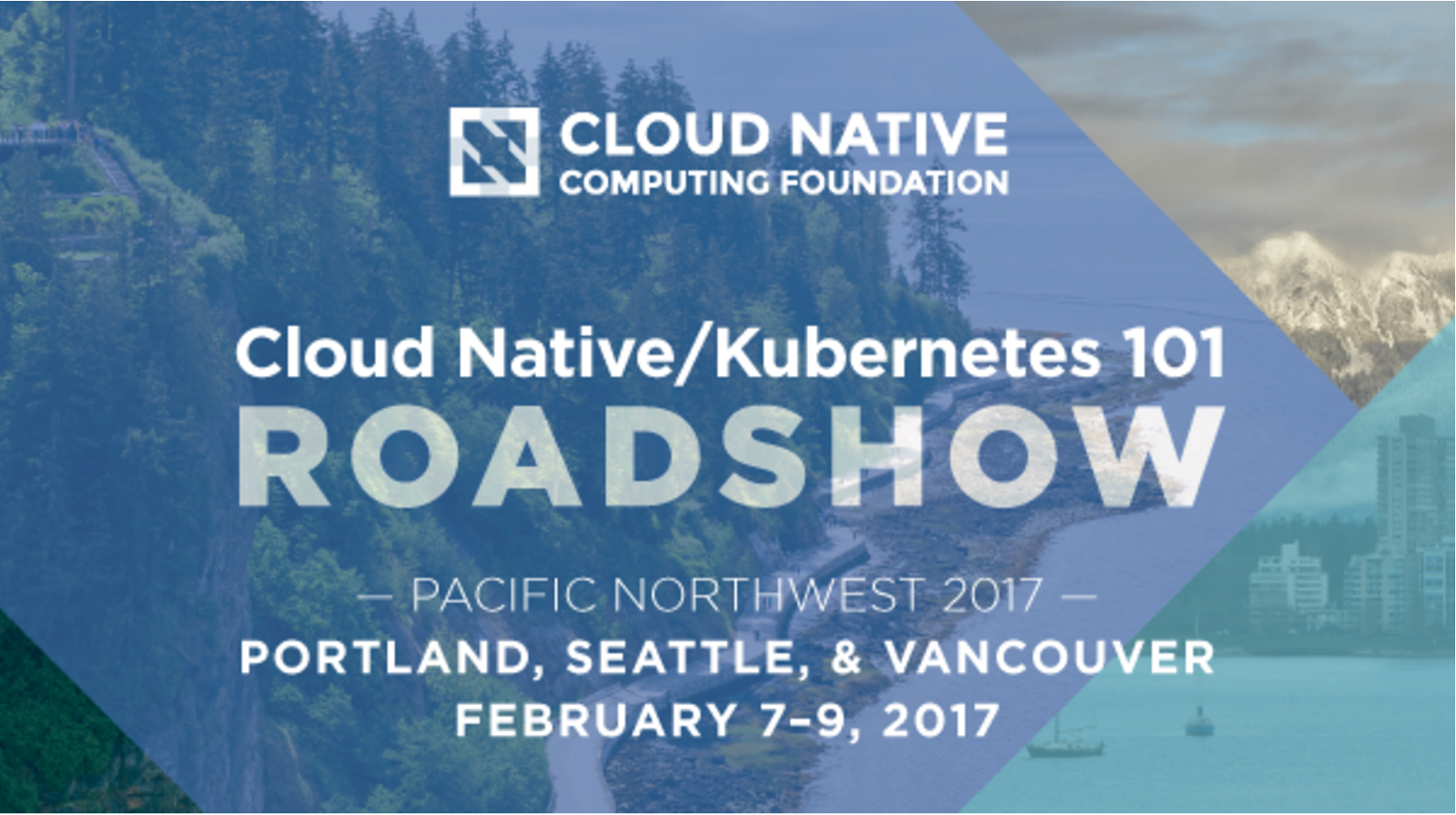
The Cloud Native Computing Foundation is taking to the road February 7-9  in Portland, Seattle and Vancouver to offer end users, developers, students and other community members the ability to learn from experts at Red Hat, Apprenda and CNCF on how to use Kubernetes and other cloud native technologies in production. Sponsored by Intel and Tigera, the first ever Cloud Native/Kubernetes 101 Roadshow: Pacific Northwest will introduce key concepts, resources and opportunities for learning more about cloud native computing.

The CNCF roadshow series focuses on meeting with and catering to those using cloud native technologies in development, but not yet in production. Cities and locations include:

Each roadshow will be held from 2-5pm, with the full agenda including presentations from:

Dan Kohn, Executive Director of the Cloud Native Computing Foundation.  Dan will discuss:

  • What is cloud native computing — orchestrated containers as part of a microservices architecture — and why are so many cloud users moving to it instead of virtual machines

  • An overview of the CNCF projects — Kubernetes, Prometheus, OpenTracing and Fluentd — and how we as a community are building maps through previously uncharted territory

  • A discussion of top resources for learning more, including Kubernetes the Hard Way, Kubernetes bootcamp, and CloudNativeCon/KubeCon and training and certification opportunities

Brian Gracely, Director of Product Strategy at Red Hat. Brian will discuss:

  • Real-world use of Kubernetes in production today at Amadeus, LeShop, Produban/Santander & FICO

  • Why contributing to CNCF-hosted projects should matter to you

  • How cross-community collaboration is the key to the success of the future of Cloud Native

Isaac Arias, Technology Executive, Digital Business Builder, and Passionate Entrepreneur at Apprenda. Isaac will discuss:

  • Brief history of machine abstractions: from VMs to Containers

  • Why containers are not enough: the case for container orchestration

  • From Borg to Kubernetes: the power of declarative orchestration

  • Kubernetes concepts and principles and what it takes to be Cloud Native

By the end of this event, attendees will understand how cloud users are implementing cloud native computing — orchestrated containers as part of a microservices architecture – instead of virtual machines. Real-world Kubernetes use cases at Amadeus, LeShop, Produban/Santander, and FICO will be presented. A detailed walk through of Prometheus (monitoring system), OpenTracing (tracing standard) and Fluentd (logging) projects and each level of the stack will also be provided.

Each city is limited in space, so sign up now! Use the code MEETUP50 to receive 50% off registration!

omhIFAtkg2SLFFdl0mzJazFtC3OK1RwVr8zjmpZY

Top 5 Videos from Embedded Linux Conference and OpenIoT Summit 2016

In 2017, The Linux Foundation’s Embedded Linux Conference marks its 12th year as the premier vendor-neutral technical conference for companies and developers using Linux in embedded products.

Now co-located with OpenIoT Summit, ELC promises to be the best place for embedded and application developers, product vendors, kernel and systems developers as well systems architects and firmware developers to learn, share and advance the technical work required for embedded Linux and IoT.

In anticipation of this year’s North America event, to be held Feb. 21-23 in Portland, Oregon, we rounded up the top videos from the 2017 ELC and OpenIoT Summit. Register now with the discount code, LINUXRD5, for 5% off the registration price. Save over $150 by registering before January 15, 2017.

1. Home Assistant: The Python Approach to Home Automation

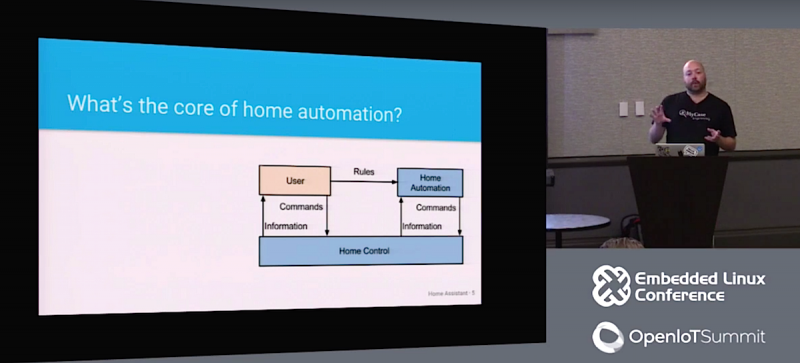
Several home automation platforms support Python as an extension, but if you’re a real Python fiend, you’ll probably want Home Assistant, which places the programming language front and center. Paulus Schoutsen created Home Assistant in 2013 “as a simple script to turn on the lights when the sun was setting,” as he told attendees of his recent Embedded Linux Conference and OpenIoT Summit presentation, “Automating your Home with Home Assistant: Python’s Answer to the Internet of Things.”

Schoutsen, who works as a senior software engineer for AppFolio in San Diego, has attracted 20 active contributors to the project. Home Assistant is now fairly mature, with updates every two weeks and support for more than 240 different smart devices and services. The open source (MIT license) software runs on anything that can run Python 3 — from desktop PCs to a Raspberry Pi, and counts thousands of users around the world.

https://www.youtube.com/watch?v=4-6rTwKl6ww?list=PLGeM09tlguZRbcUfg4rmRZ1TjpcQQFfyr

2. Linus Torvalds Talks IoT, Smart Devices, Security Concerns, and More

Linus Torvalds, the creator and lead overseer of the Linux kernel, and “the reason we are all here,” in the words of his interviewer, Intel Chief Linux and Open Source Technologist Dirk Hohndel, was upbeat about the state of Linux in embedded and Internet of Things applications. Torvalds’ very presence signaled that embedded Linux, which has often been overshadowed by Linux desktop, server, and cloud technologies, has come of age.

“Maybe you won’t see Linux at the IoT leaf nodes, but anytime you have a hub, you will need it,” Torvalds told Hohndel. “You need smart devices especially if you have 23 [IoT standards]. If you have all these stupid devices that don’t necessarily run Linux, and they all talk with slightly different standards, you will need a lot of smart devices. We will never have one completely open standard, one ring to rule them all, but you will have three of four major protocols, and then all these smart hubs that translate.”

https://www.youtube.com/watch?v=tQKUWkR-wtM

3. Taming the Chaos of Modern Caches

It turns out that software — and computer education curricula — have not always kept up with new developments in hardware, ARM Ltd. kernel developer Mark Rutland said in his presentation “Stale Data, or How We (Mis-)manage Modern Caches.”

“Cache behavior is surprisingly complex, and caches behave in subtly different ways across SoCs,” Rutland told the ELC audience. “It’s very easy to misunderstand the rules of how caches work and be lulled into a false sense of security.”

https://www.youtube.com/watch?v=F0SlIMHRnLk

4. IoTivity 2.0: What’s in Store?

Speaking shortly after the release of Open Connectivity Foundation (OCF)’s IoTivity 1.1, Vijay Kesavan, a Senior Member of Technical Staff in the Communication and Devices Group at Intel Corp, told the ELC audience about plans to support new platforms and IoT ecosystems in v2.0. He also explained how the OCF is exploring usage profiles beyond home automation in domains like automotive and industrial.

https://www.youtube.com/watch?v=_k7OAXUNl6I

5. A Linux Kernel Wizard’s Adventures in Embedded Hardware

Sometimes the best tutorials come not from experts, but from proficient newcomers who are up to date on the latest entry-level technologies and can remember what it’s like to be a newbie. It also helps if, like Grant Likely, the teacher is a major figure in embedded Linux who understands how hardware is ignited by software.

At the Embedded Linux Conference, Likely — who is a Linux kernel engineer and maintainer of the Linux Device Tree subsystem used by many embedded systems — described his embedded hardware journey in a presentation called “Hardware Design for Linux Engineers” — or as he put it, “explaining stuff I only learned six months ago.”

https://www.youtube.com/watch?v=kCH5QkmKArg

Linux.com readers can register now with the discount code, LINUXRD5, for 5% off the registration price. Save over $150 by registering before January 15, 2017.

Read More:

10 Great Moments from Linux Foundation 2016 Events

Top 7 Videos from ApacheCon and Apache Big Data 2016

Keynote: From DaVinci to The Avengers by Dr. Thomas Di Giacomo, Chief Technology Officer, SUSE The Linux Foundation

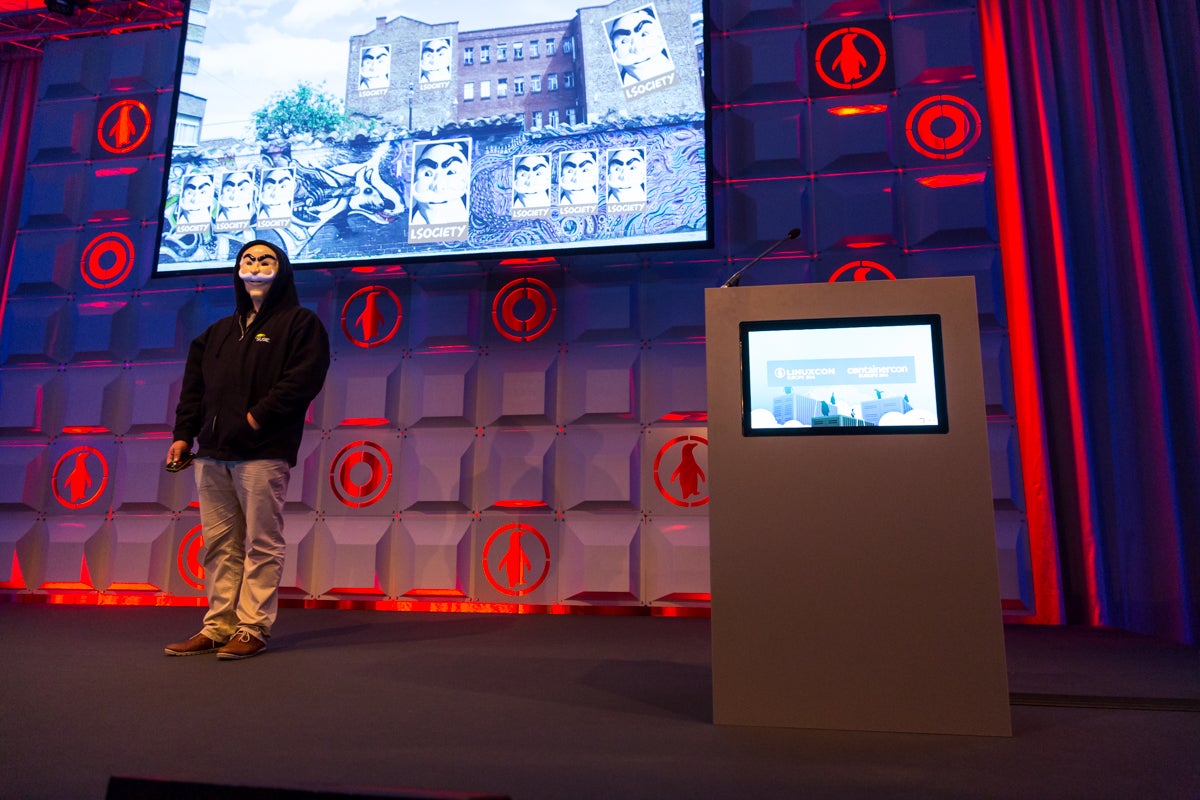
Thomas Di Giacomo, Chief Technology Officer at SUSE started his LinuxCon Europe keynote with a brief clip in the style of Mr. Robot where in 2016 even Evil Corp has gone open source. 

From DaVinci to The Avengers: Building Collective Genius

The 25th anniversary of Linux was a big milestone celebrated by many of us at LinuxCon events throughout the year, and it was a theme throughout many of the presentations. Thomas Di Giacomo, Chief Technology Officer at SUSE started his LinuxCon Europe keynote with a brief clip in the style of Mr. Robot where in 2016 even Evil Corp has gone open source and we have won. He says that “open source is seen as a technology savior. That’s why companies have been embracing it, because they have to, to remain viable.”

Giacomo compares the human brain at age 25 with Linux. He talks about how at 25 years old, neurologists say that our brains make a big leap in maturity when the prefrontal cortex becomes fully operational, which helps us focus, make more logical decisions, make more complex plans, be more organized, and be more disciplined. At 25, Linux is also maturing in all of these ways, which leads us to collaborate more together to achieve great things.

Going back a few centuries to around the time of Leonardo Da Vinci before science was fully mature, there were individual bright minds active in poetry, philosophy, and other arts and domains, who could cover most of their contemporary knowledge. Giacomo described them “as men who knew it all, people like Aristotle, Roger Bacon, Da Vinci, Kepler, Humboldt, and others.” 

Technology today is much too complex to be understood by a single person. “The future of open source is about contributing together more and more, so that we can achieve more and more complex challenges. We should try to scale our individual brains into a much larger collective, connected, and functional brain,” Giacomo says.

This is similar to the Avengers. Individual super heroes acting alone couldn’t save the day, so they are teaming up to be stronger together and more powerful than the sum of their parts. 
Giacomo suggests that “in our community too, we have gone from individual mighty Hulks to groups of Avengers, so … we have to work more and more together to keep fixing more and more challenging problems. … Simply having the code available is not enough to ensure long-term viability of open source. We also need to make sure we keep working on fostering inclusive environments where everyone can contribute, so that the open source momentum continues and grows for the next decades to come.” 

This was a fun talk that can be best appreciated by watching the entire video!

Interested in speaking at Open Source Summit North America on September 11 – 13? Submit your proposal by May 6, 2017. Submit now>>

Not interested in speaking but want to attend? Linux.com readers can register now with the discount code, LINUXRD5, for 5% off the all-access attendee registration price. Register now to save over $300!