‘DevOps’ is easy when you know your organization can adopt changes easily and have a right attitude to use some tools that make DevOps come true in your organization.
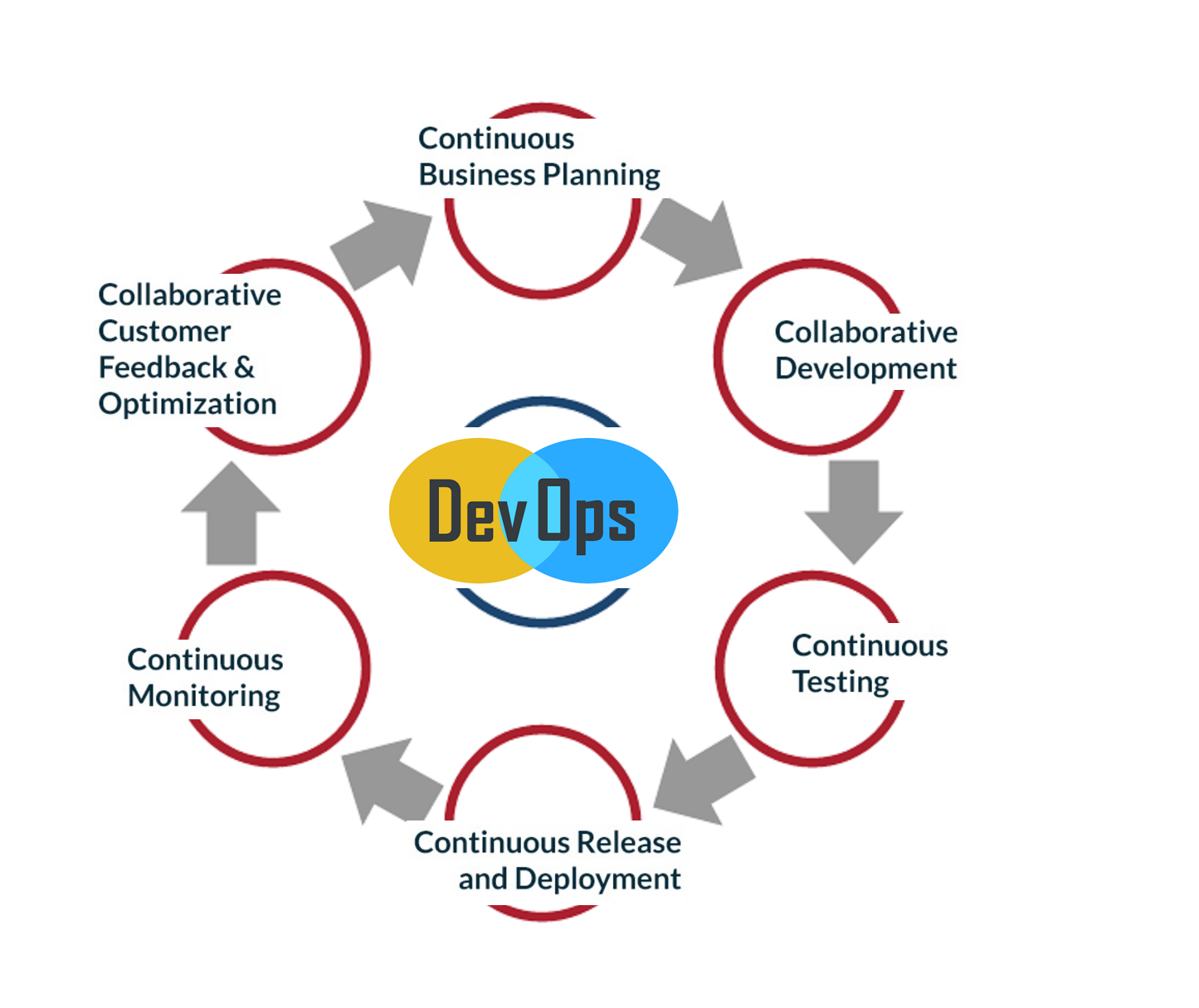
Along with the tools, you need to know the DevOps cycle and here it is,
What are the 6 C’s of DevOps?
1. Continuous business planning: Starts with identifying the skills, outcomes, and resources needed.
2. Collaborative development: Starts with development sketch plan and programming.
3. Continuous testing: Unit and integration testing to help increase the efficiency and speed of the development.
4. Continuous release and deployment: Non-stop CD pipeline to help you implement code reviews and developer check-ins easily.
5. Continuous monitoring: To monitor the changes and address the errors/mistakes spontaneously whenever they happen.
6. Customer feedback and optimization: This allows the immediate response of your customers for your product and its features and helps you modify accordingly.
Taking care of these 6 stages will make you a good DevOps organization. BTW, this is not the must have a model but a more sophisticated model out there. This will give you a fair idea on the tools to use at different stages to make this process more lucrative for a software powered organization.
CD pipeline, CI tool and Containers make things easy and when you want to practice DevOps, having a microservices architecture makes more sense.
From Day One of eBay’s cloud journey, the e-commerce company has focused on keeping its developers happy, according to Suneet Nandwani, eBay’s senior director of cloud infrastructure and platforms. That’s led to several challenges and innovations at the company, the latest of which is the development of TessMaster — a management framework to deploy Kubernetes on OpenStack.
With the emergence of Docker, it became clear that containers are “a technology which developers love,” Nandwani told ZDNet.
Let’s look at the Agile development process – again focusing on Scrum from the Ops perspective. Let’s review the places where we intervene: in which points in the process do we intervene? How do we help development? How do we help QA? And what about ourselves, Ops? How do we help ourselves? And despite our previous statement, we’ll also say a few words about the mindset. Let’s ask the obvious first question on the way to involvement:
Are Ops part of the Scrum team or not?
We have made the testers part of the team. After all, the whole idea behind Scrum is independently organized multidisciplinary teams. So what will it be? Ops in the team or outside of it?
Web analytics is nothing but the measuring web traffic. It is not limited to measuring web traffic. It includes:
Analysis
Data collection
Reporting of web data for purposes of understanding and optimizing web pages.
Google Analytics is the most widely used cloud-based web analytics service. However, your data is locked into Google Eco-system. If you want 100% data ownership, try the following open source web analytics software to get information about the number of visitors to your website and the number of page views. The information is useful for market research and understanding popularity trends on your website.
A number of interesting and notable legal developments in open source took place in 2016. These seven legal news stories stood out:
1. Victory for Google on fair use in Java API case
In 2012 the jury in the first Oracle v. Google trial found that Google’s inclusion of Java core library APIs in Android infringed Oracle’s copyright. The district court overturned the verdict, holding that the APIs as such were not copyrightable (either as individual method declarations or their “structure, sequence and organization” [SSO]).
The first day of 2017 starts off for Linux users with the release of the second RC (Release Candidate) development version of the upcoming Linux 4.10 kernel, as announced by Linus Torvalds himself.
As expected, Linux kernel 4.10 entered development two weeks after the release of Linux kernel 4.9, on Christmas Day (December 25, 2016), but don’t expect to see any major improvements or any other exciting things in RC2, which comes one week after the release of the first RC, because most of the developers were busy partying.
Tracy Hinds is the education and community manager for the Node.js Foundation. The educational aspect of her job means she oversees training, onboarding, certification, and other educational programs — with a major focus on providing educational resources that help new Node.js users more readily access the platform. The community aspect means she helps plan, organize and produce events where the Node.js crowd gathers to encounter the foundation’s educational initiatives hands-on and in person.
The foundation’s annual conference, Node Interactive North America 2017, is this week in Vancouver, British Columbia, and Hinds is — naturally — one of the organizers. The New Stack caught up with Hinds to hear all about new tracks and offerings, speakers she is particularly excited to encounter, and what we are pretty sure must be the Node.js community’s first ever 5K Fun Run.
What’s new or different about Node Interactive this year?
To start with, we will all be in one place! Last year we had two different events, in two different locations at two different times of the year. Node Interactive North America, in Austin, and Node Interactive EU, in Amsterdam.
Short Bytes: ZeroPhone is an open source smartphone that’s powered by Raspberry Pi Zero. It runs on Linux and you can make one for yourself using parts worth $50. One can use it to make calls and SMS, run apps, and pentesting. Soon, phone’s crowdfunding is also expected to go live.
Raspberry Pi is often listed as one of the most accessible and helpful innovations in the computer hardware industry. It has helped children learn programming and allowed the makers to develop powerful and cheap DIY projects. In the past, we have told you about different Raspberry Pi DIYs like a pocket-size Linux computer, Wi-Fi Drone killer, temperature controller, etc. Recently, I found an interesting project listed on Hackaday. Named ZeroPhone, this smartphone uses a Raspberry Pi Zero. It’s as open source as possible, making it dirt cheap. Fortunately, all the parts are easily available on eBay and Amazon, and they cost about $50.
Using a Linux terminal is always difficult, especially at the beginning when everything is new to the user. I remember my first contact with a Linux terminal like it was yesterday. After all, I was interacting with a machine that responded to everything I typed. I started learning the basic commands such as “cd”, “ps” “w” “mkdir” which at the time it was like I entered another world, a digitalized one which I’m just starting to uncover. The excitement I felt back then still hits me when I discover some great combination of commands to ease the server/service administration or configuration.
Linux is an all-present OS in our world. It is an extremely flexible system due to its open source nature which allows anyone to contribute.
Most lightweight Linux distributions are fairly standard: They use a window manager with a small footprint and install a minimal amount of apps to continue with the small size metaphor. In the end, many of those distributions function well…at a cost of functionality. Typically, to get a lightweight distro to do what you want, you wind up having to install numerous other apps, which basically defeats the purpose.
Then there are distributions like LXLE. This particular take on the small footprint Linux feels more like it belongs in the good old regular footprint Linux. It’s stuck squarely in the middle and can stake the claim that it can truly revive your old hardware without doing so at the cost of productivity. And, with the latest release (Eclectica, based on Ubuntu 16.04.01), that distribution is better and more capable than you’d imagine.
Random wallpaper changer (with 100 wallpapers pre-installed)
Theme consistency throughout
32- and 64-bit OS versions available
Although you might scoff at the idea of including so many wallpapers, when you start clicking through the random wallpaper button (located on the desktop panel), you’ll quickly appreciate how beautiful your desktop can be.
Instant familiarity
As with most of the lightweight Linux distributions, you’ll find zero learning curve with the desktop environment. LXLE makes great use of LXDE. With the main panel at the top of the desktop (Figure 1), you’ll find the applications menu, shortcuts for the file manager, wallpaper changer app, a launcher for the terminal app, a quick launch app, time/calendar app, and system tray.
Figure 1: The LXLE default desktop is instantly familiar to the user.
A second panel, set to auto hide, can be found at the bottom of the screen (Figure 2). This panel includes the Application Launch Bar (where you can add application launchers), Window List app (for minimized apps), desktop pager, window iconify, and Exposé button.
Figure 2: The LXLE bottom panel.
Update system
Although LXLE does ship with the Synaptic package manager, I wouldn’t recommend using it to upgrade the system. I attempted two runs with Synaptic and both attempts brought the desktop to a pixelated halt. Instead, LXLE includes a very handy app called uCareSystem. This text-based tool does the following:
Updates all available packages
Updates your Ubuntu system
Downloads and install updates
Checks for the list of old Linux Kernels and uninstalls them
Clears the cache folder
Uninstalls packages that are obsolete or no longer needed
Uninstalls orphaned packages
Deletes package settings that have been previously uninstalled
You can launch uCareSystem by clicking Applications > Updates. A terminal window will open (Figure 3), and the tool will automatically run through all of its steps to update and clean your system. This tool is so easy to use, it makes me wonder why more distributions don’t include it.
Figure 3: The uCareSystem tool in action.
You can also run uCareSystem from the terminal window by issuing the command sudo ucaresystem-core. The uCareSystem tool was so impressive, I added it to my running Elementary OS Loki production machine. This can be done with the following commands:
sudo add-apt-repository ppa:utappia/stable
sudo apt update
sudo apt install ucaresystem-core
Not without problems
LXLE is an impressive distribution, but it’s not without its problems. The first issue reared its ugly head during installation. I tend to prefer the live-to-install route, so I booted up the live instance of LXLE…only to be greeted by a password prompt. There was no indication on the website of a required username/password for the live instance and the only mention I could find was within the forums (that being a possible corrupted ISO image). I downloaded a second…and third…and fourth. Each of the live instances required a username and password—something no one seemed to know.
To that end, I opted to go the direct install route. This also failed. The installation would walk me through the wizard and start copying packages. Before the installation of the boot loader could begin, the installation crashed. I attempted this five times before finally giving up.
However, during the user setup process of the direct-install method, I noticed the installer always wanted to default to user qwerty. I took that as a hint and rebooted into a live instance. After entering qwertyas the username and an empty password, I was greeted with the LXLE desktop. Bingo. Next step, run the installer from the live instance. This time, the installation succeeded without a hitch. Within a few minutes, I had a working LXLE and was happily kicking the tires.
The only other caveat I came across was something that tends to plague most small-footprint distributions…an out-of-date web browser. LXLE uses a Mozilla build of Seamonkey and the second you open it (even after running uCareSystem), you’ll be warned that the included version is out of date (Figure 4).
Figure 4: An out-of-date web browser is not something you want on a desktop.
Clicking on the Check for Updates button came back with no available updates. A sticky conundrum, no doubt. The best way around this is to install either Firefox, Vivaldi, Chrome, or Chromium and avoid the pitfalls that come along with using an out-of-date browser (security vulnerabilities, lack of support, etc.).
A treat to use
Beyond the easily resolved issues, LXLE was a treat to use. As a desktop, it is instantly familiar and runs with the stability of a well-seasoned environment. As a Linux distribution, it will serve you incredibly well, whether you’re running new or older hardware. Give LXLE a go and see if you don’t opt to make it your distribution of choice.