Home Blog Page 655

Greenlight for Girls: Finding the STEM Leaders of the Future

There is growing anxiety within tech companies about the lack of skilled professionals to keep up with demand. There’s also a realization that one of the largest untapped resources is women. A keynote at the recent Embedded Linux Conference Europe in Berlin described a potential solution to the challenge called Greenlight for Girls, a non-profit organization with a mission to provide girls around the world with the opportunity to love STEM.

The problem is that many girls who have a natural talent for STEM (science, technology, engineering, and math) are often steered elsewhere by teachers, parents, peers, and stereotypes reinforced by the media. A recent National Science Foundation report claimed that more than twice as many U.S. men than women attend graduate school in computer science, and more than four times as many men are enrolled in engineering. While gender discrimination continues to be a problem in hiring, a greater challenge is that relatively few girls get hooked on STEM at an early age and then stick with it.

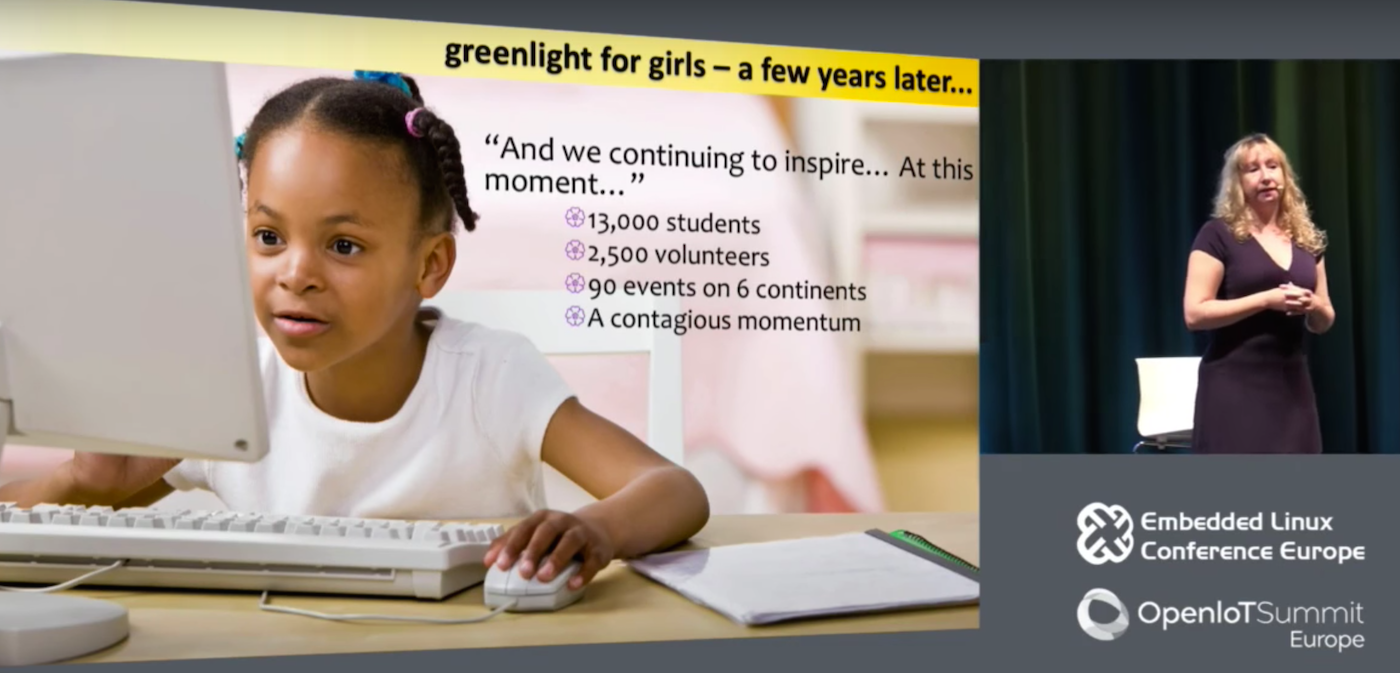
At ELCE, Greenlight for Girls project founder Melissa Rancourt and International Project Manager Jelena Lucin explained how their organization sponsors hands-on STEM workshops and events for girls around the world, often led by role-model volunteers from industry.

Rancourt has been a computer engineer for 20 years. “I love everything about it, from programming to all the science and math behind it, so I’m constantly amazed that not everybody gets how fabulous this is,” Rancourt told the ELCE audience. “For 20 years I’ve enjoyed the opportunity to get women and girls interested in STEM, but really it was just pissing me off because the numbers aren’t changing. In some fields, the number of women was even going down.”

Several years ago, Rancourt decided to address the problem on a larger scale. She sent off an email blast to gauge interest in launching an organization that promotes STEM education among girls, and was overwhelmed with the favorable response. Within the first year, Greenlight for Girls launched with an international board of directors, more than 500 volunteers, and 1,000 participating girls. Today, the group has grown to 2,500 volunteers serving 13,000 students. So far, there have been 90 events held on six continents.

“We go into the classrooms and into the community, and provide scholarships and libraries,” explained Rancourt, who mentioned projects including robotics, routers, rocket science, telepresence, Arduino hacking, and the physics of playing rugby. “We have role models who come together and show how STEM is linked to everything,” she said. The group also provides girls with free meals, which can make a big difference in many communities.

Greenlight for Girls decided it was important to start working with girls at an early age. “It’s never too early to incite a passion for science,” said Rancourt. “Some school systems put kids in boxes pretty quickly, and it’s easy to veer off the STEM path. Once you’re off the path, it’s so difficult get back on.”

Global Reach

The group’s global reach has led to a flexible approach based on local needs. “In our first group in the Congo, they asked to change the format to cover things the kids could do in their community to make a difference, so we changed the workshops to orient to their needs,” said Rancourt. Even in the U.S. where girls have easier access to technology, there’s a need for programs like Greenlight for Girls, she added. “In Silicon Valley we have had parents tell us that they don’t have anything like this in the area.”

Decisions about where to launch new groups often come from the program’s sponsors, which contribute volunteers and equipment. “We ask our global partners like Cisco, AIG, Swift, and Proctor & Gamble, where they need to build a workforce, and then we see if we can set up a program there,” said Rancourt. “We have new city launches every two weeks.”

The group has now been around long enough that Rancourt and Lucin are beginning to see results. “We have so many wonderful stories about kids who stay with it,” said Rancourt. “One 14-year-old created an app, and we went with her to Apple for the launch.”

Yet, the impact of Greenlight for Girls goes beyond the girls who are inspired to find a career in STEM. “The passion we encourage in them will let them ignore the ‘nos’ and keep on going,” said Rancourt. “One child can change a lot in a community.”

Watch the complete presentation below:

https://www.youtube.com/watch?v=5arcdOfzn_M?list=PLbzoR-pLrL6pRFP6SOywVJWdEHlmQE51q

ELC videos

Keynote: Breaking Barriers: Creatively and Courageously

https://www.youtube.com/watch?v=5arcdOfzn_M?list=PLbzoR-pLrL6pRFP6SOywVJWdEHlmQE51q

Greenlight for Girls is an international organization dedicated to inspiring girls of all ages and backgrounds by demonstrating just how fun and interactive STEM can be.  The Greenlight for Girls team tells the story of how an initiative can grow from one email to a global organization in a few short years by breaking barriers, creatively and courageously.

The Docker Monitoring Problem

This post is part 1 in a 4-part series about Docker monitoring. Part 2 explores metrics that are available from Docker, part 3 covers the nuts and bolts of collecting those Docker metrics, and part 4 describes how the largest TV and radio outlet in the U.S. monitors Docker. This article dives into some of the new challenges Docker creates for infrastructure monitoring.

You have probably heard of Docker—it is a young container technology with a ton of momentum. But if you haven’t, you can think of containers as easily—configured, lightweight VMs that start up fast, often in under one second. Containers are ideal for microservice architectures and for environments that scale rapidly or release often.

Read more at DataDog

OpenStack Becomes a Standard Building Block for NFV

OpenStack is becoming the de facto standard for infrastructure orchestration for NFV deployment by leading Communications Service Providers (CSPs). CSPs are trading off the challenges of OpenStack implementations (e.g. immature technology and evolving standards) for the benefits of open source and open architectures (i.e. reduced vendor lock-in). Lack of standards for NFV management and orchestration (MANO) remains a leading impediment.

NFV and OpenStack

OpenStack is a set of open source software tools for building and managing cloud computing platforms. It enables service providers to provision and orchestrate pools of data center resources across compute and storage. With regards to NFV, CSPs deploy different types of data centers than the typical large enterprise or hyper-scale cloudprovides. Their compute capabilities are distributed in tiers including centralized cores, aggregation points, and local points of presence (PoPs). OpenStack implementations for CSPs must be highly reliable and be able to distribute workloads across hundreds of geographically distributed data centers (of varying sizes).

Read more at SDx Central

FPGA Myths

As data center sprawl is now understood to be expensive and may not deliver performance increases for all types of applications, new technologies are coming to the rescue.  A field-programmable gate array (FPGA) is an integrated circuit designed to be configured by a customer or a designer after manufacturing – hence “field-programmable”.  While the use of GPUs and HPC accelerators are generally understood today, there are a number of misconceptions about FPGAs that need to be understood.

The first is that FPGAs are only good for embedded devices. However, this is not the case. FPGAs can be used to sift through the massive amounts of data that are created in any given time frame for Internet of Things (IoT) environments as well as a wide range of Big Data applications.  FPGAs can be programmed to do many different tasks and are becoming more mainstream.

Read more at InsideHPC

IBM, Intel, Microsoft, Mozilla and NodeSource Join Forces on Node.js API

Part of Node.js Foundation’s mission is growing Node.js everywhere. The Node.js platform is already available on a variety of VMs, like Samsung’s JerryScript, a lightweight JavaScript engine for the Internet of Things. While many steps are needed to allow Node.js to work in VM environments outside of V8, the work the Node.js API working group and ChakraCore are doing are important steps to offer greater choice.

Today, we are excited to announce several initial milestones in these efforts. The first is centered around Node.js API (ABI Stable Module API or NAPI for short), which is focused on defining a stable module API that is independent from changes in V8.

Read more at Node.js blog

12 Signs You’re Working in a Feature Factory

I’ve used the term Feature Factory at a couple conference talks over the past two years. I started using the term when a software developer friend complained that he was “just sitting in the factory, cranking out features, and sending them down the line.”

How do you know if you’re working in a feature factory?

  1. No measurement. Teams do not measure the impact of their work. Or, if measurement happens, it is done in isolation by the product management team and selectively shared. You have no idea if your work worked…

Read more at HackerNoon

Containers Moving Beyond Servers

It’s obvious enough why containers are valuable within the data center. They provide a portable, lightweight mode of deploying applications to servers.

However, servers account for only one part of the software market. There is a good chance that, sooner or later, containers will expand to other types of devices and deployment scenarios.

Docker Beyond the Data Center

Read more at Container Journal

How to Choose the Ultimate DevOps Tools

It’s not just about deciding to practice DevOps, Agile, and Lean, it’s also important to know the proper tools that make DevOps a success.

To be frank, there are no any magical tools that make you agile or lean. Hence, DevOps is more of a cultural shift rather than a toolset. This cultural shift should transfer from the top level management to the developers in the organization.

The top management should enable the use of certain set of identified tools to practice DevOps.

A proper understanding of the tools and training is required to use these tools.

Although there are tools that help in every touch points in the development life cycle, not all you can consider as DevOps tools.

0-1VcTqUT4SJct9YMSO4cD_vIl90xBiIMBVjga6T

  1. Plan : GitHub

  2. Build : Docker

  3. Continuous integration : Shippable

  4. Deploy : Heroku & Amazon Web Services

  5. Operate : Botmetric

  6. Continuous Feedback : Github

Let’s discuss each stage with the tools that can fit properly as DevOps tools,

Plan:

Planning is the major and initial part of any software development life cycle. Choosing a tool that can help you easily plan and assign work to different teams or developers is very important.

Transparency, collaboration and clear assignment of issues with who should do what are some key factors to look for when choosing the right tool for planning. Here comes ‘GitHub’ that can help you ease this process.

Build:

After all the planning done, it’s time to get the work going. To build, there is a need for a tool/platform that supports various environments, languages etc and since it’s the age of containers, it’s obvious that developers use Docker to provision individual development environments. Docker gets more work done with the ease of containerization, many things are possible now.

Continuous integration:

In this stage, every code written by developers will be integrated immediately and this is the objective of continuous integration. Here you need to look for a tool/platform that can help do the testing faster and give you instant feedback. Although there are many tools available, Shippable is one best tool that gets you going all the way from continuous integration to continuous deployment.

Shippable enables teams to build and test their repositories for every code commit or pull request and get instant feedback. Shippable can be said as the fastest CI/CD platform.

Deploy:

Deploy is the critical stage and here you need to find a tool that gives you full visibility on branches, builds, pull requests, and deployment warnings in one place. Here comes the platform Heroku, a cloud application platform that helps app developers spend their time on their application code, not managing servers, deployment, ongoing operations, or scaling. This increases the developer productivity by easing the deployment with less effort and full visibility.

Another best platform here is AWS, that let’s you use it’s amazing cloud computing services. Running your applications in the AWS Cloud can help you move faster, operate more securely, and save substantial costs.

Operate:

Here is the stage where you critical need to monitor the application, server performance budget reports. You need to consider a tool that can let you know the application performance and whether the development is happening in the right path or not. Botmetric can run a comprehensive audit of your AWS Cloud to detect security issues, performance problems, disaster recovery bottlenecks, adherence to cloud best practices and cost optimization opportunities etc. The special features of this tool like budget alerts and daily reports help you analyze critical business data and take proper high-level IT decisions.

Continuous Feedback:

Continuous feedback is one thing that you can never neglect, if you consider it less, then you will go out of business soon. A continuous feedback loop is necessary where your customers will let you know what they liked, what they want and what are the issues they are facing. There are so many tools to name but many software powered organizations prefer GitHub issue board to know the customers’ feedback.

I think these are the tools/platforms for DevOps success. Let me know your favorite tools.

3 Emerging Cloud Technologies You Should Know

In previous articles, we’ve discussed four notable trends in cloud computing and how the rise of microservices and the public cloud has led to a whole new class of open source cloud computing projects. These projects leverage the elasticity of the public cloud and enable applications designed and built to run on it.

Early on in cloud computing, there was a migration of existing applications to Amazon Web Services, Google, and Microsoft’s Azure. Virtually any app that ran on hardware in private data centers could be virtualized and deployed to the cloud. Now with a mature cloud market, more applications are being written and deployed directly to the cloud and are often referred to as being cloud native.

Here we’ll explore three emerging cloud technologies and mention a few key projects in each area. For a more in-depth explanation and to see a full list of all the projects across six broad categories, download our free 2016 Guide to the Open Cloud report.  

Cloud Native Applications

While there is no textbook definition, the self-described cloud native in its simplest definition indicates applications that have been designed to run on modern distributed systems environments capable of scaling to tens of thousands of nodes. The old mantra, “No one ever got fired for buying IBM (or Microsoft),” has changed to the new slogan of “No one is going to get fired for moving to the cloud.” Rather than looking at hard and fast qualifiers for cloud-native, we need to look at the design patterns that are being applied to this evolving breed of applications.

In the pre-cloud days we saw virtualization take hold where entire operating systems were portable inside of virtual machines. That way a machine could move from server to server based on its compatibility with hypervisors like VMware, KVM or Xen Project. In recent years we have seen the level of abstraction at the application layer where applications are container-based and run in portable units that are easily moved from server to server regardless of hypervisor due to container technologies like Docker and CoreOS-sponsored rkt (pronounced rocket).

Containers

A more recent addition in the cloud era is the rise of the container, most notably Docker and rkt. These application hosts are an evolution of previous innovations including Linux control groups (cgroups) and LXC, and an even further abstraction to make applications more portable. This allows them to be moved from development environments to production without the need for reconfiguration.

Applications are now deployed either from registries or through continuous deployment systems to containers that are orchestrated using tools like Ansible, Puppet, or Chef.

Finally, to scale out these applications, the use of schedulers such as Kubernetes, Docker Swarm, Mesos, and Diego coordinate these containers across machines and nodes.

Unikernels

Another emerging technology that bears some similarity to containers is that of unikernels. A unikernel is a pared-down operating system, which is combined with a single application into a unikernel application and which is typically run within a virtual machine. Unikernels are sometimes called library operating systems, because they include libraries that enable applications to use hardware and network protocols in combination with a set of policies for access control and isolation of the network layer. There were systems in the 1990s called Exokernel and Nemesis, but today popular unikernels include MirageOS and OSv. Because unikernel applications can be used independently and deployed across diverse environments, unikernels can create highly specialized and isolated services and have become increasingly used for developing applications in a microservices architecture.

In the series that follows, we’ll dive into each category of open source cloud technology and list the most useful, influential, and promising open source projects with which IT managers and practitioners can build, manage, and monitor their current and future mission-critical cloud resources.  

Learn more about trends in open source cloud computing and see the full list of the top open source cloud computing projects. Download The Linux Foundation’s Guide to the Open Cloud report today!

Read the other articles in this series:

4 Notable Trends in Open Source Cloud Computing

Trends in the Open Source Cloud: A Shift to Microservices and the Public Cloud

Why the Open Source Cloud Is Important