Home Blog Page 669

First 64-Bit Orange Pi Slips in Under $20

The open spec Orange Pi PC 2 runs Linux or Android on a quad-core -A53 Allwinner H5 SoC, and offers GbE, a 40-pin RPi interface, and three USB host ports.


Shenzhen Xunlong is keeping up its prolific pace in spinning off new Allwinner SoCs into open source SBCs, and now it has released its first 64-bit ARM model, and one of the cheapest quad-core -A53 boards around. The Orange Pi PC 2 runs Linux or Android on a new Allwinner H5 SoC featuring four Cortex-A53 cores and a more powerful Mali-450 GPU. The Orange Pi PC 2, which sells at Aliexpress for $19.98, or $23.33 including shipping to the U.S., updates the quad-core -A7 Allwinner H3 based Orange Pi PC, which came in 14th out of 81 SBCs in our hacker boards reader survey.

Read more at HackerBoards

The DevOpsification of Security

In December 2009, Google was the target of a series of highly coordinated, sophisticated advanced persistent threat (APT) attacks in which state-sponsored hackers from China stole intellectual property and sought to access and potentially modify Google source code the companys crown jewels. Dubbed Operation Aurora, the attack proved to be a referendum at Google on the layered, perimeter-based security model.

Five years later, in 2014, Google published a paper titled  “BeyondCorp: A New Approach to Enterprise Security,” which detailed the companys radical security overhaul, transitioning to a trustless model where all applications live on the public Internet. Google wrote:

Virtually every company today uses firewalls to enforce perimeter security. However, this security model is problematic because, when that perimeter is breached, an attacker has relatively easy access to a companys privileged intranet. As companies adopt mobile and cloud technologies, the perimeter is becoming increasingly difficult to enforce. Google is taking a different approach…We are removing the requirement for a privileged intranet and moving our corporate applications to the Internet.

Yet while much of the world is in the throes of adopting the open, on-demand IT paradigm characterized by agility and elasticity that Google helped define, security has yet to be reimagined in the image of cloud and DevOps, much less Google.

Read more at The New Stack

A Practical Guide to Nmap (Network Security Scanner) in Kali Linux

In the second Kali Linux article, the network tool known as ‘nmap‘ will be discussed. While nmap isn’t a Kali only tool, it is one of the most useful network mapping tools in Kali.

  1. Kali Linux Installation Guide for Beginners – Part 1

Nmap, short for Network Mapper, is maintained by Gordon Lyon (more about Mr. Lyon here: http://insecure.org/fyodor/) and is used by many security professionals all over the world. The utility works in both Linux and Windows and is command line (CLI) driven. However for those a little more timid of the command line, there is a wonderful graphical front end for nmap called zenmap.

Read complete article at Tecmint

How We Built a Metering & Chargeback System to Incentivize Higher Resource Utilization -Michael Benedict & Vinu Charanya, Twitter

This talk by Vinu Charanya and Michael Benedict at LinuxCon North America goes into fascinating detail on the metering and chargeback system Twitter engineers built to solve this problem, using both a technical and social approach.


The Linux Foundation Issues 2016 Guide to Open Source Cloud Projects

The Linux Foundation today released its third annual “Guide to the Open Cloud” report on current trends and open source projects in cloud computing.

Guide to the Open Cloud Report
The report aggregates and analyzes industry research to provide insights on how trends in containers, microservices, and more shape cloud computing today. It also defines the open source cloud and cloud native computing and discusses why the open cloud is important to just about every industry.

“From banking and finance to automotive and healthcare, companies are facing the reality that they’re now in the technology business. In this new reality, cloud strategies can make or break an organization’s market success. And successful cloud strategies are built on Linux and open source software,” according to the report.

A list of 75 projects at the end of the report serves as a directory for IT managers and practitioners looking to build, manage, and monitor their cloud resources. These are the projects to know about, try out, and contribute to in order to ensure your business stays competitive in the cloud.

The projects are organized into key categories of cloud infrastructure including IaaS, PaaS, virtualization, containers, cloud operating systems, DevOps, configuration management, logging and monitoring, software-defined networking (SDN), software-defined storage, and networking for containers.

New this year is the addition of a section on container management and automation tools, which is a hot area for development as companies race to fill the growing need to manage highly distributed, cloud-native applications. Traditional DevOps CI/CD tools have also been collected in a separate category, though functionality can overlap.

These additions reflect a movement toward the use of public cloud services and microservices architectures which is changing the nature of open source cloud computing.

“A whole new class of open source cloud computing projects has now begun to leverage the elasticity of the public cloud and enable applications designed and built to run on it,” according to the report.

To learn more about current trends in cloud computing and to see a full list of the most useful, influential, and promising open source cloud projects, download the report now.

Twitter’s Chargeback System Measures Resource Use and Sends Out a Bill

Twitter runs on a massively complex infrastructure running thousands of services, so small efficiencies result in large gains. But figuring out how to measure performance is a giant problem in a system this complex, as is giving Twitter’s teams the incentive and tools to improve resource allocation. Vinu Charanya and Michael Benedict’s talk at LinuxCon North America goes into fascinating detail on the metering and chargeback system Twitter engineers built to solve this problem, using both a technical and social approach.

One of the events responsible for the creation of this system was the 2010 World Cup. Twitter engineers anticipated several times greater demand and scaled up to meet it. But the scale-up was not entirely successful. This resulted in a fundamental architecture change, breaking down functionality into multiple independent microservices.

In 2014, Ellen DeGeneres tweeted a selfie from the Oscars podium, which exposed additional weaknesses in the system. It was retweeted so many times and so fast that the original tweet became inaccessible for over an hour. Diagnosing exactly what went wrong was not easy. Benedict says, “Given the scale and size of Twitter, it’s important to really understand what is really the overall use of infrastructure platform resources across all of these services. How do you know who’s really using what? Given these number of services and number of teams at Twitter, it’s extremely important to understand how we can start capturing the utilization of resources per team, per project, per hour. Finally, how do you really incentivize the right behavior for these engineers, the team leads, the managers, to do the right thing in using our resources?”

Four Challenges

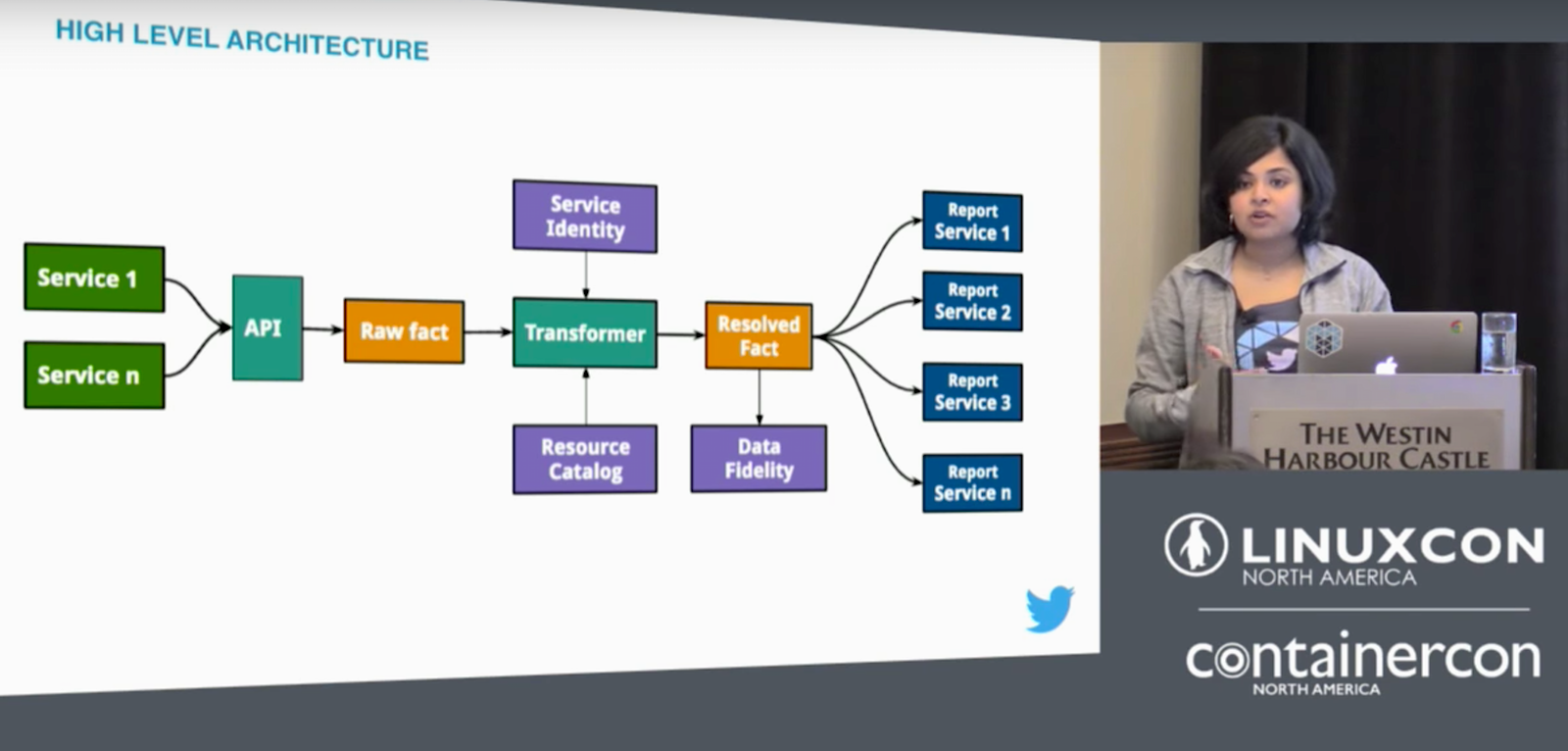
Vinu Charanya describes the Chargeback system that they built to address these problems. She says, “Chargeback provides the ability to track and measure infrastructure usage on a per engineering team basis and charge each owner their usage cost accordingly. Keeping this in mind as we started designing the system, we identified the top four challenges.

“Number one: service identity. We designed a generic service identification abstraction that provides a canonical way to identify a service across infrastructures.

“Number two: resource catalog. We worked with the infrastructure teams to identify and abstract resources that can be published for developers to consume and build.

“Number three: metering. Each infrastructure graphs the consumption of resources by each service through their service identifiers. We built a classic ETL data pipeline to collect all the usage metrics to aggregate and process them in a central location.

“Number four: service metadata. We also built a service metadata system that keeps track of ops and other service-related metadata.”

The end result of Chargeback is three reports for users: a Chargeback bill, an infrastructure profit-and-loss report, and a budgeting report.

Chargeback not only gives Twitter teams measurements of their resource usage and real-world costs, it is also an amazing tool for understanding exactly what is happening inside this huge, fast-moving, interdependent system. Watch Charanya and Benedict’s talk (below) to learn more about the tools and architecture of this most bleeding-edge of techologies.

LinuxCon videos

Free Webinar: How Shared Development Is Driving the Automotive Industry

The Linux Foundation’s Automotive Grade Linux (AGL) project is hosting a free webinar called “Open Source Automotive: How Shared Development Will Drive the Industry Forward.” The hour-long event, which starts at 11am on Wednesday, November 9, will be led by Dan Cauchy, Executive Director of the Automotive Grade Linux project at The Linux Foundation.

The webinar will reveal how AGL’s Unified Code Base (UCB) 2.0, which was released in July, is bringing together automotive manufacturers and suppliers to develop an open connected car platform that can serve as a de facto standard for automotive computing. The current focus is on in-vehicle infotainment, but this is quickly moving toward more comprehensive digital cockpit and assisted driving technology.

AGL’s UCB is necessary, says Cauchy, because the traditional automotive supply chain model has failed to keep up with digital technology.

“Consumers have come to expect their personal devices to be intuitive and user-friendly, and they want that experience to extend into the vehicle,” Cauchy told Linux.com. “In-car connectivity and infotainment systems have not kept pace with smartphone technology primarily because automotive software is fragmented.

“AGL’s goal is to eliminate this fragmentation by building a single software platform for the entire industry,” he said. “Adopting an open platform will lead to more software reuse, enabling shorter production cycles and more rapid innovation.” 

The webinar is a warm-up for a larger AGL Demonstration Showcase to be held January 4-7 at the CES show in Las Vegas. The showcase will include an AGL Demo Suite held on January 5-6 that will showcase a broader range of application developers who use the AGL/UCB codebase.

AGL announced a new round of members in September, including AutoIO Technology (instrument clusters), Irdeto (security technology), Link Motion (IVI), Pocket Soft (RTPatch software updating tools), sdtech (HMI and system design), and Synopsys (automotive-specific IC design and verification tools, and security software). Automotive security is a common theme among all the new members’ solutions.

More than 40 new companies have joined AGL in the past year, bringing the member total to more than 80. Automotive manufacturers like Ford, Honda, Jaguar Land Rover, Mazda, Mitsubishi Motors, Nissan, Subaru, and Toyota, have been joined by technology companies including Aisin AW, Codethink, Continental, DENSO, Fujitsu Ten, Harman, Mitsubishi Electric, NTT DATA MSE, Panasonic, Pioneer, Qualcomm, Renesas Electronics, Wind River, and others.

UCB 2.0 shipped with new rear seat display, video playback, and audio routing support, as well as a comprehensive application framework. At CES, we’ll see more information on UCB 3.0, which is expected to be released later this year.

“UCB 3.0 is the version we expect to see members put into production,” says Cauchy. “UCB 3.0 will also be the basis for the work we are starting on telematics, instrument cluster, heads up display (HUD), and advanced driver assistance systems (ADAS), which are on our roadmap for 2017.”

Learn more about how AGL and shared development are driving the auto industry forward. Join us Wednesday, Nov. 9, 2016 at 11 a.m. Pacific for this free webinar presented by Dan Cauchy. Register Now >>

Agile, DevOps and the Algorithmic Enterprise

The next big trends for technology leaders today are Agile, DevOps, and becoming data-driven ‘algorithmic enterprises’.

That’s the opinion of Mike Mason, technology activist and adviser to the CTO at ThoughtWorks. Speaking to Computing recently, Mason explained that an effective data strategy is needed to solve traditional problems around legacy applications and multiple, conflicting data sets.

“Against a backdrop of increasing speed of technological advancement – which is itself a challenge to which IT leaders must respond – the next big shift is to become a data-driven, algorithmic enterprise,” said Mason

Read more at V3

5 Terminal Commands Every Linux Newbie Should Know

I’m a big fan of the anime series Neon Genesis Evangelion. One of the quotes from it that stands out in my head is, “Man fears the darkness, and so he scrapes away at the edges of it with fire.” For newcomers to the world of Linux, the black screen of the terminal can seem like a deep, foreboding darkness, which is desperately replaced by a GUI whenever possible. It doesn’t have to be that way.

A graphical user interface makes modern computing more enjoyable and easier to use the majority of the time. After all, placing an Amazon order using a text-mode browser in a terminal sounds like an over-enthusiastic exercise in masochism. We like our GUIs and graphical browsers, but there are times when you’ll find yourself in the world of the command line. Like any new tool, knowing a few basics can keep your blood pressure in check when a GUI fails to start, or you need to perform maintenance.

Read more at PCWorld

How to Generate a Strong Password from the Linux Command Line

Having a strong password is one of the most important things you need to have in order to secure your Linux system. There are a lot of methods for generating a strong password. In this tutorial, you’ll learn how to generate a strong password via the Linux CLI.

If you don’t already have a strong password, pick a method and generate one ASAP.

How to generate a strong password through the command line

Using these command line tools is a secure (and fun) way of generating a strong password.