
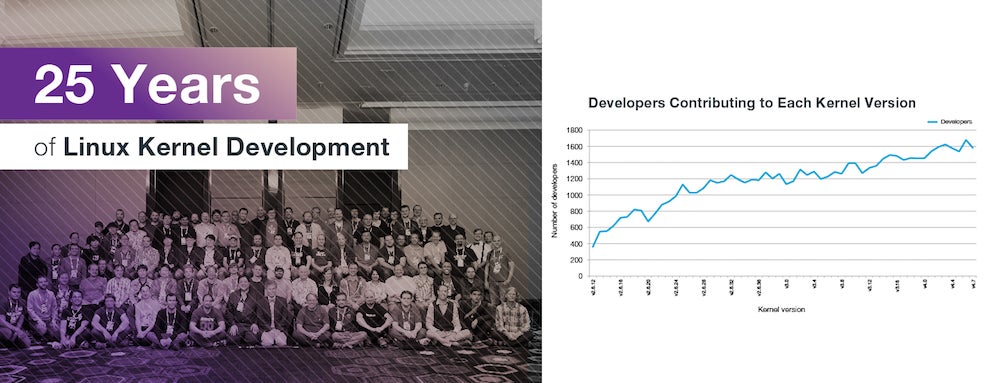
The Linux kernel community came close this year to setting a new record for the number of changes merged in a single release, according to the latest Linux Kernel Development report released today by The Linux Foundation.
Kernel version 4.6 saw an astounding 13,517 patches merged in 63 days — just shy of the record set by version 3.15 at 13,722 patches on June 8, 2014.
But, changes to the kernel kept up their breakneck pace over the past 15 months, with more than 3 million lines of code added to the Linux kernel at a rate of 7.8 changes per hour.
“The ability to sustain this rate of change for years is unprecedented in any previous public software project,” according to the report.
The seventh edition of this report details the developers contributing to the kernel, the companies they work for, and the most significant changes made to the code and the development process since kernel version 3.18. The data mostly covers development since the last report was released in March 2015 — versions 3.19 to 4.7 — but some statistics go back to 2005 when development moved to the Git repository, and even back to Linus Torvalds’ first release in 1991.
Celebrating the 25th Anniversary of Linux
This year the report also reflects on 25 years of Linux kernel development as the Linux and open source community gathers at LinuxCon North America in Toronto Wednesday night for a gala celebration commemorating the day Linus Torvalds first released Linux on Aug. 25, 1991.
At almost 22 million lines of code and a new release happening every 9-10 weeks, the Linux kernel is one of the largest, fastest moving open source projects in the history of technology. It’s also one of the most important as the core of the Linux operating system, which runs most of modern technology — from Android phones and Chromebooks, to nuclear submarines, the space station, global stock exchanges, and much more.
What started as Torvalds’ passion project has evolved over the past 25 years into a collective effort to build and maintain the code by thousands of developers employed by hundreds of companies.
“Clearly, the kernel developers are doing something right,” reads the report. “This report provides an update on what those developers have been doing and why they continue to be successful.”
Here are some of the highlights from the report, compiled from Git and analyzed by LWN Editor Jon Corbet and Linux kernel maintainer and Linux Foundation Fellow Greg Kroah-Hartman. Download the full report for more in-depth data and analysis.
2015-2016 Linux Kernel Development Highlights
From the report:
-
Almost 115,000 changesets have been merged since the 3.18 release on Dec. 7, 2014.
-
Contributions came from 5,062 individual developers representing nearly 500 corporations.
-
2,355 of those developers were first-time contributors
-
New features include support for live patching of the kernel, support for persistent-memory devices, encrypted storage for the ext4 filesystem, numerous networking enhancements with a focus on IPv6 and data-center improvements, and much more.
-
The “zero-day build and boot robot” testing system found nearly 400 bugs (all of which were fixed).
-
The busiest development cycle was kernel 4.6 with 13,517 patches merged — just shy of the record set by version 3.15 at 13,722 patches.
The top 10 developers contributing changes to the kernel were:
Name                         Number of changes
H Hartley Sweeten            1,456
Geert Uytterhoeven           1,036
Arnd Bergmann                  877
Al Viro                        782
Takashi Iwai                   735
Lars-Peter Clausen             729
Mauro Carvalho Chehab          714
Ville Syrjälä                  707
Linus Walleij                  661
Dan Carpenter                  631
The top 10 companies, which employ kernel developers to contribute to the Linux kernel, make up nearly 57 percent of the total changes to the kernel. The category “none,” which represents volunteer developers who aren’t paid by any company, fell to the No. 3 spot this year from No. 1 in the last report issued in 2015. And Renesas moved up in the rankings from No. 13, replacing Texas Instruments at No. 10. A large portion of development continues to be developers of unknown corporate affiliation, who typically contribute 10 or fewer changes.
Company                Changes    Percent of total
Intel                  14,384     12.9%
Red Hat                 8,987      8.0%
None                    8,571      7.7%
Unknown                 7,582      6.8%
Linaro                  4,515      4.0%
Samsung                 4,338      3.9%
SUSE                    3,619      3.2%
IBM                     2,995      2.7%
Consultants             2,938      2.6%
Renesas Electronics     2,239      2.0%
Download the full report: “Linux Kernel Development: How Fast It is Going, Who is Doing It, What They Are Doing and Who is Sponsoring the Work”