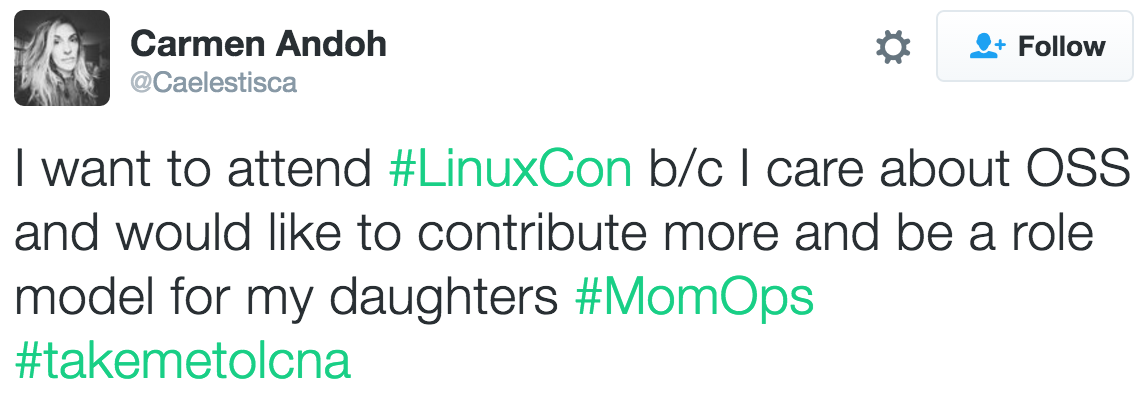
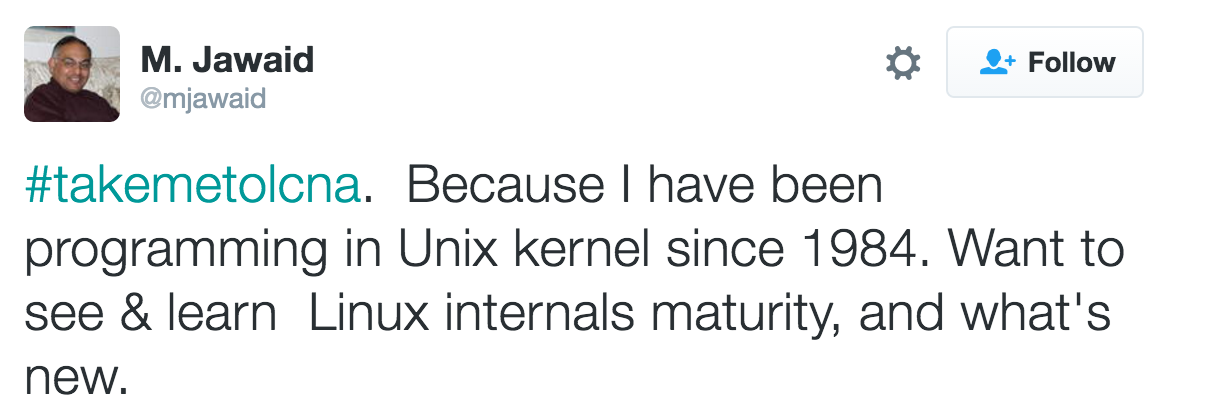
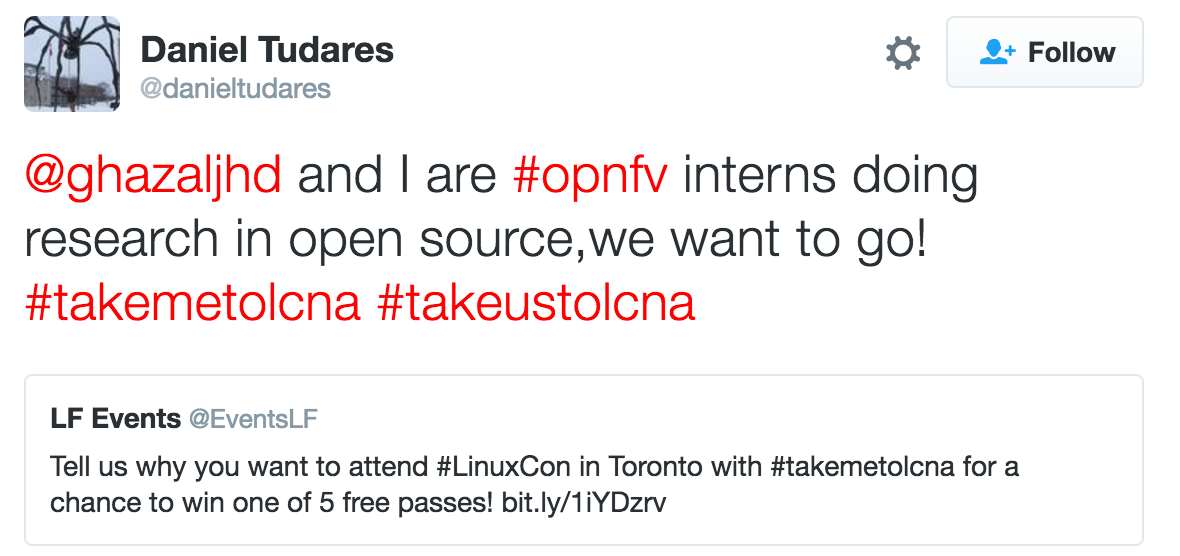
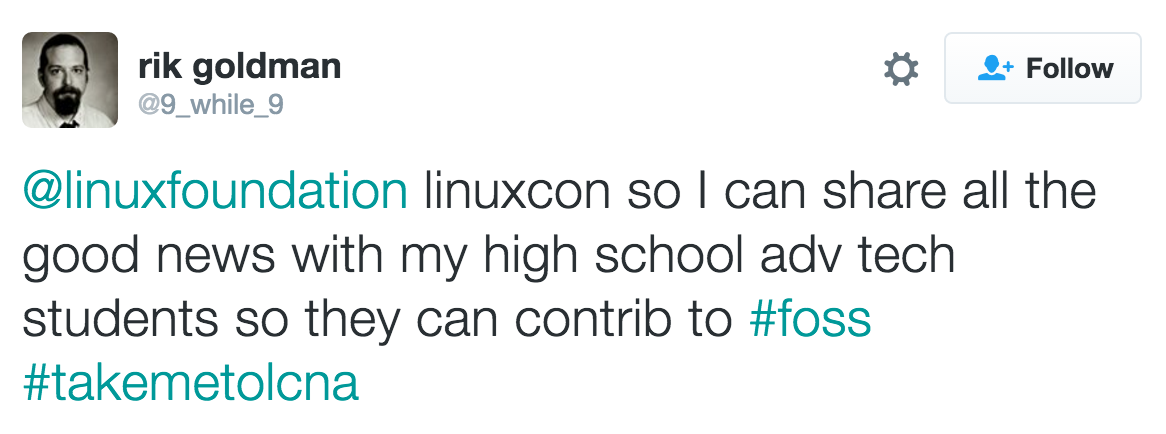
With LinuxCon North America approaching quickly (August 22!), The Linux Foundation is in preparation and invitation mode. This year, the organization is especially keen on opening up the event and its benefits to diverse communities. One such effort recently took place on Twitter.
During the week of June 15, @linuxfoundation asked their followers to request a free VIP all-access pass by tagging #takemetolcna (that’s Take Me to LinuxCon North America) and explaining why they should win.
Many great responses were tweeted and The Linux Foundation chose five very worthy guests. Here’s what the winners had to say:
There’s been much progress in transforming enterprise networks, but not enough organizations equate advances in software-defined networking (SDN) with increased business agility, according to a new survey from Juniper Networks and Wakefield Research of 2,700 IT decision makers (ITDMs) and business decision makers (BDMs).
Most organizations operate two networking environments. One based on SDN technology tends to be highly automated. The other is based on legacy networking technology that requires each piece of networking equipment to be manually configured. The biggest challenge in shifting to SDNs is available budget.
Mark Imbriaco has spent the past 20 years working at some of the most interesting and innovative companies in the industry, including 37Signals, GitHub, and DigitalOcean before moving on to become Co-Founder and CEO at Operable. You can also find him talking about various DevOps topics at conferences and elsewhere online.
Linux.com: Why are so many organizations embracing DevOps?
Mark Imbriaco is Co-Founder and CEO at Operable.
Mark Imbriaco: This is a tough question to answer because there are so many factors involved. In the end, the movement toward DevOps is not caused by any sort of inherent altruism in organizations but rather as a reaction to increasing demands to deliver more software, more quickly, and with fewer resources.
DevOps is focused on reducing friction and improving collaboration through the entire software delivery cycle. As more and more organizations see successful outcomes with this approach, it only becomes an easier sell. After all, it’s pretty intuitive that working collaboratively throughout the process is more efficient than attempting to coordinate across silos of development, QA, and operations at the last minute before a release.
Linux.com: Why are individuals interested in participating?
Mark: People like to feel empowered and like their voices are being heard. The collaborative nature of DevOps ensures that everyone involved in a project has the opportunity to contribute their point of view and ideas to have a positive impact even in areas that may not have traditionally been their department.
Linux.com: What’s the primary advantage of DevOps?
Mark: There is, at this point, a significant body of evidence that shows that agile, iterative development processes are able to significantly improve both the rate of software development and the ultimate quality. Rather than minutely specifying all of the details up front, practitioners of an iterative approach are able to continually learn by delivering small units of functionality and preserve the ability to adapt to what they learn along the way.
It turns out that this iterative approach is just as useful operationally. The result is systems that can be deployed more quickly, managed more effectively, and which incorporate feedback mechanisms to enable learning as a core feature.
Linux.com: What is the overwhelming hurdle?
Mark: The biggest barrier is in the variability of implementation. DevOps is not something you can buy, and no two organizations will wind up with the same implementation details in the end. This lack of a linear implementation plan can be daunting to those who are intrigued by the ideas but are already overwhelmed by a mountain of work.
The good news is that the same iterative approach that DevOps suggests for delivering projects works for adoption of the methodology as a whole.
Linux.com: What advice would you give to people who want to get started in DevOps?
Mark: As with anything, start as small as you can. Choose a small project or a new feature delivery as a testbed for a new methodology. Resist the urge to make a big splash by attacking a high profile project and apply the same iterative approach that DevOps and Agile advocate for software delivery to the delivery of changes to your human systems.
Finally, never stop learning. The real power of DevOps is the ability to continuously learn and immediately apply knowledge. The more you and your team can internalize that idea, the better your outcomes will be.
A number of assumptions and myths have sprung up around NFV during the past few years, all of which are worth unpicking.
The transition toward network functions virtualization (NFV) is in progress and, as with any technology transition, companies are proceeding with caution. The trick is figuring out which anticipated hazards are real, if any of those have already been cleared, and making sure you don’t get frozen by hazards you anticipated but which failed to materialize.
Make no mistake, the course ahead is tricky. Evangelists for new technologies can get overly enthusiastic, envisioning everyone at the finish line before anyone has cleared all the technological barriers. And then there are those companies who take off without surveying the course ahead — they’re the ones that bumble into hurdles they could have anticipated if they’d simply prepared better.
The Automotive Grade Linux (AGL) project announced the release of its Unified Code Base 2.0, implementing new in-vehicle entertainment support desired by automakers and drivers.
The new code base adds support for audio routing, rear-seat entertainment systems and apps. It follows the version 1.0 release at CES earlier this year. Automotive infotainment systems, which usually combine navigation, digital audio, hands-free phone calling and third-party apps, have been developed by automakers and equipment suppliers alike, leading to fragmentation and disparate interfaces unique to each brand of vehicle. AGL attempts to make a unified dashboard operating system, freeing automotive software engineers from individual platform development.
Among the vendors that are working on enabling OpenStack to run as a set of containers is Miranits, which is currently developing a new version of its Fuel platform to make use of Kubernetes. To date, Fuel has heavily relied on Puppet configuration management technology to help enable many functions. Moving forward, Puppet will still be a part of future Fuel releases, though not quite in the same depth as before.
As the population of DevOps practitioners grows greater in size, so does the Linux container userbase, as these often go hand in hand. In the world of Linux container implementations, Docker is certainly the most popular for server-side application deployments as of this writing. Docker is a powerful tool that provides a standard build workflow, an imaging format, a distribution mechanism, and a runtime. These attributes have made it a very attractive for developer and operations teams alike as it helps lower the barrier between these groups and establishes common ground.
In part one we learned about data and how it can be used to find knowledge or meaning. Part two explained the term Big Data and showed how it became an industry mainly in response to economic forces. This is part three, where it all has to fit together and make sense — rueful, sometimes ironic, and occasionally frightening sense. You see our technological, business, and even social futures are being redefined right now by Big Data in ways we are only now coming to understand and may no longer be able to control.
Whether the analysis is done by a supercomputer or using a hand-written table compiled in 1665 from the Bills of Mortality, some aspects of Big Data have been with us far longer than we realize.
The dark side of Big Data. Historically the role of Big Data hasn’t always been so squeaky clean. The idea of crunching numbers to come up with a quantitative rationalization for something we wanted to do anyway has been with us almost as long as we’ve had money to lose.
We think we’re doing the whole DevOps thing right — new hires can deploy on day one, Travis CI is humming along, and we own the code we ship. But then something breaks, something doesn’t go according to plan, tempers flare up, and all that warm, fuzzy collaboration seems to evaporate. What’s going on? What happened to #HugOps?
A large part of software engineering doesn’t involve code at all— it’s talking and collaborating with our teammates. Soft skills are harder to measure and quantify than performance or reliability, but they’re just as important— and while we’ll readily spend hundreds to thousands of dollars on books, courses, and training to improve our software skills, companies rarely invest in creating the culture of empathy and compassion that was behind DevOps in the first place.
As an open source professional, even if you have the technical chops required for a position, it doesn’t necessarily mean you are a “shoe-in” for the role. Surprisingly, what many don’t know is that what sets you apart from other candidates in the interview process is your soft skills. Finding a professional who has the technical skills to handle a job can be difficult, but finding a professional who has both the technical skills required and the personal attributes that enable collaboration with team members can even more challenging.
For open source professionals looking to move, improving some of your soft skills is a great way to make yourself indispensable to employers. Focusing on these skills allows you to still grow professionally and attract potential employers without having to go through the formal training methods required to learn some of the more technical skills. In particular, pay specific attention to some of the skills listed below, as they were found to be amongst the top soft skills employers on Dice requested from open source professionals:
Communication:Having strong communication skills is perhaps the most important soft skill you can have. On any given day, approximately 23% of all job postings on Dice request professionals who are good communicators. On a tech team, you are bound to run into colleagues with different working styles. What is important is knowing how to adjust to their styles and communicate with them in a way that fosters strong working relationships and drives productivity within your team.
Teamwork:As an open source professional, a lot of the work that you do is team-oriented. Take for example, a software developer. Software isn’t designed and deployed through the hard work and expertise of one. It requires the work of a team to successfully build and launch applications and products. For Devops professionals, being a team player can be even more important, with collaboration needed between development, operations and testing in order to streamline software delivery and tech infrastructure changes. Therefore, knowing how to be a team player, is key, with roughly 2,000 Dice job postings on any given day advertising for professionals with this skillset.
Mentoring:Being a strong professional doesn’t just mean developing your own skills, it also involves helping others grow. It should come as no surprise then that hiring managers and recruiters on Dice are looking for professionals with extensive mentoring and leadership experience. Being a good mentor is particularly important for mid-senior level managers who are in charge of a team of professionals. Having strong leadership skills is crucial to your team’s success. Thus, employers are more selective when looking to fill management positions.
Problem Solver:The 2016 Open Source Jobs Report found that working on the most cutting edge technology challenges was one of the top reasons why tech professionals sought a career in open source. It’s a good thing that they are up to the challenge because as companies build out their tech infrastructure, they need open source professionals who can handle these changes and solve complex tech concerns. For that reason, employers seek out individuals who are problem solvers. They need people who are quick on their feet, can work well under pressure and are adaptable.
Being skilled technically is key if you want to have a successful career as an open source professional. However, it is not everything. For professionals looking to move, supplementing your technical skills with strong soft skills is what “puts you over the top” during the hiring process. As an open source professional with both technical and soft skills under your belt, you are a must have for all employers looking to add to their talent roster.
Bob Melk serves as the President of Dice, overseeing the growth strategy, product, marketing and sales of the company.