
Home Blog Page 788

Univa Brings Supercomputer Scheduling to Kubernetes

As the market about container scheduling heats up, Univa, workload management specialists from the high-performance computing (HPC) market, are among those entering the ring. Earlier this month, the company demonstrated Navops Command, a pluggable, automated workload placement and policy management solution for Kubernetes, at OSCON conference in Austin, Texas.

“Navops Commands big differentiator is its rich policy management which allows a Kubernetes admin to have a lot more control over what runs where when, said Robert Lalonde, vice president and general manager of Navops. NavOps Command offers Kubernetes-enhancing features access control, fair share resource placement, workload prioritization, pre-emption, and a variety of placement policies provide for enterprise-grade scheduling.


Read more at The New Stack
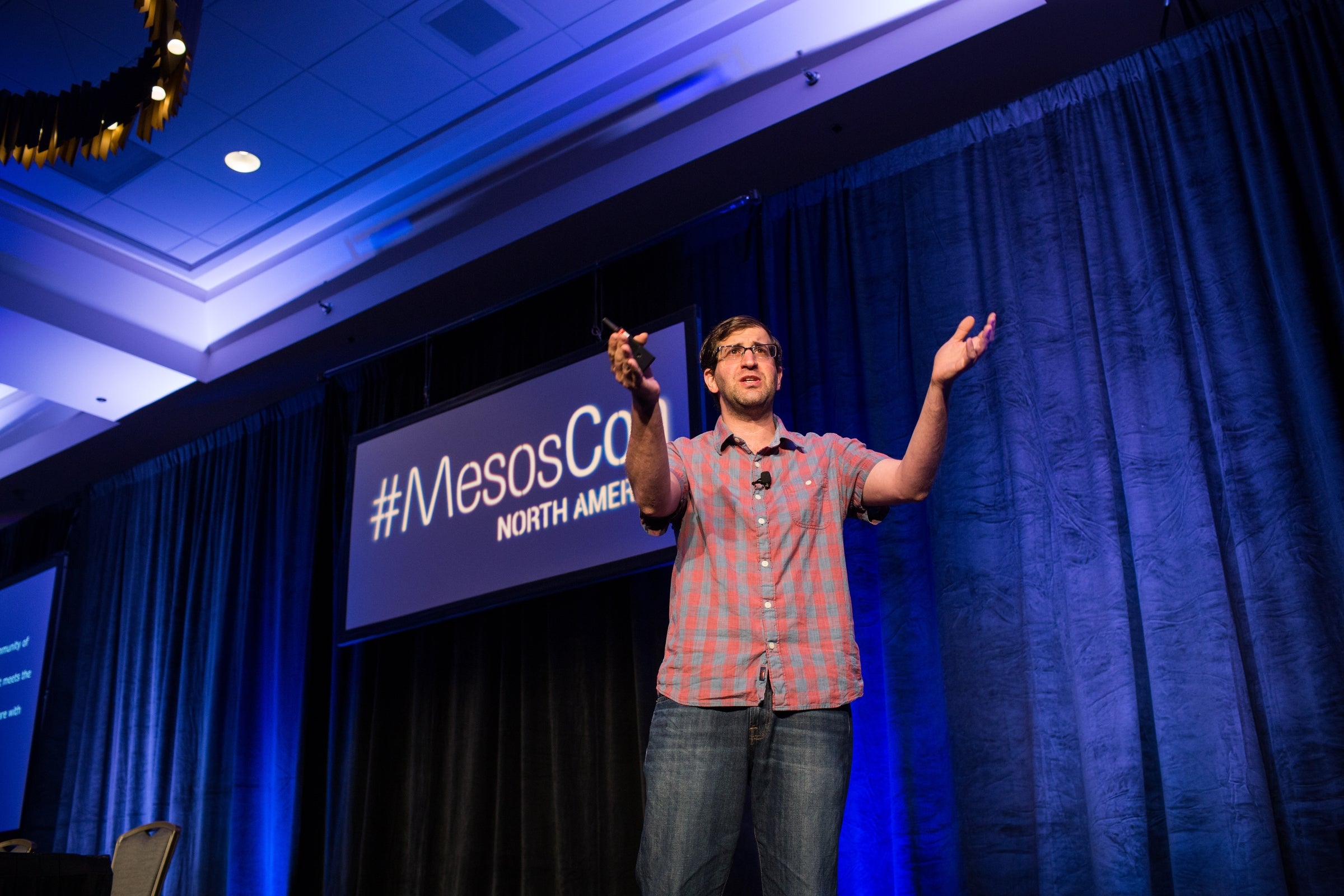
Watch Apache Mesos Keynotes Live Today at MesosCon

Can’t make it to MesosCon North America this week? The Linux Foundation is pleased to offer free live video streaming of all keynote sessions on June 1-2, 2016.

The Apache Mesos conference going on in Denver is a veritable who’s who from across the industry of those using Mesos as a framework to develop cloud native applications. MesosCon is a great place to learn about how to design application clusters running on Apache Mesos from engineers who have done it.

Tune in at 9 a.m. Mountain Time today, June 1, to watch Benjamin Hindman (@benh), the co-creator of Apache Mesos, give the welcome address. And, at 10:15 MT, Craig Neth (@cneth), distinguished member of the technical staff at Verizon, will walk attendees through how they got a 600-node Mesos cluster powered up and running tasks in 14 days.

On June 2, the event features a special keynote from Matei Zaharia, VP of Apache Spark, and keynotes from Twitter, Mesosphere, and EMC. See the full agenda of keynotes here, and sign up for the livestream. While you watch, we encourage you to join the conversation on Twitter using #mesoscon.

By signing up, you’ll also be the first to get notified when the recordings of the keynotes and more than 50 sessions, become available.

Once you sign up, you’ll be able to view the livestream on this page. If you sign up prior to the livestream day/time, simply return to this page and you’ll be able to view.

linux-com_ctas_mesosconna_452x121_final.png?itok=jfAjYJN3

Announcing the Open Source License API

Over the last 19 years, the Open Source Initiative (OSI) has been the steward of the Open Source Definition (or OSD), establishing a common language when discussing what it means to be an Open Source license, and a list of licenses which are known to be compatible with the OSD.

This is taken to its logic next step this year, with the OSI providing a machine readable publication of OSI approved licenses at api.opensource.org. This will allow third parties to become license-aware, and give organizations the ability to clearly determine if a license is, in fact, an Open Source license, from the authoritative source regarding Open Source licenses, the OSI.

Read more at OSI

Linus Torvalds Announces Linux Kernel 4.7 RC1 with a Big Change to the VFS Layer

It’s Sunday, and it has been two weeks since the release of the Linux 4.6 kernel, so the time has come for Linus Torvalds to introduce us to the development cycle of the next major kernel branch.

Yes, we’re talking about Linux kernel 4.7, which has just received its first Release Candidate (RC) build. It allows the community to download it, compile it for their GNU/Linux systems, and take it for a long weekend test drive, especially now that the merge window has finally been closed by Mr. Torvalds, probably a little bit earlier than expected.

Read more at Softpedia

How to Scan for Rootkits, backdoors and Exploits Using ‘Rootkit Hunter’ in Linux

Guys, if you are a regular reader of tecmint.com you will notice that this is our third article on security tools.

In our previous two articles we have given you all the guidance in how to secureApache and Linux Systems from MalwareDOS and DDOS attacks using mod_security and mod_evasive and LMD (Linux Malware Detect).

Again we are here to introduce a new security tool called Rkhunter (Rootkit Hunter). This article will guide you a way to install and configure RKH (RootKit Hunter) in Linux systems using source code.

[[ This is a content summary only. Visit my website for full links, other content, and more! ]]

3 Things Infrastructure as Code Is Not

The role of the network engineer is changing. This is not a result of DevOps, although some would claim it is. As DevOps takes center stage in organizations, it can seem like network engineers are being asked to become developers.

There have been a number of talks discussing this, some of which have surfaced at Interop Las Vegas. The shift has been Infrastructure as Code (IaC), which was fundamental to the start of the DevOps movement. So maybe you could say this is caused by DevOps.

IaC is providing an approach to employ code to the Ops infrastructure. Companies like Ansible, Chef, Puppet, and Cumulus Networks have made this shift possible. The tools provided by these companies have made the DevOps culture possible, and IaC is a large result of this.

Read more at DZone

PSAD Installation and Configuration on Debian 8 (Jessie)

In this tutorial, I will show you the installation and configuration of the PSAD (Port Scan Attack Detection) tool on Debian 8 (Jessie). PSAD provides intrusion detection and log-analysis with IPtables (Linux firewall).

How to Install PHP 7 for Apache or Nginx on Ubuntu 14.04 and 14.10

Months after the stable version of PHP 7.0 was released, this could be the right time for you to think of upgrading to it from the old versions. There is always caution about upgrades…

[[ This is a content summary only. Visit my website for full links, other content, and more! ]]

Set up VM to connect Tripleo QuickStart Overcloud via Virt-manager GUI

Set up Gnome Desktop && VirtTools on Virtualization Server ( VIRTHOST ) and make remote connection to Virt-manager running on  VIRTHOST (192.168.1.75). Then create VM via virt-manager as follows using standard CentOS 7.2 ISO image , I am aware of post Connecting another vm to your tripleo-quickstart deployment at oddbits.com and manage this way deliberately.  Just wondering is it possible to get results similar to obtained by LarsKS ( via in depth knowledge virsh CLI and Libvirt features)  with Virt-manager GUI  intuitively much more affordable. I realize that speed and flexibility of approach suggested bellow are losing the aforementioned  
 

Complete text may be viewed here http://bderzhavets.blogspot.com/2016/05/set-up-vm-to-connect-tripleo-quickstart.html


SD-WAN Demands Different Network Monitoring

ThousandEyes, a company that does network monitoring, says software-defined wide-area networking (SD-WAN) is making visibility more difficult, so it has created agent-to-agent tests to make it easier to pinpoint issues in both the forward and reverse paths.

SD-WAN is becoming a popular technology for organizations looking to manage multiple Internet connections, but “it’s introducing new variability in routing,” says Nick Kephart, senior director of product marketing at ThousandEyes. “Now, if you need to troubleshoot, you need a more detailed perspective.”

Prior to SD-WAN, a typical WAN connection might be a single leaf from one provider. But with SD-WAN, traffic can move through different networks in each direction.

Read more at SDxCentral.