Late last year, Facebook enhanced the performance of its Android application with a byte-code-optimizing tool called ReDex.
Now, ReDex has been open-sourced. Android developers can use the tool to optimize their own apps at no charge. They can also use it as the basis for other Android byte code optimizers. In a post on Facebook’s engineering blog, the company explained that classes in a .DEX file — the executable format used in Android — aren’t organized by how they’re accessed when the application starts, but simply by the order the build tooling encountered them.
Today, April 12, 2016, renowned Linux kernel developer Greg Kroah-Hartman has announced the release of the first maintenance build of the Linux 4.5 kernel series.
We’ve been asked several times in the last couple of weeks when Linux kernel 4.5 will get its first point release, version 4.5.1. So here it is, and just by looking at the appended shortlog, we can tell that it’s a big one, bringing changes to a total of 230 files, with 2,358 insertions and 1,265 deletions.
“I’m announcing the release of the 4.5.1 kernel. All users of the 4.5 kernel series must upgrade,” said Greg Kroah-Hartman.
After four months, the certificate authority is ready to bring free encryption to even more webmasters.
The certificate authority (CA) announced on Tuesday that the Let’s Encrypt program has left the beta stage of testing after four months, having issued over 1.5 million HTTPS certificates to approximately three million websites worldwide. Transport Layer Security (TLS) certificates are implemented on websites to add a layer of encryption and additional security to communication between a user and website server. Without this layer, communication and transactions are more vulnerable to surveillance, drive-by attacks and potentially data theft.
In its bid to make Cassandra the go-to database of choice for a wide array of uses, DataStax is launching DataStax Enterprise (DSE) Graph, a scale-out graph database for cloud applications based on Cassandra and additional graph database technology the company acquired last year.
For the new product, the company pulled together the expertise from its acquisition of Aurelius, the folks behind TitanDB, and Apache TinkerPop, a graph computing framework for both graph databases (OLTP) and graph analytic systems (OLAP).
IBM, Amazon, Blazegraph and others have products using TinkerPop, an API technology that DataStax donated to the Apache Software Foundation. However, DataStax bills DSE Graph as the only scalable real-time graph database. DSE Graph will be generally available by July.
A new Node.js Foundation survey shows full stack demand for Node.js, along with developers using it with containers and for IoT development.
The Node.js Foundation, a consortium of organizations fostering the development of the Node.js platform, today announced the results of its first Node.js User Survey Report. Node.js is an event-driven server-side JavaScript development environment based on Google’s V8 JavaScript engine. Mikeal Rogers, community manager for the Node.js Foundation, said there are more than 3.5 million Node.js users. And with an annual growth rate of 100 percent, Node.js is emerging as a universal platform used for Web applications, the Internet of things (IoT) and the enterprise, he said. The foundation interacts regularly with Node.js developers but decided to conduct a survey to take a more definite pulse of what developers are doing with Node, Rogers said.
A previous article on next-generation cloud technologies listed container orchestration as one of the emerging technologies to know. As the use of containers increases and organizations deploy them more widely, the need for tools to manage containers across the infrastructure also increases. Orchestrating a cluster of containers is a competitive and rapidly evolving area, and many tools exist offering various feature sets.
Container orchestration tools can be broadly defined as providing an enterprise-level framework for integrating and managing containers at scale. Such tools aim to simplify container management and provide a framework not only for defining initial container deployment but also for managing multiple containers as one entity — for purposes of availability, scaling, and networking.
Some container orchestration tools to know about include:
Amazon ECS — The Amazon EC2 Container Service (ECS) supports Docker containers and lets you run applications on a managed cluster of Amazon EC2 instances.
Azure Container Service (ACS) — ACS lets you create a cluster of virtual machines that act as container hosts along with master machines that are used to manage your application containers.
CoreOS Fleet — Fleet is a container management tool that lets you deploy Docker containers on hosts in a cluster as well as distribute services across a cluster.
Docker Swarm — Docker Swarm provides native clustering functionality for Docker containers, which lets you turn a group of Docker engines into a single, virtual Docker engine.
Google Container Engine — Google Container Engine, which is built on Kubernetes, lets you run Docker containers on the Google Cloud platform. It schedules containers into the cluster and manages them based on user-defined requirements.
Kubernetes — Kubernetes is an orchestration system for Docker containers. It handles scheduling and manages workloads based on user-defined parameters.
Mesosphere Marathon — Marathon is a container orchestration framework for Apache Mesos that is designed to launch long-running applications. It offers key features for running applications in a clustered environment.
Additionally, the Cloud Native Computing Foundation (CNCF) is focused on integrating the orchestration layer of the container ecosystem. The CNCF’s stated goal is to create and drive adoption of a new set of common container technologies, and it recently selected Google’s Kubernetes container orchestration tool as its first containerization technology.
You can learn more about Container Orchestration and other next-gen cloud technologies through The Linux Foundation Training free “Cloud Infrastructure Technologies” course — a massively open online course being offered through edX. Registration for this course is open now, and course content will be available in June.
Nginx is making its commercially supported enterprise Web server more extensible, providing interoperability for add-on modules that have previously been used only with the open source version of the server.
Nginx Plus R9, debuting today, uses the new Dynamic Modules feature to work with more than 100 modules for capabilities like Web security, authentication, and integrating third-party languages. Nginx will host a repository and support the modules, ensuring they have been properly compiled and tested, Owen Garrett, Nginx head of product, said.
Freely available tool derives password used to corrupt master boot record.
A nasty piece of ransomware that took crypto-extortion to new heights contains a fatal weakness that allows victims to decrypt their data without paying the hefty ransom. When it came to light two weeks ago, Petya was notable because it targeted a victim’s entire startup drive by rendering its master boot record inoperable. It accomplished this by encrypting the master boot file and displaying a ransom note. As a result, without the decryption password, the infected computer wouldn’t boot up, and all files on the startup disk were inaccessible. A master boot record is a special type of boot sector at the very beginning of partitioned hard drive, while a master boot file is a file on NTFS volumes that contains the name, size and location of all other files.
When Google released Android Studio 1.0 integrated development environment (IDE) back in 2013, it was welcomed as a substantial improvement over Eclipse. Yet, Apple’s Xcode tools for iOS has been widely considered to be superior. With the recent release of Android Studio 2.0, however, Google may have flipped the equation.
Android Studio 2.0 introduces a much faster emulator, as well as an “Instant Run” feature for quickly testing minor code changes. Version 2.0 also adds a Cloud Test Lab service, plus an improved GPU Developer debugger and an app indexing feature.
The IDE continues to fill the gap between high-end Android SDK and Native Development Kit (NDK) tools and a variety of cross-platform Android-compatible, mobile app frameworks like Onsen, Kendo UI, and Sencha Touch. Unlike these mostly JavaScript- and HTML5-focused programs, as well as alternatives like Qt and Microsoft’s Xamarin, Android Studio can only be used to develop Android apps. Yet, it also supports Android Auto, Android Wear, and Android TV in addition to mobile apps.
Android Studio 2.0 arrived a month after Google released the first developer preview for the upcoming Android N, which is expected to arrive fully baked in the third quarter, possibly to be dubbed Android 7.0. Android N provides the first native Android support for split screens, and offers improvements to notifications and power-saving.
Like Android Studio 2.0, Android N is built around Java 8. Yet, Java’s domination of Android may be in jeopardy. The Next Web reports that Google is considering transitioning Android from Java to Apple’s open source Swift language (see farther below).
Android Studio 2.0 speeds testing and emulation
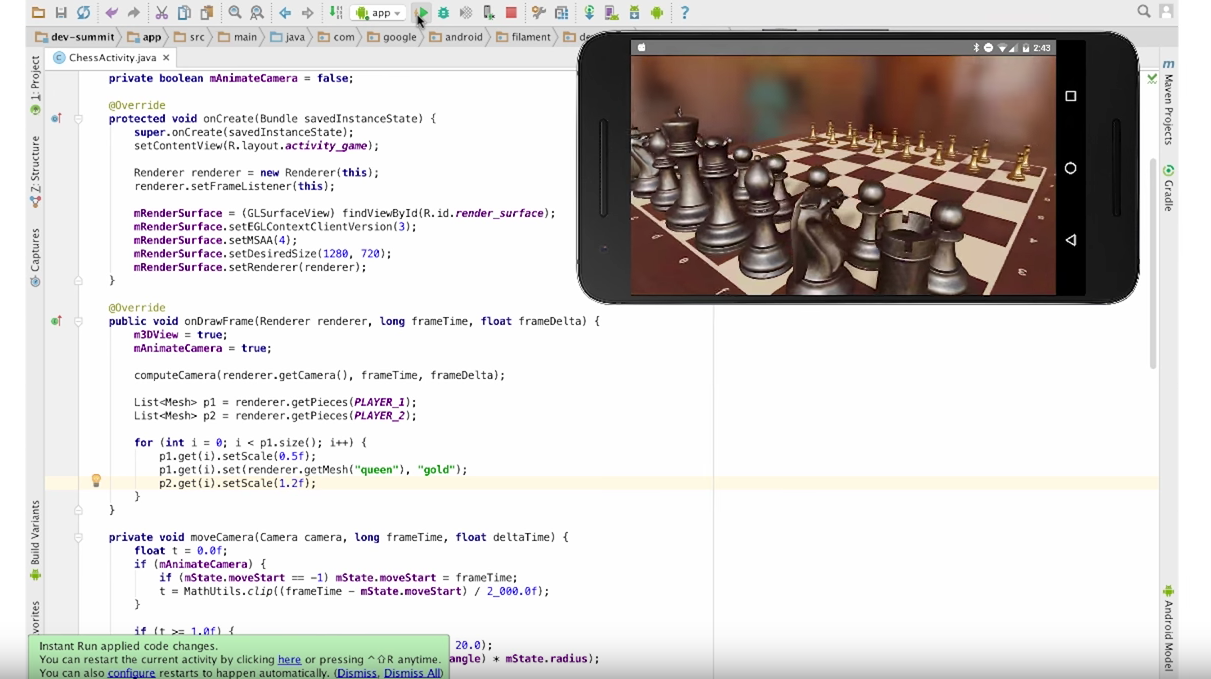
The previously previewed Instant Run feature is ready to roll in Android Studio 2.0. This time-saving extension to the run and debug commands uses a VM swap feature that sends only code that has changed for testing on an emulated device without requiring a recompile or a reinstallation of the APK.
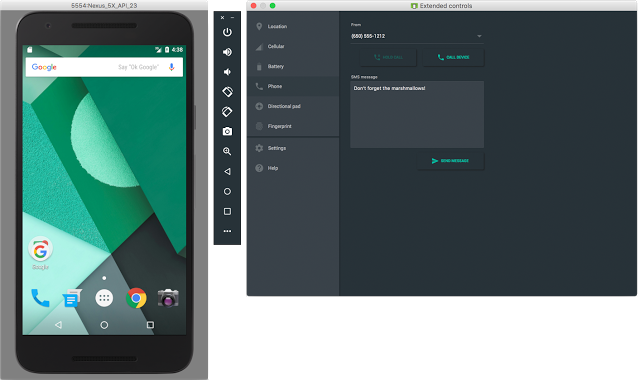
Android Studio 2.0 introduces a much faster emulator.
Instant Run “may take longer to complete,” according to the release notes, but after that, minor changes can be tested much more quickly, accelerating edit, build, and run cycles. Based on the changes indicated, Android Studio automatically determines whether to use hot, warm, or cold swaps. With a hot swap, you can update a live, running app, whereas a warm swap requires a restart of the activity and a cold swap needs an app restart.
The feature is optimized for the newly enhanced Android Emulator, which is claimed to run about three times faster than the original. This is largely due to the fact that it’s now optimized for multi-core system-on-chips. With ADB enhancements in the build cycle, “you can now push apps and data 10x faster to the emulator than to a physical device,” says Google.
Other emulator improvements include new features for testing battery, network, GPS, and phone calls, as well as integrated Google Play Services for checking additional API functions. The overhauled interface features drag and drop APKs, plus support for multi-touch actions and easier window resizing and rescaling, says Google.
After using Android Emulator, you can turn to a new physical emulation service called Cloud Test Lab. The currently free service lets developers test an app across a wide range of real-world devices and device configurations hosted on Google servers.
Android Studio 2.0 adds an App Indexing API that helps to improve app search and discovery. The feature helps developers devise the best URL structure for their app code, as well as add attributes to AndroidManifest.xml to streamline indexing.
Finally, if you’re developing OpenGL ES based games or other graphics-rich apps, you can check out the GPU debugger, which is debuting in a preview release. The debugger enables the debugging of graphics rendering problems frame by frame, and supplies “rich information about the GL state,” says Google.
As before, Android Studio provides an IntelliJ IDEA-based Java code editor, now updated to IntelliJ 15. Android Studio continues to offer a Gradle-based build system and ProGuard tools for manipulating code. Once again, there’s a GUI layout editor, template based wizards and preview layouts for multiple screen configurations.
Is Google switching from Java to Swift?
The same week Android Studio arrived, the future of Java development for Android came into question. The Next Web cited unnamed sources claiming Google is considering elevating Apple’s Swift to be a “first class” language for Android alongside Java. Swift, which was adopted by Apple for Xcode as a more user-friendly replacement for the gnarly Objective C, was open sourced in December.
According to the story, Swift won’t replace Java, at least initially. Yet, Swift will be ready to step in in case Google’s six-year long, Java-related legal battle with Oracle continues to tip toward Larry Ellison’s lawyers. Oracle recently demanded a staggering $8.8 billion in damages for the case, which resumes in early May.
In late December, Google quietly replaced its own implementation of standard Java libraries in favor of Oracle’s open source OpenJDK. Google pitched the move as a step toward openness that will make life easier for Java developers. Yet, it may also be a way to minimize potential legal damages from the Java lawsuit, possibly as part of a longer transition to Swift.
The object-oriented Swift has other benefits aside from not being under litigation. It’s open source and optimized for mobile, and generally considered to be easy to use and strong on safety-oriented features. Sharing the same programming environment with iOS should streamline cross-platform development.
Swift has been adopted by companies ranging from IBM to Lyft, and Facebook and Uber are also said to be expanding its use. Yet, it would be harder for Google to switch Android to Swift, says The Next Web. Among other hurdles, Google would need to create a runtime for Swift and find a way to bridge it to Android’s low-level C++ APIs.
Meanwhile, Java has plenty going for it, and the language got a boost last October when Microsoft’s Xamarin acquired RoboVM and its Java-based technology. Another possibility mentioned by The Next Web’s sources is that Google will move to the Java-friendly, yet Swift-like Kotlin, which is already supported by Android Studio.
There’s been grumblings about a growing fork of OpenELEC the past few weeks while today two Phoronix readers wrote in with news of LibreELEC, the new fork of OpenELEC as a Kodi/XBMC appliance Linux distribution that has a number of the original OpenELEC developers involved.
While the post is dated from the end of March, you can see the LibreELEC announcement here.