We’ve all been in this situation were we want to exchange files with other users connected to the same network as we are, and while there are tons of ways to do this, almost none of them is easy, quick, or simple enough. Thankfully, though, Linux users can utilize a small tool called “woof” that simplifies the process and makes the exchanging of files a walk in the park. What I am about to present in this short tutorial is suitable for home networks where convenience is the primary concern, and security isn’t an issue.
Acecard – One of Today’s Most Dangerous Android Trojans
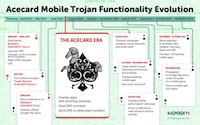
Acecard evolved from a simple information stealer to the most sophisticated Android banking trojan ever seen. The Android malware scene has a new top threat if we are to believe the security researchers from Kaspersky Lab, who identified during the past months a massive campaign being carried out using the once-benign Android Acecard malware family.
First spotted in February 2014, Acecard was initially a simple sniffer that collected information on its victims, sending it to its C&C server. Many security researchers dismissed the trojan as a simple-minded tool and ignored it,…
Read more at Softpedia
Intel Shows Budget Android Phone Powering Big-Screen Linux
MWC16 Intel is showing what it calls “Big Screen Experience” at Mobile World Congress, an Android smartphone which runs a full Linux desktop when plugged into an external display. The concept is broadly similar to Microsoft’s Continuum for Windows 10 Mobile, but whereas Continuum devices are towards the high end, Intel’s project is aimed, it says, at budget smartphones and emerging markets.
On display in Barcelona is a prototype SoFIA (Smart or Feature Phone with Intel Architecture) smartphone with an Atom x3 processor, 2GB RAM and 16GB storage, and modified to support an external display. Attach keyboard, mouse and display, and it becomes desktop Linux…
Read more at The Register
New Docker Data Center Admin Suite Should Bring Order to Containerization
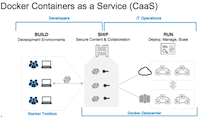
Docker announced a new container control center today it’s calling the Docker Data Center (DDC), an integrated administrative console that has been designed to give large and small businesses control over creating, managing and shipping containers.
The DDC is a new tool made up of various commercial pieces including Docker Universal Control Plane (which also happens to be generally available today) and Docker Trusted Registry. It also includes open source pieces such as Docker Engine. The idea is to give companies the ability to manage the entire lifecycle of Dockerized applications from one central administrative interface.
Read more at TechCrunch
ARM’s Cortex A32 is a Tiny CPU for Wearables and Raspberry Pi-Like Boards
ARM’s Cortex CPU core designs are widely used by all kinds of chipmakers who don’t want to create their own ARM CPU designs from scratch, so it’s important to pay attention when the company announces a new one. The ones we see the most often around here are the mainstream 64-bit cores for smartphones and tablets—the high-end Cortex A72 and A57 and the mid-end Cortex A53—but ARM produces a variety of smaller designs for ultra-low-power and embedded applications, too.
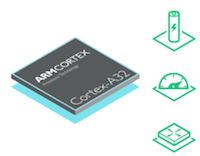
Enter the Cortex A32, a new super-small ARM core designed specifically for wearables, Internet of Things things, embedded systems, low-cost boards like the Raspberry Pi or Pi Zero, and other places where power, space, and cost savings are more important than raw performance.
Read more at Ars Technica
BeeGFS Parallel File System Goes Open Source
Today ThinkParQ announced that the complete BeeGFS parallel file system is now available as open source. Developed specifically for performance-critical environments, the BeeGFS parallel file system was developed with a strong focus on easy installation and high flexibility, including converged setups where storage servers are also used for compute jobs. By increasing the number of servers and disks in the system, performance and capacity of the file system can simply be scaled out to the desired level, seamlessly from small clusters up to enterprise-class systems with thousands of nodes.
Cisco, Ericsson, Intel Partnering on 5G Networking Router
Cisco Systems, Intel and Ericsson are working together to create what officials for the companies are saying will be the industry’s first 5G router.
The companies made the announcement Feb. 22 at the Mobile World Congress (MWC) 2016 show in Barcelona, Spain, saying the router could help accelerate the pace of innovation around 5G, the next generation of cellular networking that is expected to bring up to 100 times the speed of current 4G networks and handle the rapid increase in the numbers of connected devices, the growing Internet of things (IoT) and the rising presence of video on mobile networks.
It’s also the latest step in a partnership between Cisco and Ericsson that was announced in November 2015, a move designed to help the two vendors better address a range of emerging markets—including the IoT, software-defined networking (SDN) and network-functions virtualization (NFV)—and strongly compete in a changing networking space…
Read more at eWeek
Countless Computers Vulnerable to MouseJack Attack Through Wireless Mice and Keyboards
Countless wireless mice and keyboards can be hacked from 100 yards away leaving their host machines and the networks they are attached to open to malware, Bastille has discovered.
The problem, which is being called MouseJack, affects Amazon, Dell, Gigabyte, HP, Lenovo, Logitech and Microsoft products, the company says, and likely more vendors’ gear that they haven’t tested. Logitech alone shipped its billionth mouse in 2008, so the problem is widespread.
CERT-CC at Carnegie Mellon University issued an advisory about the vulnerability today.
Read more at Network World
Facebook Launches Project to Open Source Hardware, Designs for Cell Networks
At the Mobile World Congress in Barcelona, Facebook announced the launch of a new open source hardware effort to extend cellular wireless service and hopefully accelerate the scaling up of telecommunications infrastructure and the development of new wireless broadband technologies, including 5G wireless.
The program, called the Telecom Infra Project (TIP), is also working on providing currently unserved rural communities with wireless network efforts. A pilot 4G network is already underway in the Philippines, and Facebook has a project in planning for the Scottish Highlands.
Modeled on the Open Compute Project, which tackled data center computing and networking hardware, TIP already has 30 participating members (including a number of telecommunications and networking hardware providers alongside global and regional telecommunications carriers).
Read more at Ars Technica
Canonical Releases Major Linux Kernel Update for Ubuntu 14.04 LTS (Trusty Tahr)
We reported earlier that Canonical published several Ubuntu Security Notices on its website about the availability of new kernel updates for the Ubuntu 15.10 (Wily Werewolf) and Ubuntu 12.04 LTS (Precise Pangolin)operating systems.
But it looks like they have also come up with a major kernel update for its current LTS (Long Term Support) release, Ubuntu 14.04 LTS, patching a total of seven security issues discovered recently in the upstream kernels by various developers and hackers.