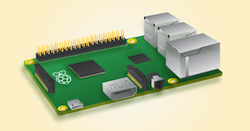
 Last week’s news that Tizen 3.0 has been ported to the Raspberry Pi 2 Model B is the latest example of how the year-old ARMv7 version of the Pi is attracting ports from more powerful Linux distributions, most notably Fedora, Ubuntu MATE, and Snappy. The Samsung Open Source Group’s Tizen for Pi project has been underway for several years, achieving several beta releases, and now the effort has shifted to the new Tizen 3.0. It’s still in beta, but now you can create builds for the Pi 2 using tools from the Yocto Project and OpenEmbedded project.
Tizen 3.0 offers performance and security improvements, multiple-user and 64-bit support, and an Internet of Things (IoT) framework. Samsung, the principal backer of the Linux Foundation hosted Tizen project, is using the Pi port to expand the base of developers using Tizen for IoT projects, according to an IDG News Service post that reported on the port.
Although Samsung finally shipped a Tizen-based phone in India last summer, and Gear smartwatches continue to use Tizen, the main focus now appears to be on IoT. At CES last month, Samsung announced that all of its Tizen-based, 2016 Smart TVs will be able to act as SmartThings home automation hubs, letting users monitor the household while watching TV.
The Growing List of Pi Distros
Elinux.org lists some 46 ARMv6-ready distributions that run on all the Raspberry Pi boards. A separate listing notes two ARMv7-only distros that require the ARMv7 Raspberry Pi 2: Ubuntu MATE, which replaces the resource-intensive Unity desktop with the Gnome 2.0 flavored MATE, and Windows 10 IoT Core. The prominent placement of a Microsoft distribution is not as controversial as one might have thought. To many younger Linux developers and casual Pi hackers, Microsoft is just another tech company, not so much the evil empire loathed by old-time Linux hackers.
Windows 10 IoT Core isn’t the only non-Linux distro running on the Pi. There’s also the Unix-like FreeBSD and NetBSD, as well as the revived RISC OS Pi version of the old Acorn Computers OS. Some of the 48 operating systems on the Elinux.org list are incomplete, out-of-date, or dedicated to limited niches. DistroWatch offers a more manageable list of 20.
 The Raspberry Pi Foundation still prominently posts a download page for its homegrown, Debian-based Raspbian, in both standard and NOOBS packages. This lightweight distro is still the most popular and typically the highest rated Linux build for the Pi. The Scratch-ready distro is especially equally suited for desktop use and embedded hacking with home automation gear, robots, and other IoT gizmos. Raspbian recently received an update with an experimental OpenGL driver for doing hardware acceleration on the VideoCore IV GPU used with the Pi 2’s Broadcom BCM2836 SoC.
The Pi Foundation also lists several third-party downloads. In addition to Windows 10 IoT Core and and Ubuntu MATE, the list includes the lightweight, transactionally focused Snappy Ubuntu Core for the Pi 2. Canonical is aiming Snappy at those who want an app platform and cloud integration in embedded devices like drones and IoT devices. Snappy also came out last week in a version designed for Intel NUC mini-PCs. The Pi Foundation also posts images for RISC OS and the education-focused PINET. There are also two media center distros related to KODI/XBMC: OSMC and OpenElec.
In addition to its list of 48 released distros, Elinux.org lists several “announced” distros including Firefox OS, openSUSE, Meego MER & XBMC, Puppy, RPi-Buildroot, and Aros. Missing, however, is Tizen, as well as newly announced ports such as Manjaro-ARM and the CentOS 7-based CentOS AltArch 7 for the Pi 2, Banana Pi, and CubieTruck SBCs.
Android Still Pi in the Sky
Elinux.org’s “announced” list also includes Android and a Miracast-like program called Android Transporter. People have been trying to port Android to the Pi for years; yet, even with the more suitable Pi 2 shipping for a year now, Android is still pretty much a no-show. Android can run on lower-powered SoCs than the Pi 2’s quad-core, Cortex-A7, but the limited 1GB of RAM and the lack of GPU acceleration are big challenges. Perhaps Raspbian’s OpenGL driver could be ported to Android as well, although the Pi Foundation does not seem very interested in Android.
There are several Android-for-Pi projects in the works, but without the foundation’s backing, there is still nothing close to a complete port. Projects include an AOSP Marshmallow patch-set from Peter Yoon, as well as a RaspAnd release based on the Ubuntu-based RaspEx, which makes use of the Aptoide package manager to load some Android 5.1 apps on a Pi 2. The Razdroid project, which aims to tap into the secrets of Broadcom hardware acceleration, seems to have stalled.
Most Rasp Pi users, however, appear more interested in Ubuntu MATE, which was never optimized for ARMv6, and Fedora. For years, Pi users have run the lightweight spin-down of Fedora called Pidora, but with the Pi 2, they can now try the real thing. The Raspberry Pi Foundation has yet to post Fedora, but the recent betas of the Pi 2 port have received high marks.
Other Linux distributions that regularly make Top Pi distro lists include Arch Linux, which unlike most ports from mature Linux distros, works just fine on ARMv6. A recent TechRadar Top 5 list includes several more niche distros in addition to Raspbian. These include the OSMC media player environment, RetroPie for playing classic games, OpenMediaVault for turning your Pi into a NAS, and Pi MusicBox, based on the Mopidy music streaming server.
Beyond Ubuntu, Fedora, and Tizen, other distros, both arcane and general, are heading for the Pi 2, as well. The platform is rapidly expanding the boundaries of, as well as redefining the meaning of, desktop Linux.
Early bird registration for Embedded Linux Conference ends this Sunday, Feb. 21. Register now and save $300.

 Short answer: Yes, but it’s more complicated than that. We have been following D-Wave’s claims about its quantum hardware at Ars for a number of years. Over that time, my impression has oscillated between skepticism, strong skepticism, and mild enthusiasm….
 The embrace of the OpenDaylight SDN controller follows the support of the ONOS controller in the first release of the Atrium software last year.
