Most Linux servers offer an SSH login via Port 22 for remote administration purposes. This port is a well-known port, therefore, it is often attacked by brute force attacks. Fail2ban is a software that scans log files for brute force login attempts in real-time and bans the attackers with firewalld or iptables. This tutorial shows the installation and configuration of Fail2Ban with firewalld on CentOS 7.
Raspberry Pi: New NOOBS and Raspbian Releases
Updated images are available for NOOBS (1.6.0) and Raspbian (2016-02-03). Existing system can simply be updated in place.

New distribution images have showed up on the Raspberry Pi Downloads page, for NOOBS 1.6.0 and Raspbian 2016-02-03. There has not been an official announcement yet (also known as a Raspberry Pi Blog post), but I assume one will come along very soon. The last time there was a delay between the release showing up in downloads and the actual announcement, it was because they were waiting for the Pi Zero announcement …
Read more at ZDNet News
Twelve Robots That Run Linux
The future of robotics is open source. Linux helps power these 12 robots.

Read more at ZDNet
VMware’s Workspace One Targets Mobile Enterprise With “Hybridity”
VMware’s Workspace One effort aims to consolidate the multiple acronyms needed to manage enterprise mobility.
VMware on Tuesday updated its Horizon product lines and rolled out Workspace One, an end-user application designed to address “hybridity” as workers toggle between devices and personal and professional roles. Sumit Dhawan, general manager of end-user computing at VMware, said the company was aiming to create a tool for a mobile application that isn’t siloed by device or acronym
Read more at ZDNet News
It’s Been 20 Years Since This Man Declared Cyberspace Independence
When digital dystopians and critics of Internet libertarians need a rhetorical dart board, they often pull out a document written by John Perry Barlow, co-founder of the nonprofit Electronic Frontier Foundation, a former cattle rancher and Grateful Dead lyricist. On this day in 1996, Barlow sat down in front of a clunky Apple laptop and typed out one very controversial email, now known as the “Declaration of Independence of Cyberspace,” a manifesto with a simple message: Governments don’t—and can’t—govern the Internet.
Read more at WIRED
Dell Moves Forward With Firmware Updating On Linux
Dell is moving forward with offering natively UEFI firmware flashing from the Linux desktop. Via the UEFI firmware capsule feature of UEFI 2.5 and newer, they are beginning to support updating your system’s firmware in a standardized and fully open manner. Dell will support the fwupd utility developed by the Red Hat developers for Fedora and has since been picked up by Canonical and others.
4 Open Source Tools for Linux System Monitoring
Information is the key to resolving any computer problem, including problems with or relating to Linux and the hardware on which it runs. There are many tools available for and included with most distributions even though they are not all installed by default. These tools can be used to obtain huge amounts of information.
This article discusses some of the interactive command line interface (CLI) tools that are provided with or which can be easily installed on Red Hat related distributions including Red Hat Enterprise Linux, Fedora, CentOS, and other derivative distributions.
Vulnerability in Font Processing Library Affects Linux, OpenOffice, Firefox
Four vulnerabilities in the Graphite (or libgraphite) font processing library allow attackers to compromise machines by supplying them with malicious fonts.
In its description, Graphite‘s authors describe the library as a tool capable of creating “smart fonts” that can display dynamic glyphs for showing complex writing systems.Many applications use Graphite, and among them are Firefox, Pale Moon, Thunderbird, OpenOffice, LibreOffice, and WorldPad, …
Read more at Softpedia
Should the Fight for the Linux Desktop Really Matter?
World Domination has long been the battle cry for Linux. But does that cry really hold any relevance these days? Jack Wallen tackles that tireless question to hopefully put it to rest.
This is a tricky, multi-layered question that needs to be asked. Before I dive into it, you must know that I have been using one form of Linux or another as my only OS since the late nineties. So, for me, the ability to use Linux is crucial. Why? Without Linux, getting my work done would not be nearly as easy, trouble-free, or cost effective. That being said, let’s take a look at this question.
Read more at Tech Republic
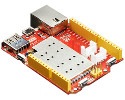
Arduino Yun Clone Runs OpenWrt, Offers Grove I/O
The Arduino Yún- and Grove-compatible “Seeeduino Cloud†SBC has an AR9331 WiFi chipset that runs Linux via a Dragino HE COM, plus Ethernet and USB ports. The Seeeduino Arduino clone from Seeed Studios has been around for years, adding three onboard Grove sensor interfaces to basic Arduino functionality. Now, Seeed Studios has launched a Seeeduino Cloud version that promises Arduino Yún compatibility, and which like the Yún, provides a Qualcomm Atheros AR9331 WiFi SoC…