Home Blog Page 8975

Don’t copy that floppy drive

Author: JT Smith

Kelly McNeill writes: “The iMac’s form factor, small footprint, colors, removal of many legacy ports, and nearly every other aspect of the machine have been all but entirely copied except for one thing — removal of the floppy drive. Apparently, the Register managed to get its mitts on a confidential Intel document, which apparently is pressuring PC manufacturers to do away with a little piece of unnecessary technology — long since removed from Mac — called a floppy drive. Similarly, Intel is also requesting that PC manufacturers be more Mac-like and rid themselves of both PS/2 and serial ports while they’re at it.”

Category:

  • Unix

Rally to free Dmitry in NYC Monday

Author: JT Smith

Noon Monday 8 October 2001 at 41st Street and Fifth Avenue, before the
New York Public Library, on the Island of Manhattan, there will be a rally
to free Dmitry Sklyarov.

Note that this is not an LXNY event, but rather the twelfth of a series of
rallies, whose Lead Organizer and First Contact is Leonid Gorkin
at lgorkin@excite.com or lgorkin1@nyc.rr.com.

Do not bring any sticks to this rally.

There is a New York City regulation forbidding sticks at gatherings.

The New York City police officers who told us of this regulation were
parfit gentle in their courtesy.

There have been and will be rallies in about twenty cities.

http://freesklyarov.org/calendar.

Much of the organizing of New York City Rallies to Free Dmitry take place
on the fairuse mailing list of NYFairUse, which list may be joined at http://www.nyfairuse.org.

GNU-Darwin packages for Mac OSX.1 and Darwin-1.4.1

Author: JT Smith

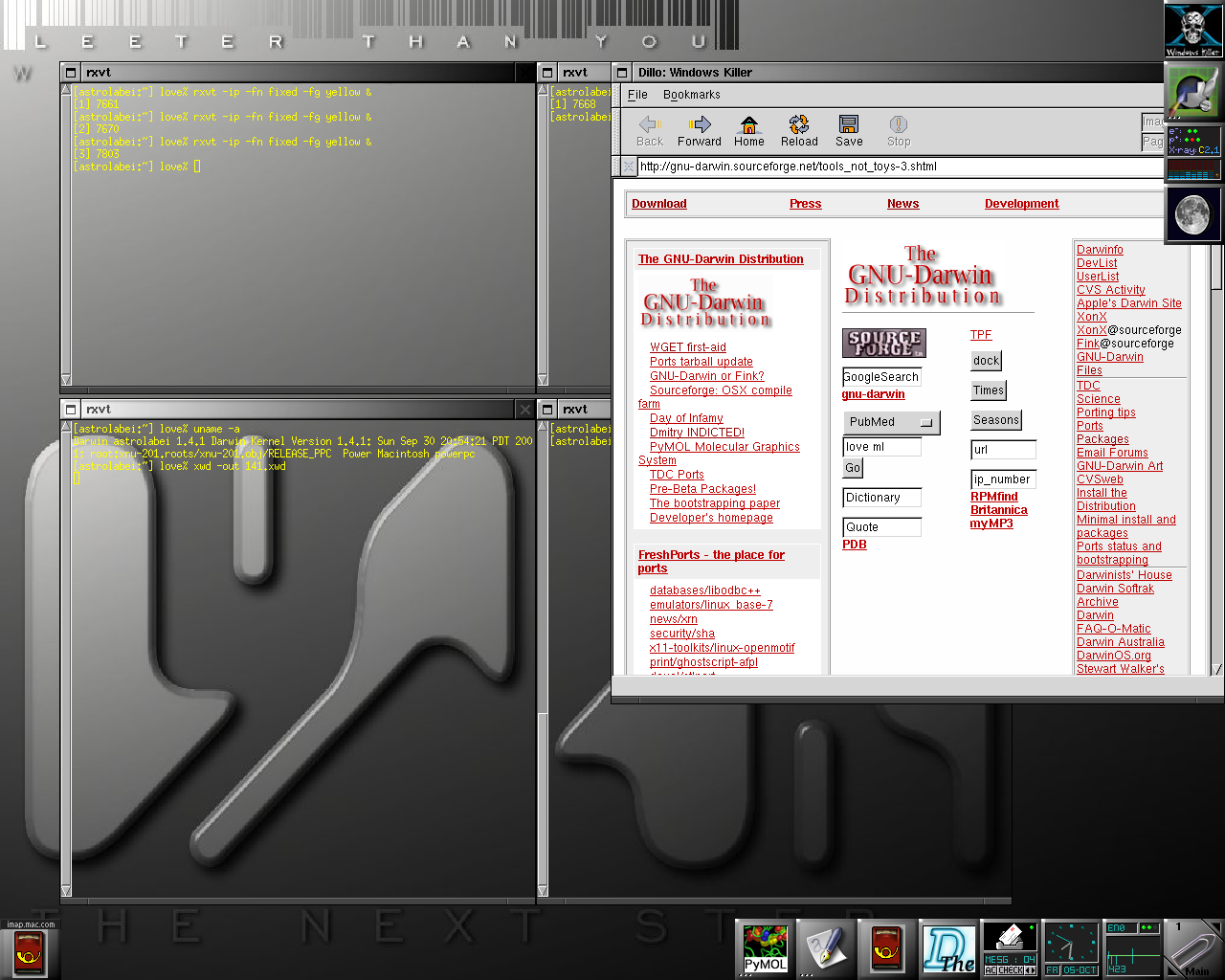
proclus writes, “The GNU-Darwin packages are compatible with Apple’s newly released Darwin-1.4.1,
and we now have
Net Installation instructions
for Darwin-only users. Our Bootable Installer CD is now in beta, thanks to the efforts of GNU-Darwin developer rrp. As you can
see in the screenshot, our packages work fine with the
XFree86
software which is now a part of Apple’s Darwin distribution. We have recently packaged the latest versions of Mac OSX.1 compatible OpenSSH
and XFree86.
(Our older OpenSSH and XFree86 packages appear to be broken.) It is important for
OSX.1
users to upgrade their OpenSSH. This is a great time to check
out our other
packaged
offerings
, which are also Darwin-1.4.1 and Mac OSX.1 compatible.
OSX.1 users who are new to GNU-Darwin might like to try our new Net Installer. Just follow the
OSX-specific directions at the top of the script.

Category:

  • Unix

Weekly news wrap-up: Community responds to Web patents, proprietary copy protection

Author: JT Smith

By Grant Gross

Lots of reaction from Open Source advocates this week on two proposals, one introduced in the U.S. Congress, and one winding its way through the World Wide Web Consortium, both with the potential to have a large impact on the Free Software and Open Source communities, as well as technology users in general.

First, we have the W3C’s proposal to allow Web standards to be patented and therefore, for makers of those standards to collect fees. That proposal has drawn criticism, of course, from Open Source advocates and others, with Open Source leader Bruce Perens suggesting the community would fork the Web instead of paying for patents. The W3C ended up extending the comment period on the proposal after so much feedback.

Meanwhile, the Open Source community is firing up protests against the proposed Security Systems Standards and Certification Act, which would require proprietary copy-protection standards on computers. An online petition has already collected more than 11,000 signatures urging defeat of the SSSCA, which one advocate predicts would turn Linux users into “federal felons overnight,” reports NewsForge’s Tina Gasperson.

Also, the guys that bring us The Linux Show every week are calling for a boycott of Disney, one company advocating the SSSCA.

In other government news, the U.S. Federal Trade Commission, under a new Republican chairman, has taken what some commentators are calling a u-turn on privacy policy. No new consumer privacy laws — on the Web and elsewhere — are needed, according to the new chiefs of the FTC.

Big in Europe

While the United States seems to be doing its best to beat down Open Source, some government entities in Europe are embracing it. The German Federal Agency for IT Security has contracted with three companies to include Open Source options like KMail and mutt in its secure email project.

Over in Finland, the city of Turku is protesting Microsoft’s licensing schemes by considering a move to Linux, on as many as 5,000 city desktops.

The Fins aren’t the only ones considering a switch: A survey done this week suggests many more Microsoft customers are concerned with the company’s new licensing policy that would mandate customers update their software every two years. Thirty-six percent of those surveyed say they will consider competing products. A chance for Open Source software to make a move?

Bad news for FreeBSD

Most of the developers on the development team of the Unix-like operating system were laid off from Wind River Systems this week. There are reports that a handful of remaining FreeBSD developers at Wind River will work to release a commercial FreeBSD product.

Throw away Microsoft Office

The first round of reviews for Sun’s new StarOffice 6.0 beta, which runs on Linux, came out this week. LinuxWorld says the office suite loads faster, but it still hogs memory. Generally, the review was a positive one, saying the 6.0 beta is much improved over earlier versions. Over at Linux Orbit, the verdict was similar, with the reviewer saying StarOffice 6.0 has improved handling of Microsoft-type documents. “I’m sure I’ll like it more and more as I get a chance to create and edit more complex documents in StarOffice. If you can spare the download time to get the software, I would recommend that you do so.”

New in NewsForge

Stories that appeared first in NewsForge this week:

  • Why do commercial Linux software projects fail. Robin “Roblimo” Miller has some ideas: Often the software doesn’t work the way it’s promised to.

  • Dan Berkes tests out the new RealOne music player for Linux and says it shows promise. Look for more software reviews from NewsForge soon.

  • IBM launches wireless security package

    Author: JT Smith

    From C|Net: “IBM is due to launch on Monday new services and software aimed at making wireless networks and communications more secure and widely used, the company said Sunday.”

    Category:

    • Linux

    Does Linux need another commercial compiler?

    Author: JT Smith

    From AskSlashdot: “My company, Codeplay, is set up to develop new and innovative compiler technology for the games industry. Our C compiler, VectorC, is a cutting edge vectorizing compiler aimed at games and multimedia applications that demand high performance generally through hand-optimized assembly. I’m writing to ask the burning question on our minds, is it worth porting VectorC to Linux?”

    Category:

    • Linux

    Recording, movie industries sue Napster progeny

    Author: JT Smith

    From CNN: “Having successfully forced file-sharing rogue Napster Inc. into compliance with copyright laws, the Recording Industry Association of America Inc. (RIAA), along with the major Hollywood studios, is now launching attacks against popular file-swapping services MusicCity, KaZaA, Morpheus and Grokster.”

    Category:

    • Open Source

    Gadgets with Linux inside

    Author: JT Smith

    From Slashdot: “An anonymous submitter sends in a link to a quick reference guide of various devices and gadgets that are in some way running Linux. Cell phones, set-top boxes, web pads, internet radios, and some miscellaneous gizmos.”

    Category:

    • Unix

    IBM set to sail Regatta

    Author: JT Smith

    From CNN.com: “IBM Corp’s long-awaited p690 high-end Unix server, formerly code-named Regatta, is now on sale. The system should help IBM catch up with competitor Sun Microsystems Inc., according to industry analysts. The p690 supports up to 32 Power4 processors running at either 1.1GHz or 1.3GHz, according to Rod Adkins, general manager for IBM’s Unix business. It will start shipping in volume by December, he said.”

    Category:

    • Unix

    Protecting yourself from nosy e-snoops

    Author: JT Smith

    From SeattleTimes.com: “When my words left my computer, I used to think they were protected and could flit around the Internet with no chance of interception. I used to ridicule the notion of someone listening in, as that would require physical access to network hubs or something inside my office. But I’m not so dismissive anymore.”

    Category:

    • Programming