
 Need a cool gift idea? Hankering to build a robot army? These Arduino-powered robotics kits are affordable, expandable, and the perfect way to learn robotics OR conquer your enemies.
Read more at ZDNet
Need a cool gift idea? Hankering to build a robot army? These Arduino-powered robotics kits are affordable, expandable, and the perfect way to learn robotics OR conquer your enemies.
Read more at ZDNet
 When my journey into the world of open source began in the mid-90s, the easiest way to get installation media was to buy CD sets from online stores and have them shipped to you. Being interested in experimenting with different operating systems, I always bought the giant bundle that included all the distributions. Debian, Red Hat, Slackware, SUSE, and several now defunct distributions were include for me to play with, but the bundles also came with installation discs for the various BSD distributions (FreeBSD, NetBSD, and later, OpenBSD).
Read more at OpenSource.com
 While digging through the Internet, we’ve recently found a new and powerful 64-bit expandable SBC (Single-board computer) called PINE64 that costs only $15 (approximately €14).
Just by looking at its features, we can notice that PINE64 is a versatile single-board computer, which is capable of running the latest versions of the Android mobile operating system, as well as any other modern GNU/Linux distribution on its open-source hardware.
Read more at Softpedia Linux Blog
 A few minutes ago, December 7, Mr. Linus Torvalds, father of Linux kernel, had the great pleasure of unleashing the fourth RC (Release Candidate) build of the upcoming Linux 4.4 kernel. Linux kernel 4.4 RC4 is now available for download from the usual places (see the download links at the end of the article), and, according to Mr. Torvalds, things are still calm and there’s nothing stands out.
In numbers, the fourth Release Candidate version of the Linux 4.4 kernel consists of approximately 70% driver updates, especially for things like GPU, SCSI, sound, and networking, 15% networking updates, and 15% is split between core improvements, architecture updates, and others.
KaOS is proud to present the 2015.11 ISO.
The policy is, once a first pacman -Syu becomes a major update, it is time for a new ISO so new users are not faced with a difficult first update. With new builds effecting over half of the KaOS repositories (currently at about 2100), that new ISO is more than due.
As always with this rolling distribution you will find the very latest packages for the Plasma Desktop, this includes Frameworks 5.16.0, Plasma 5.4.3 and KDE Applications 15.08.3.
Most notable major updates to the base of the system are the Boost 1.59.0/ICU 56.1 stack, Glib2 2.46.2 stack, a move of Mariadb to the 10 series, Perl 5.22.0 stack, Linux 4.2.6, all Texlive packages updated to their 2015 versions, Qt 5.5.1 and Systemd 228.
Artwork received several updates. The all new logo is implemented over various parts of the system.
A fully scalable slideshow with SVG based images and QML based text was designed for the installer, replacing the old png based slides.
This ISO uses the CRC and finobt enabled XFS filesystem as default. CRCs enable enhanced error detection due to hardware issues, whilst the format changes also improves crash recovery algorithms and the ability of various tools to validate and repair metadata corruptions when they are found. The free inode btree does not index used inodes, allowing faster, more consistent inode allocation performance as filesystems age.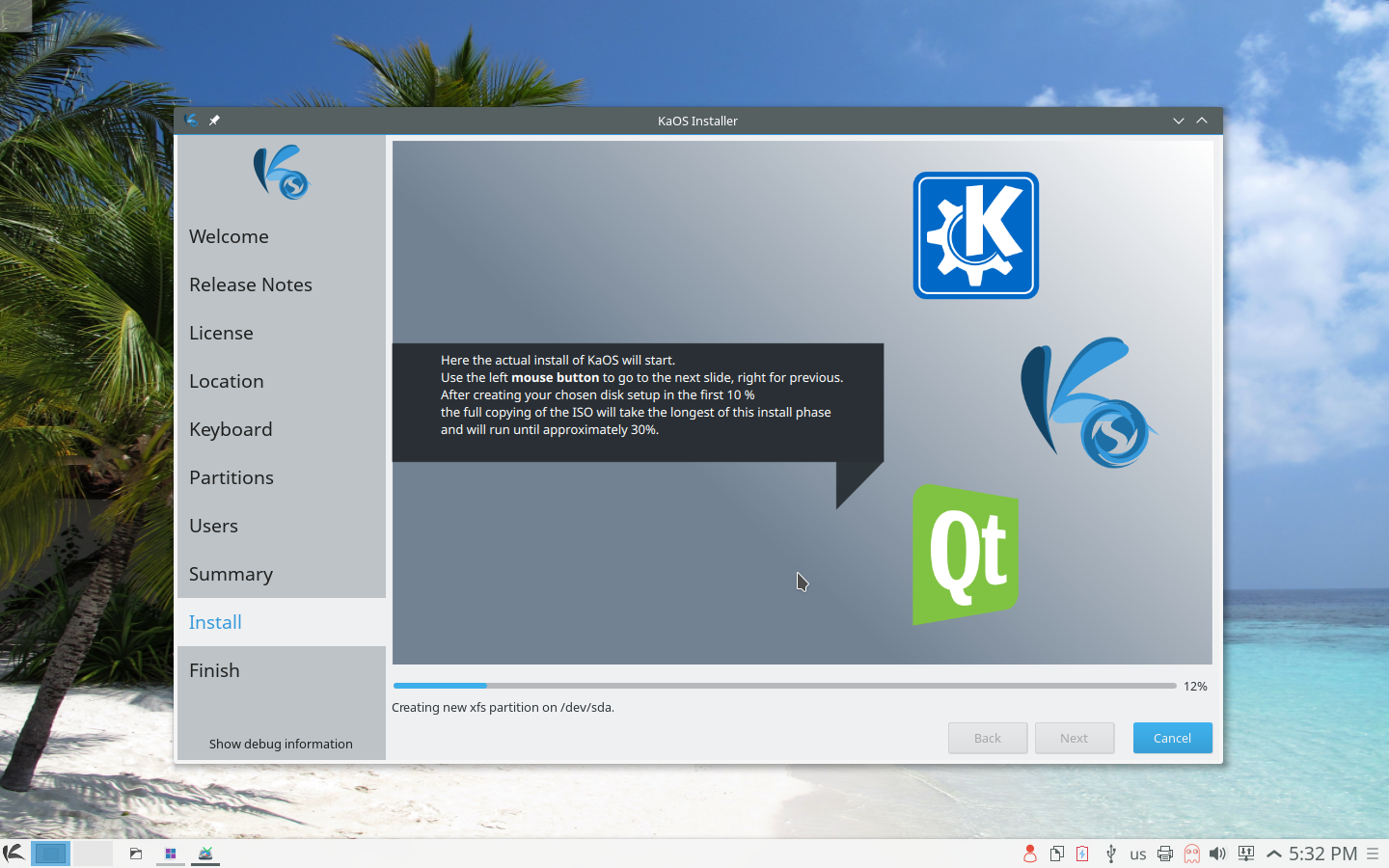
KaOS specific settings for SDDM, kwin and kinit make it possible to start a Plasma Wayland session right from the login manager. An X11 session is of course still default, but the drop-down menu has a wayland entry too. The default web-browser Qupzilla is one of the first applications that heavily relied on X11 in its code that is fully ported to run a Wayland session too.
This ISO KaOS uses the Systemd provided Systemd-boot for UEFI installs, Gummiboot is depreciated.
Calamares, the used installer framework, has moved to the 2.0 series. Highlights of the changes and additions:
Known issues:
To create reliable installation media, please follow the instructions from the Download page. KaOS’s ISO’sdo not support unetbootin, and DVDs need a burn speed no higher than 4x.
 The Linux Foundation hosts numerous Collaborative Projects — these are independently funded software projects that harness the power of collaborative development in an effort to drive innovation. For these projects, the Linux Foundation provides the essential collaborative and organizational framework so that participants can focus on innovation and results.
To increase understanding and provide greater insight into these collaborative projects, we are producing a series of articles highlighting some of the people involved. In the series, we talk with key contributors about what they do, what motivates them, and how they got involved.
The Node.js Foundation is a community-led, industry-backed consortium created to advance the development of the Node.js platform. Node.js itself is an open-source, cross-platform runtime environment for developing server-side web applications. It is used by thousands of organizations, including PayPal, GoDaddy, Joyent, and IBM, and is the runtime of choice for high-performance, low-latency applications. Node.js can be found in everything from cloud stacks and enterprise applications to mobile websites and the IoT.
Formed earlier this year, the Node.js Foundation supports the growth and evolution of the Node.js platform in a collaborative environment. Fedor Indutny, a key contributor and a member of the Node.js Technical Steering Committee (TSC), says the Foundation is something that many in the Node.js core team have craved for a long time.
 “To me, the Node.js Foundation is a way to join the efforts. Big companies, startups, contributors — the Foundation provides a way for us to collaborate and determine the project’s future, while accounting for as many views and opinions as possible. The project governance is really important to me; it was the reason for io.js to appear, and is the reason why it merged back with Node.js under the roof of Node.js Foundation,” Fedor says.
Fedor, who is a Software Engineer at PayPal, has been involved in Node.js core development since 2010 and a core member since 2012. His first big commits to Node.js were improvements for the command-line debugger. Since then, he has moved to working on HTTP protocol support, crypto APIs, and fixing some V8 issues. Currently, Fedor’s daily duties are split into two parts. He says:
As a contributor, I triage GitHub issues that are relevant to my scope. Many of them fall to my email inbox, so most of my activity is an attempt to reach “Inbox Zero.” Quite often, I switch from this activity to experimentation: trying to improve performance or create a new useful feature.
As a TSC member, I participate in a weekly call, where we discuss and make technical decisions on various questions raised by the community. Whenever any controversial idea arises, we discuss what to do with it on a TSC call.
Finding the balance between performance and API elegance for Node.js is a particular area of focus, according to Fedor. “This is very challenging, and this struggle is not going to end anywhere soon, because the features that Node.js offers and their APIs are constantly growing and improving. Another, contrary, challenge is to not overdo with the API growth. Having a small core of essential features is important for the diverse and productive user-land modules (npm) progression. We have recently hit the mark of 200K npm modules, and this is fantastic!”
The rise in Node.js adoption is a serious motivator for keeping Indutny involved with the project. However, Fedor continues, “that feeling would not be complete without doing this in the open and making the code that I write available for everyone for free. The Open Source model is what keeps me involved with Node.js.”
One of most rewarding aspects of being involved, however, is seeing the deployment of new projects that are running on Node.js. “Knowing that the code you wrote runs on many servers throughout the world is an incredible feeling,” Fedor says.
He has also contributed small patches to various other open source projects, including Mozilla’s Rust compiler, but one of the most delightful experiences he’s had was being involved with Google’s V8 JavaScript engine, which is the “rocket power” of Node.js (referring to the famous rocket and turtle image). According to Indutny, “Many components of V8 are one step ahead of what we currently do in Node.js core. This Google team is pretty serious about innovation, and this continuously fascinates me.”
If you’re considering becoming involved with Node.js or another open source project, Fedor advises, “Don’t be afraid to contribute minor changes to the project. It starts with a small patch and then eventually will end up rewriting all of the existing code (obviously kidding, but sometimes very major changes happen, too!).”
When asked about the future of the Node.js Foundation, Fedor says, “I try to avoid doing any predictions, but I’m sure that the Node.js Foundation support that we have now will lead the Node.js community to a prosperous future.”