On 16th August 2015, the Debian project has celebrated its 22nd anniversary, making it one of the oldest popular distribution in open source world. Debian project was conceived and founded in the year 1993 by Ian Murdock. By that time Slackware had already made a remarkable presence as one of the earliest Linux Distribution.
Mozilla Defaults Tracking Protection for Firefox Developer Builds, But Only for Private Browsing
Pre-beta versions of Firefox will block domains known to track users by default when a private browser window is opened. After remaining hidden behind an about:config flag for some time, Mozilla has moved Tracking Protection into Firefox’s developer release channel.
Read more at ZDNet News
Chinese, Russian, tech giants join global open source efforts
Technology independence looks distant as Xen and OpenBSD welcome new pals
Notable tech companies from China and Russia are taking strides into the heart of the global technology community.…
Distribution Release: Linux Mangaka Koe
The developers of Linux Mangaka have released a new version of their Manga and Anime focused distribution. The new release, which is based on Kubuntu 14.04, features the KDE 4 desktop environment. “After the success releasing Nyu with a lot of passion, we decided to start creating Koe…
Dell Launches Premium Chromebook for Business Users
The new Dell Chromebook 13 is a well-equipped machine aimed at business users who want all-day battery life and high performance. Dell has unveiled the Chromebook 13, the company’s first premium-level business Chromebook that incorporates features and security required by enterprise users.
FreeBSD 10.2 Lands with GNOME 3.14.2 and KDE 4.14.3
FreeBSD, an operating system for x86, ARM, IA-64, PowerPC, PC-98, and UltraSPARC architectures, has been upgraded to version 10.2, which brings this development cycle to an end.
Users might forget from time to time that Linux is the not the only operating system out there and that BSD is alive and thriving. There are a number of BSD derivatives in production and FreeBSD is just one of them. Its developers are quite active, and updates are made all the time.
Read more at Softpedia Linux News
9 of the Best Free OCaml Books
The OCaml system is the main implementation of the Caml language. It has an advanced type system, offers a powerful module system, automatic memory management, and adds full-fledged object-oriented layer. OCaml includes a native-code compiler supporting numerous architectures, for high performance; a bytecode compiler, for increased portability; and an interactive loop, for experimentation and rapid development. OCaml’s integrated object system allows object-oriented programming without sacrificing the benefits of functional programming, parametric polymorphism, and type inference. The language is mature, producing efficient code and comes with a large set of general purpose as well as domain-specific libraries.
<A HREF=”http://www.linuxlinks.com/article/20150815094952608/9oftheBestFreeOCamlBooks-Part1.html“>Read on</A>
Replacing ifconfig with ip

If you’ve been around Linux long enough, you know tools come and go. This was assumed to be the case back around 2009 when the debian-devel mailing list announced plans on deprecating the net-tools package due to lack of maintenance. It is now 2015 and net-tools is still around. In fact, as of Ubuntu 14.10, you can still issue the ifconfig command to manage your network configuration.
However, in some instances (e.g., Ubuntu Docker container), the net-tools suite isn’t installed by default. This means the ifconfig command isn’t available. Although you can install net-tools with the command
sudo apt-get install net-tools
it is most often recommended to move forward with the command that has replaced ifconfig. That command is ip, and it does a great job of stepping in for the out-of-date ifconfig.
Thing is, ip is not a drop-in replacement for ifconfig. There are differences in the structure of the commands. Even with these differences, both commands are used for similar purposes. In fact, ip can do the following:
-
Discover which interfaces are configured on a system
-
Query the status of a network interface
-
Configure the network interfaces (including local loop-back, and Ethernet)
-
Bring an interface up or down
-
Manage both default and static routing
-
Configure tunnel over IP
-
Configure ARP or NDISC cache entry
With all of that said, let’s embark on replacing ifconfig with ip. I’ll offer a few examples of how the replacement command is used. Understand that this command does require admin privileges (so you’ll either have to su to root or make use of sudo — depending upon your distribution). Because these commands can make changes to your machine’s networking information, use them with caution.
NOTE: All addresses used in this how-to are examples. The addresses you will use will be dictated by your network and your hardware.
Now, on with the how-to.
Gathering Information
The first thing most people learn with the ifconfig command is how to find out what IP address has been assigned to an interface. This is usually done with the command ifconfig and no flags or arguments. To do the same with the ip command, it is run as such:
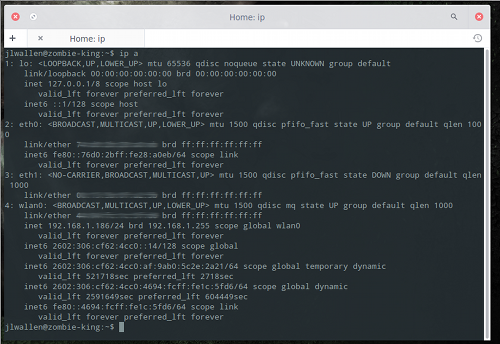
ip a
This command will list all interfaces with their associated information (Figure 1 above).
Let’s say you only want to see IPv4 information (for clarity). To do this, issue the command:
ip -4 a
Or, if you only want to see IPv6 information:
ip -6 a
What if you only want to see information regarding a specific interface? You can list information for a wireless connection with the command:
ip a show wlan0
You can even get more specific with this command. If you only want to view IPv4 on the wlan0 interface, issue the command:
ip -4 a show wlan0
You can even list only the running interface using:
ip link ls up
Modifying an Interface
Now we get into the heart of the command… using it to modify an interface. Suppose you wanted to assign a specific address to the first ethernet interface, eth0. With the ifconfig command, that would look like:
ifconfig eth0 192.168.1.101
With the ip command, this now looks like:
ip a add 192.168.1.101/255.255.255.0 dev eth0
You could shorten this a bit with:
ip a add 192.168.1.101/24 dev eth0
Clearly, you will need to know the subnet mask of the address you are assigning.
What about deleting an address from an interface? With the ip command, you can do that as well. For example, to delete the address just assigned to eth0, issue the following command:
ip a del 192.168.1.101/24 dev eth0
What if you want to simply flush all addresses from all interfaces? The ip command has you covered with this command:
ip -s -s a f to 192.168.1.0/24
Another crucial aspect of the ip command is the ability to bring up/down an interface. To bring eth0 down, issue:
ip link set dev eth0 down
To bring eth0 back up, use:
ip link set dev eth0 up
With the ip command, you can also add and delete default gateways. This is handled like so:
ip route add default via 192.168.1.254
If you want to get really detailed on your interfaces, you can edit the transmit queue. You can set the transmit queue to a low value for slower interfaces and a higher value for faster interfaces. To do this, the command would look like:
ip link set txqueuelen 10000 dev eth0
The above command would set a high transmit queue. You can play around with this value to find what works best for your hardware.
You can also set the Maximum Transmission Unit (MTU) of your network interface with the command:
ip link set mtu 9000 dev eth0
Once you’ve made the changes, use ip a list eth0 to verify the changes have gone into effect.
Managing the Routing Table
With the ip command you can also manage the system’s routing tables. This is a very powerful element of the ip command, and you should use it with caution.
Suppose you want to view all routing tables. To do this, you would issue the command:
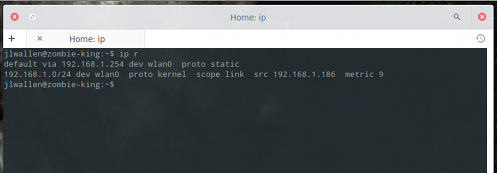
ip r
The output of this command will look like that shown in Figure 2.

Now, say you want to route all traffic via the 192.168.1.254 gateway connected via eth0 network interface: To do that, issue the command:
ip route add 192.168.1.0/24 dev eth0
To delete that same route, issue:
ip route del 192.168.1.0/24 dev eth0
This article should serve as merely an introduction to the ip command. This, of course, doesn’t mean you must immediately jump from ifconfig. Because the deprecation of ifconfig has been so slow, the command still exists on many a distribution. But, on the occasion of ifconfig finally vanishing from sight, you’ll be ready to make the transition with ease. For more detailed information on the ip command, take a look at the ip man page by issuing the command man ip from a terminal window.
Samsung Unveils Android Phablets — And Teases a Tizen Watch
Around the time of the iPhone’s 2007 release, Intel convinced OEMs to try out a new 4- to 6-inch tablet form-factor called Mobile Internet Devices (MIDs). These Linux- and Windows CE-based devices never made it very far, and were almost unknown in the United States. One reason cited for their demise was the belief that Intel had chosen the wrong size. Indeed, in the first part of this decade, smartphones tended to range from 3.5 to 4.5 inches, while tablets went from 7 to 13 inches. The gap in between was considered a no-fly zone.
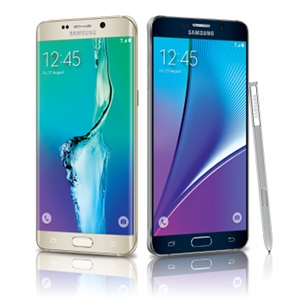
Yesterday, Samsung launched a 5.7-inch Galaxy Note5 and almost identical, stylus-free Galaxy S6 Edge+ phone, hoping to continue its success in the same no-fly zone. The Korean CE giant also formally announced its Samsung Pay mobile payment service and tipped a round-faced, Tizen-based Gear S2 smartwatch. Three weeks ago, amid rumors of a quad-core Samsung Z3 phone running Tizen 3.0, the company tipped a version of Tizen for the Internet of Things (see below).
In 2011, when Samsung had only recently emerged as the leading Android vendor with its Galaxy phones, it surprised the industry by unveiling the 5.3-inch Galaxy Note. Considered too large for a phone, the device also broke with the iPhone chic look by offering a stylus, a device thought to be extinct with the arrival of capacitive touchscreens.
After four popular Note offerings, the latest of which pushed the size to 5.7 inches, Samsung continues to lead the way in the hot 5- to 6-inch phablet market. Phablets — many of them with styluses — now dominate high-end smartphones.
“When we first came out with the Note, people called us crazy,” said Samsung CEO JK Shin’s at yesterday’s New York City launch of the Note5 and S6 Edge+. Justin Denison, VP and Head of Mobile Products at Samsung Electronics America, added: “To say there was doubt and market skepticism is a bit of an understatement. But what was once called a gimmick has now become the norm.”
Both new Galaxy phones stick with the Note4’s 5.7-inch dimensions. However, following the lead of the 5.1-inch Galaxy S6 Edge phone released earlier this year, the S6 Edge+ literally pushes the screen over the edge with a display that curves over the 6.9mm-wide sides of the device. The Note5 has no curved screen, but it feels more compact than its 5.7-inch specs would suggest due to its narrower metal bezel and curved back.
By contrast, the MIDs of last decade were thicker and bulkier, with screens framed by up to an inch of plastic on all sides. There’s a fine line between a 5- to 6-inch device that can fit in one hand and slide into your pocket and a 6- to 7-inch device that can’t.
64-Bit Octa-Core SoC and 4GB of DDR4
Reflecting the maturity of the smartphone market, there are few noteworthy hardware additions to the Note5 and S6 Edge+, which largely mimic the Note4 or S6 Edge. That’s not to say the specs aren’t impressive. They continue to offer Super AMOLED, 2560×1440 screens and Samsung’s much praised 16- and 5-megapixel cameras, which support 4K video capture.
Both phones run Android 5.1 on an octa-core Samsung Exynos 7420, the 64-bit system-on-chip that debuted in the Galaxy S6 and S6 Edge. Interestingly, Samsung made no mention of the processor at yesterday’s Samsung Unpacked event, despite the fact that the 14nm-fabricated, Cortex-A53 (1.5GHz) and Cortex-A57 (2.1GHz) octa-core would seem to be a fairly significant upgrade over the Note4’s octa-core Cortex-A15/A7-based Exynos 5433 (international) or Snapdragon 805 (North America). Samsung did, however, crow about the phones’ 4GB of DDR4 RAM, up from 3GB on the Note4 and S6 Edge. The company also touts the phones’ much faster wireless charging.
Samsung also added an unusual, $80 keyboard cover accessory that slides over the bottom part of the screen to provide a mini-QWERTY keyboard. When you’re not using it, you can store in on the back of the phone where it’s protected by an additional back cover. The keyboard cover works with both phones, as well as the earlier Galaxy S6 and S6 Edge.
The Galaxy phones’ latest software improvements, meanwhile, include a Live Broadcast app that live streams video direct to YouTube. Because it’s built into the native camera app, Live Broadcast is said to be more convenient than third-party apps (such as Periscope).
The S6 Edge+ adds an Apps Edge feature, which expands upon the earlier People Edge feature to let you swipe from the screen’s side to bring up quick-launch apps. The Note5 has its own new trick: A more accurate version of the S Pen stylus lets you write and capture notes even when the screen is turned off.
Both phones will ship August 21. Pre-orders are said to be available now.
Samsung Pay
Another interesting addition is a Magnetic Secure Transmission (MST) device compatible with MST readers found in Point of Sale equipment. The feature is designed to work with the newly announced Samsung Pay, which debuts September 28 in the United States. Thanks to MST, Samsung Pay will work with many more retailers than Apple Pay or Android Pay, claims Samsung.
Samsung Pay is also claimed to be more secure, as it’s built on the latest version of Samsung’s Knox security solution, which includes fingerprint scanning. Both the payment service and the Galaxy phones also support the NFC technology used by the Apple and Google services.
Round Tizen Watch Tipped Amid Z3 Phone Rumors
The only appearance of Samsung’s other Linux-based operating system came at the end of the Unpacked event. Samsung flashed an image of a round-faced watch with a tip for a September 3 unveiling. The displayed interface, as well as the lack of “Galaxy” in the name, reinforces the earlier rumor that the watch is Tizen-based, the heir to the Gear S.
Until recently, the prospects of smartphone success for the Linux Foundation hosted Tizen OS seemed to have faded, even while it was invading Samsung Smart TVs and watches. Yet, on June 29, Samsung announced that it had sold more than one million units of its flagship Z1 phone in India, Bangladesh, and Sri Lanka.
In late July, SamMobile reported on an upcoming, Tizen-powered Z3 phone that it says will launch later this year in in India, Bangladesh, and Nepal. The 5-inch phone will offer a faster quad-core Spreadtrum SoC compared to the dual-core Z1, and offer higher-end features including Tizen 3.0, 1.5GB of RAM, 8GB of storage, and 8- and 5-megapixel cameras, said the story. We may find out more at the September 3 Gear S2 event in Berlin at IFA.
It’s unclear when Samsung might expand its Tizen phone efforts beyond South Asia. More than a quarter of all Tizen app developers live in India, and Samsung will no doubt want to build upon its success. Samsung benefits from the fact that no company has yet dominated the fledgling, although potentially huge, Indian smartphone market.
Google’s Android One project, which launched almost a year ago in India, has underperformed, according to the Financial Times. Google is said to be working with OEM partners like Micromax to launch Android One phones that cost a half to a third the price of the current $70 to $100 models.
Still, the previously announced figure of 700,000 units sold during the first 100 days suggests Android One is doing better than Tizen’s Z1. Google’s competition here isn’t so much Tizen or Firefox OS, whose partners’ single-core, Spreadtrum-based “$25 phones” have been withdrawn from the market. Instead, Indian phone vendors are increasingly loading up CyanogenMod’s Android builds or are rebadging low-cost Android clones from China.
Tizen for IoT
On July 30 at the Tizen Development Summit in Bangalore, India, Samsung announced the release of Tizen SDK 2.3.1 for wearables. For the first time, the SDK enables the development of native apps, as well as HTML5-based web apps. The SDK also supports rumored Gear S2 features like a circular display and bezel interface.
Samsung also released a Tizen SDK 2.4 beta, which covers phones and TVs as well as wearables. Version 2.4 is said to offer a richer GUI, more contextual triggering support based on user behavior, and a new 3D engine named DALi (Dynamic Animation Library). There’s also a “Cloudbox” cloud feature.
Additionally, Samsung said it will invest $100 million to create an IoT version of Tizen that will run on all of its household appliances by 2020. There were few details and no indication of how this might intersect with Samsung’s acquisition of home automation company SmartThings or work with its IoT-focused, Yocto Linux-ready Artik modules.

LinuxCon Preview: Q&A with IBM’s Ross Mauri
As a preview to next week’s LinuxCon, we spoke with Ross Mauri, General Manager, IBM z Systems, about how open infrastructures drive innovation and IBM’s commitment to open ecosystems.

For more from Ross Mauri, check out his keynote presentation at LinuxCon “Unleashing the Full Potential of Linux and Open Technologies to Fuel New Innovation.” In this presentation, Mr. Mauri, along with Dr. Angel Diaz (Vice President of Cloud Technology and Architecture, IBM), will discuss the opportunities Linux offers to optimize workloads with enterprise platforms and why an open infrastructure matters now more than ever.
Linux.com: What does being open mean in IT infrastructure?
Ross Mauri: One of the strongest trends in IT infrastructure is the move towards building strong, open ecosystems that drive innovation and share the benefits from those innovations. In the context of IT infrastructure, this means building an open architecture to enable choice, adopting standards to ensure interoperability and using open technologies to benefit from and contribute to community innovation.
Open is about how organizations, companies and even countries can address disruptions and technology shifts to create a fundamentally new competitive approach. No one company alone can spark the magnitude or diversity of the type of innovation we are going to need so that organizations have the flexibility and capabilities to meet their specific needs. In short, we must collaborate not only to survive…we must collaborate to innovate, differentiate and thrive.
Linux.com: What does it mean to be open by design?
Ross Mauri: Open by design is all about infusing the open concept throughout your organization. It is about creating a culture in which the support of open technologies and open standards is woven into the company’s DNA. It includes ensuring open governance for projects, contributing code to open source software and building solutions on open technologies.
Linux.com: How is IBM adapting to this new model of collaboration in IT?
Ross Mauri: At IBM, we have long been on a mission to open doors for enterprises to usher in new innovation, foster interoperability and now, more than ever, engage developers. We have been closely involved in Linux and open source activities for almost two decades. We’ve adapted by building a world-class open source development organization – the Linux Technology Center – with IBM programmers and engineers working on open source projects as part of the community.
We’ve learned how to work collaboratively with organizations who may also be competitors in order to achieve shared goals. And we’ve opened up our intellectual property by making major contributions to open source projects, such as the original Eclipse code. IBM is also a founding member of the Open Stack Foundation, Linux Foundation, OpenPOWER foundation, and Open Virtualization Alliance. More than 500 IBM programmers work as part of open source communities.
Within IBM z Systems, we enabled Linux for the mainframe 15 years ago and have seen adoption grow with 40% of mainframe clients now running Linux. We will be making some exciting new announcements at LinuxCon that greatly advance our commitment to open ecosystems.
Linux.com: What are some of the main ways that Linux is optimizing workloads on these new open platforms?
Ross Mauri: Cloud, big data and analytics, mobile and social are all demanding much more of the underlying infrastructure – more performance, more data bandwidth, more security. Linux makes it much easier to choose the best platform for each workload in order to get the optimal solution. For example, IBM’s z Systems is able to scale to support up to 8,000 virtual Linux machines. We’re also able to leverage the mainframe’s core capabilities for the Linux environment to provide the highest levels of speed, security and availability.
We continue to expand the mainframe into the open ecosystem so clients have access to the best solution for their needs. We recently enabled Apache Spark for Linux on z Systems, making it easier for more organizations to leverage the mainframe’s advanced analytic capabilities to gain insights faster than ever.
Linux.com: Why is open infrastructure more necessary today than ever before?
Ross Mauri: It is clear that in IT infrastructure, the era of one-size fits all companies or solutions is over. Open infrastructure is the only road to future innovation and higher value. Let me give you three reasons why this is so. First, because of the growing connections between systems, organizations and people, you need to be open in order to interconnect successfully. Second, due to the contributions of so many bright people in the open communities, open technologies are delivering innovations at a very fast rate. And third, because the new workloads – cloud, big data, analytics, mobile and social –are all driven by open technologies.
Ross A. Mauri is the General Manager for z Systems. In this capacity, he is responsible for all facets of IBM’s z Systems business worldwide including strategy, architecture, operations, technology development and overall financial performance. Mr. Mauri is a member of IBM’s Performance Team and Growth & Transformation Team. He is co-leader of IBM’s Global Enablement Team that is focused on business development and Smarter Solutions for economic growth in emerging markets.