

Read more at LinuxInsider

I recently launched the Open Source Protocol (OS Protocol), a standard that can be used to link to where the code for a website is hosted. The protocol is fairly simple—all it involves is metatags, and most websites will only need two or three lines of code to be compliant.
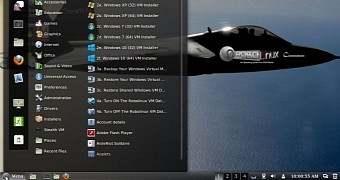 Robolinux is a Linux distribution based on Debian that features various flavors and that allows its users to run Windows apps via a virtual machine solution. Now the developer has released the first version in the 8.x branch, and it’s powered by a Cinnamon desktop.
This is the first edition of Robolinux that is based on the new Debian 8, and it looks like the developers also chose to make Cinnamon the default desktop. The previous branch was using GNOME, but it’s not sure i… (read more)

The small piece of blue tape is almost lost in the pattern of the carpet in the darkened hotel room.
There is no furniture, no lights, just a bit of illumination coming from the adjacent, connected room.
I shift my weight from left to right foot and inch a bit closer to the blue tape.
“You don’t have to be right on it.”
 The latest version of the stable Linux kernel, 4.1.3, has been made available by Greg Kroah-Hartman, which means that this is now the most advanced version released.
It’s been a while since the 4.x branch was released, and now it’s coming into its own. This particular branch has already received quite a few updates, and it’s been integrated with numerous distros already. The fact that it’s the most advanced out there is also a good incentive to use it if you want the best s… (read more)
 As power consumption has become the biggest challenge for data centers, many companies have looked to the Sun (read solar power) to cut costs and reduce carbon pollution. A much simpler solution lies in the chips powering these server farms, however.
Now that 64-bit ARM architecture is a reality, low-power ARM chips are finally becoming a viable contender in the server space and there are signs the tech industry has started to adopt them. In April PayPal, for example, deployed servers running on 64-bit ARM processors in what will perhaps become the model for other big companies to follow.
Another sign of the times is that Linux companies, which dominate the server space, are also responding to the market trend. One of the trinities of the Linux world – SUSE – has launched its partner program to bring SUSE Linux Enterprise 12 to 64-bit ARM processors.
“The expansion of our program to include the 64-bit ARM code allows our partners to develop, validate and move towards shipping solutions that utilize 64-bit ARM technology in combination with a stable and supportable enterprise Linux operating system,” according to Senior Technical Strategist David Byte and Senior Director of Product Management and Operations Gerald Pfeifer of SUSE. “The ARM platform provides a common base on which various chip vendors can build and differentiate. We are offering these vendors the opportunity to jointly work on these solution designs, provide a solid base, and optimize per individual objectives.”
Under SUSE’s ARM program the company will offer partners a version of SUSE Linux Enterprise 12 so they can develop, test and deliver products to the market using 64-bit ARM chips from vendors including AMD, AppliedMicro and Cavium along with server manufacturers Dell, HP, Huawei and SoftIron. The goal is to provide customers with more choice, flexibility, and opportunities to save on their technology infrastructure.
When I asked if 64-bit ARM is fully supported by SUSE, Byte and Pfeifer said, “We have had SUSE Linux Enterprise successfully running on 64-bit ARM in our labs for a while, and openSUSE (the “upstream” of SUSE Linux Enterprise) is running on this platform, as well.”
“SUSE is a historical innovator, and this program brings the same benefits and interaction to the ARM AArch64 ecosystem that our partners providing X86-64, Power and System z solutions already experience,” said Ralf Flaxa, SUSE vice president of engineering, in a press statement.
ARM’s efficiency is still an area of debate, as there have not been many large-scale ARM deployments before PayPal. We really don’t know how well they perform against the traditional x86 chips.
When I asked SUSE what are the primary advantages of ARM 64 architecture over x86-64 SUSE refrained from getting into specifics. Byte and Pfeifer said, “This is a question best answered by ARM and chip vendors building on their designs. At SUSE, our approach has always been to support as well as possible whatever hardware platform a customer wants to use, more so than suggesting which platform to actually use. The most interesting difference between 64-bit ARM and x86-64 is that licensees of the ARM architecture can add their own IP to the silicon. This could be networking, encryption engines or other technology that benefits a particular solution.”
They did make clear that ARM users will not miss any features as compared to the x86-64 platform. Byte and Pfeifer said, “Our approach always has been to treat and enable platforms on equal footing as much as possible (e.g., we do not feature sound support on mainframes).”
Contrary to a perceived belief, PayPal was not taking a performance hit by moving from x86 to X-Gene from Applied Micro. Mentioning the deployment Dr. Paramesh Gopi, CEO of ARM chip maker Applied Micro, said during an investor conference, “The X-Gene equipped units cost approximately one-half the price of traditional data center infrastructure hardware and incurred only one-seventh of the annual running cost. Even with these dramatically favorable capital and operating expense reductions, the X-Gene equipped systems delivered performance equivalent to the incumbent infrastructure.”
In a nutshell ARM is cheaper than x86, without compromising the performance. Putting its trust in ARM, SUSE said in the press statement, “ARM server processors provide a scalable technology platform that can be configured to meet diverse business and application needs in the data center, such as efficient web-scale workloads and rapid cloud build out.”
Byte and Pfeifer told me, “We are seeing interest across several key segments of the industry. Of particular note would be the strength of interest from hardware and system vendors around diverse scenarios such as high performance computing over “regular” data center computing, to software-defined storage, as well has telecom. We are also seeing interest from the cloud and appliance builders.”
SUSE sees immense possibilities in different sectors. They believe partners can take advantage of SUSE Linux Enterprise support for ARM processors in various market areas, including purpose-built appliances, such as security, medical and network devices; hyperscale computing; distributed storage; and software-defined and classic networking.
OpenSUSE Build Service (OBS) is one of the lesser known, but excellent services offered by the company; it’s used even by competitors and many minor and major open source projects. SUSE is using OBS to simplify partner access. They have implemented support for ARM and AArch64 into its OBS. This support will enable the open source community to build packages against real 64-bit ARM hardware and the SUSE Linux Enterprise 12 binaries, improving time to market and compatibility for AArch64 solutions.
This will directly benefit the end users as it would take less time for partners to build, test, and release products.
However, the program is not for everyone Byte and Pfeifer said, “The target audience is slightly biased toward partners who wish to build solutions based on 64-bit ARM technology. In a more traditional sense, these would mostly be considered appliances, but we are not restricting it to just that demographic.”
SUSE is offering this program for free to new and existing partners who focus on ARM-based platforms. If you are in interested in participating, you need to be a member of SUSE’s PartnerNet program.