Home Blog Page 1153

Varnish API Engine Focuses on Performance Amid Heavy Traffic

Varnish Software, the Norwegian web-performance company behind the open source project Varnish Cache is releasing Varnish API Engine, focused on managing high call volumes.

Early customer trials — the first with FINN.no, Norway’s most popular site for classified ads — indicate the Varnish API Engine can scale to handle up to 20,000 API calls per second, according to the company.

Varnish Software helps clients such as Pinterest, Wikipedia and major news sites such as The New York Times and BBC handle their web traffic — as much as 20 to 25 percent of Internet traffic, according to founder and CTO Per Buer.

1812f2e

Read more at The New Stack

How the Syria Airlift Project is Using Open Source Dronecode for Humanitarian Aid

Syria Airlift training

Mark Jacobsen is the founder and Executive Director of Uplift Aeronautics.

In March of 2014 I found myself on the Turkish-Syrian border, doing research among Syrian refugees. The stories I heard were horrific. Mass sieges were in effect; the Syrian government and brutal militias were starving out entire neighborhoods, and the government appeared to be deliberately targeting hospitals and doctors. Smuggling medical supplies into opposition-held areas was punishable by torture and death. Syrians were besides themselves, trying to find some way to get food and medicine into these besieged areas. They asked me why the US did nothing.

As a US Air Force C-17 cargo pilot, this is something I know about. The stark reality is that manned cargo airplanes cannot enter contested airspace without being shot down. After hearing these stories, that wasn’t good enough for me. I thought: surely in the 21st century, there must be some way to get at least some aid through. It seemed that micro-UAVs and swarming technology might hold the key. No single airplane could carry much, but if a launch crew could dispatch a plane every five minutes carrying 2 kilograms, that would be 192 kg (420 pounds) per night… per launch crew. The planes would be small, cheap, quiet, difficult to detect, and inefficient to shoot down.

We formed a group called the Syria Airlift Project to develop and implement the concept. Later, this grew into a broader nonprofit corporation called Uplift Aeronautics with a mission to “empower and aid communities through innovative aviation technology.” We currently have the ability to deliver 1 kg packages at a range of 30 kilometers and then return, and are working on a larger plane capable of delivering 2 kg packages at a range of 50 km, which is enough to reach Aleppo from Turkey. We would launch and recovery from Turkey and airdrop via parachute inside Syria, to recipients identified by experienced medical NGOs.

Our airlift paradigm is labor intensive, which is why we looked to nonviolent, mass-participation campaigns like Gandhi’s homespun cloth effort. More than 3 million Syrian refugees are scattered throughout neighboring countries. Many can’t work and are suffering from the boredom and humiliation of unemployment. After four years of barbaric war with no end in sight, they have little hope and their spirits are broken. With the Syria Airlift Project, we could give them something to believe in and give them direct roles in bringing healing back to their country.

The security challenges of a project like this are extraordinary, which is why we turned to Dronecode technology. In a nutshell, we need to make our planes very easy for the good guys to operate and very hard for everyone else. With open-source software like APM:Plane, we could build custom security features right into our firmware. Our custom firmware recognizes when planes are entering Syria and arms custom failsafes. If a plane thinks a crash inside Syria is imminent, it triggers a mechanism that physically damages the autopilot, ensuring it can’t be reused by malicious actors. We are also working on hard-coding no-fly zones around major airports, looking at the use of cryptographic keys and other security features to control access, and experimenting with the 3DR Pixhawk and APM:Plane advanced navigation solutions to ensure continued operation in GPS denied environments.

If the open source technology is valuable to us, Dronecode’s open source community is even more valuable. We built Uplift Aeronautics as a nonprofit because we want to leverage the incredible talent in the developer and maker communities for humanitarian good. We enjoyed meeting much of this community at the Embedded Linux/Dronecode conference in March 2015, and are finding no shortage of help.

This is an extremely ambitious project with immense technological, political, and legal challenges, but we are committed to carrying forward in a safe, responsible, and legal way. Our ultimate goal is to make sieges impossible, and to help shape a world where starvation and medical deprivation are no longer effective as weapons. UAV technology opens up new frontiers for delivering humanitarian aid, and the open-source Dronecode community is uniquely positioned to create solutions.

https://www.youtube.com/watch?v=LoUs5zjOkow” frameborder=”0

Git Success Stories and Tips from Puppet Labs’ Michael Stahnke

Michael StahnkePuppet’s dozens of Git repositories see new code commits every day from more than 200 people, says Michael Stahnke, director of engineering services at Puppet Labs. And he personally uses the open source revision control system several times a day.

“I can’t think of another tool that changed the way I work, in a positive way, more than git,” Stahnke said.

In this Q&A celebrating Git’s 10-year anniversary this week, Stahnke shared why Puppet Labs uses Git, their Git success stories, and his top pro tip for using the tool. For more in our “Git Week” series, see our interviews, below, with Git creator Linus Torvalds, and project maintainers from KVM, Qt, Drupal, and Tor.

Linux.com: Why does Puppet use Git?

Michael Stahnke: We have about 150 people in engineering and another 70-100 in roles where slinging code is certainly an expectation of the job. When you have people working around the world, you need a DVCS. When you need a DVCS, you use git. Puppet (the project) moved to git in 2007, when it was just a single developer doing nearly all the coding. But the tools git provides, such as the ability to commit work on an airplane, were immediately of use.

What makes Git such a great tool?

First, cheap merges. They usually advertise cheap branching as a thing you want. I actually want cheap merges, because that’s where the trouble lies. Beyond that, it’s flexibility. We’ve done mailing list patches, we’ve used pull requests, we’ve done merges with rerere. Rebasing to make commits and branches have a clean history with messages that make sense is hugely helpful for experiments.

How many developers do you have collaborating on Git?

I think we have about 230 people using our git repos on a regular basis. We have just north of 1,000 repos in our organization on github. We manage everything from our software, to documentation to educational materials using git.

How much do you personally use it?

Personally, I use git several times a day. I’d guess I make somewhere between 2 and 20 commits a day on average (and I’m a manager).

What’s Puppet’s most active git repo right now and why?

I’m not sure what the best metric is to use for activity, but we have dozens (probably around 100) repos that basically see commits daily. Puppet is very active, as is beaker our testing framework, puppet-server, PuppetDB and lots of Puppet modules.

What is your favorite pro tip for using Git?

Version your projects using `git describe`. If you use tags, you can use ‘git describe’ to version things when doing scratch builds. We do this on nearly all of our projects in our build pipelines. It takes the guess work out of the build process and unlike just using a raw sha, it sorts properly.

Any Git success stories you can share?

When you have meaningful commit messages, everybody’s life is better. Often you can figure what was changed from the diff, but why it was changed is what’s needed in the commit message. In our commit messages we look for why something changed, how did it used to work and how does it work now. We’re pretty medieval about commit messages. The person reading those messages will appreciate the effort you put into them, even if that person is future-you. We often start our release notes by reading the commit messages for the projects.

Anything else you’d like to say to mark the 10-year anniversary?

I can’t think of another tool that changed the way I work, in a positive way, more than git.  


Read more Git Week profiles:

Git Success Stories and Tips from Wine Maintainer Alexandre Julliard

Git Success Stories and Tips from Tor Chief Architect Nick Mathewson

Git Success Stories and Tips from Drupal Core Committer Angie Byron

Git Success Stories and Tips from Qt Maintainer Thiago Macieira

Git Success Stories and Tips from KVM Maintainer Paolo Bonzini

10 Years of Git: An Interview with Git Creator Linus Torvalds

5 Reasons To Become A Linux Foundation Certified Engineer

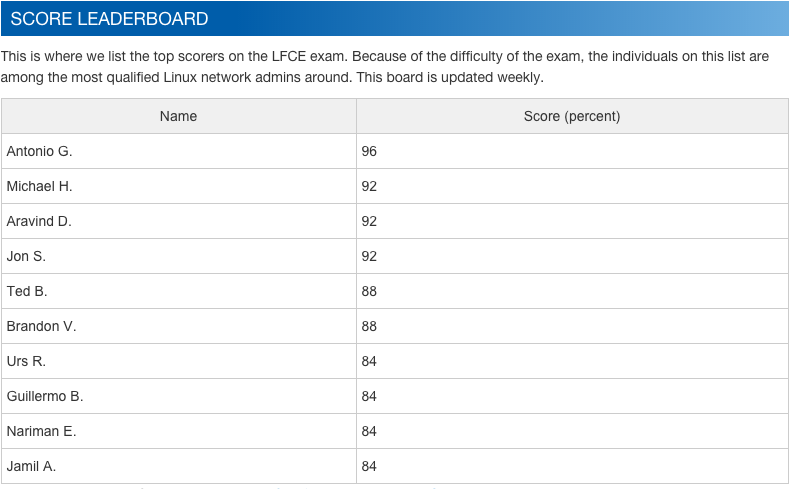
LeaderboardBecoming a Linux Foundation Certified Engineer is a challenging achievement and a good indicator of your sysadmin and network admin skills. And with the Linux job market stronger than ever, companies are looking for Linux talent to hire. So here are five reasons why you should consider sitting for the LFCE exam:

  1. Employers prefer certifications when making hiring decisions. The Linux Jobs Report found that 44% of hiring managers would be more likely to hire a candidate with a Linux certification, and more than 50% expect to see some sort of Linux certification or formal training.

  2. According to a United States government report, people with certifications make more money.

  3. Prove your chops. This exam is challenging – in fact, even some of our top kernel maintainers found it challenging! So we’ve released a new leaderboard that we’re updating weekly so you can test yourself against the best Linux has to offer. 

  4. If you’re already an RHCE or LPIC-2 or -3, try yourself out on another distro and demonstrate your versatility.

  5. We’re announcing a special sale on our Linux Foundation Certified Engineer exam. The exam, normally priced at $300, will be 50% off ($150) for a limited time. Just sign up – no coupon code needed.

Take advantage of this limited-time sale and get certified now!

Fedora 22 Beta Has Been Delayed by a Week Due to Unresolved Bugs

Fedora Project, through Jaroslav Reznik, announced that the Beta release of the upcoming Fedora 22 Linux operating system will be delayed by one week, due to unresolved blocker bugs.

The decision to delay the Fedora 22 Beta operating system was taken today, April 9, during the Fedora 22 Beta Go/No-Go meeting that took place on IRC at 17:00 UTC … (read more)

Read more at Softpedia News

Git Success Stories and Tips from Tor Chief Architect Nick Mathewson

Nick MathewsonTor, the free and open source software for anonymous web communications, has been using the Git revision control system for more than six years. The tool is so ingrained in the project’s development that Director and Chief Architect Nick Mathewson’s daily work flow is built around Git, he says.

“Git’s the eighth version control system I’ve had to use, and the first one I’ve seriously trusted,” Mathewson said. “Many thanks to the Git developers for all their hard work.”

In celebration of Git’s 10-year anniversary this week, Mathewson shared why the Tor Project uses Git, their Git success stories, and his pro tips for using the tool. For more in our “Git Week” series, see our interviews, below, with Git creator Linus Torvalds, and project maintainers from KVM, Qt, and Drupal, with more to come tomorrow.

Linux.com: Why does Tor use Git?

Nick Mathewson: We switched to Git from SVN in 2009 because we wanted offline development, distributed development, and merging to work. We need to manage a few stable and unstable releases simultaneously, and we frequently apply feature patches that require multiple revisions and long, complex branches. For both of these cases, having robust support for merging was valuable.

We picked Git over the other options because it seemed to be gaining the most mindshare among developers. That still seems to be the case.

What makes Git such a great tool?

It’s obviously designed by programmers who made it to use it themselves, and who understand that even in the sleekest version control system, you often need to get under the hood and access raw internals.

How many developers do you have collaborating on Git?

Our git repositories contain commits from hundreds of developers. (See gitweb.torproject.org for more information.)

How much do you personally use it?

I use Git every day; my workflow is built around it.

What’s Tor’s most active Git repo right now and why?

For group projects, I’d guess that would be either the repository for the Tor program itself, or the repository for the Tor Browser, mainly because those have the most developers.

What is your favorite pro tip for using git?

I’ve attached a script I use to squash git commits without rebasing them. This makes the squash commits happen, but prevents (most) rebase conflicts.

And here is my favorite non-pro tip for Git:

Any git success stories you can share?

A little while ago, I needed to decide what parts of Tor we should prioritize testing on. I guessed that functions which change frequently over time, and which get changed by many people, are likelier to have bugs than ones which didn’t. So I wrote a little python script to parse git blame and git log -p output, and had a full analysis of our change frequency by function since 2002.

On a more prosaic note, my sister lives out in the woods and has no reliable internet connection. Git enables me to get work done when I’m visiting here, which was nigh-impossible back before we had offline operation.

Anything else you’d like to say to mark the 10-year anniversary?

Git’s the eighth version control system I’ve had to use, and the first one I’ve seriously trusted. Many thanks to the Git developers for all their hard work.


Read more Git Week profiles:

Git Success Stories and Tips from Wine Maintainer Alexandre Julliard

Git Success Stories and Tips from Puppet Labs’ Michael Stahnke

Git Success Stories and Tips from Drupal Core Committer Angie Byron

Git Success Stories and Tips from Qt Maintainer Thiago Macieira

Git Success Stories and Tips from KVM Maintainer Paolo Bonzini

10 Years of Git: An Interview with Git Creator Linus Torvalds

Google Adds Chrome OS Support to Read, Write Files on Android Phones

Getting at photos and other files on a USB-connected Android phone is about to get easier if you have a Chromebook, thanks to a new experimental feature in Chrome OS.

Read more at ZDNet News

Dead Xbox 360 Converted to a Linux Server

Converting a dead Xbox 360 to a Linux server is not as difficult as it seems, especially if you only use the case of the console. It’s still a nice try, and it will make a nice addition to the living room.

A Reddit user has posted images with a Xbox 360 that has been repurposed as a Linux server. Don’t get all that exc… (read more)

Read more at Softpedia News

Microsoft is Making a Stripped Down Windows to Rival Linux

TODAY, BIG SILICON Valley names like Google and Twitter run their online services across thousands of machines. And to efficiently execute their software with so much hardware in the mix, they use the open source Linux operating system and a technology called “containers.†What they don’t use is Windows.

Microsoft’s flagship operating system operates quite differently from Linux—which could be a problem as containers become the preferred way of computing in the cloud. But now, as so many others follow the lead of giants like Google and Twitter, Microsoft is reshaping Windows so that it doesn’t get left behind.

Read more at Wired.

Linux Foundation Takes Web Security and Encryption Platform Under its Wing

The Linux Foundation has its sights set on putting reliable open source technology at the center of the web security and encryption scenes. The nonprofit organization announced that it will host the Internet Security Research Group (ISRG) and its Let’s Encrypt open certificate authority platform. It is a free, automated and open security certificate authority that is billed as “for the public’s benefit.” Let’s Encrypt allows website owners to obtain security certificates within minutes, purportedly enabling a safer web experience for all.

Akamai, Cisco Systems, Electronic Frontier Foundation, Mozilla and other organizations are backing the effort. 


Read more at Ostatic