Peter Baldwin has announced the release of ClearOS 6.6.0 “Community” edition, a CentOS-based Linux distribution for cloud-connected servers and gateways designed for homes, hobbyists and small organisations: “ClearOS Community 6.6.0 final has arrived! Along with the usual round of bug fixes and enhancements, this release introduces WPAD, QoS,….
Proxmox Server Solutions GmbH proudly announced on February 19, 2015, the immediate availability of version 3.4 of its powerful, open-source, and reliable server virtualization management computer operating system, Proxmox Virtual Environment (VE). The release brings a number of new features and improvements, including NUMA support (non-uniform memory access), ZFS storage plug-in, hotplug support, as well as the latest and greatest ZFS file system.
Proxmox VE (Virtual Environment) 3.4 is bas… (read more)
Are you doing multi-tasking on your Linuxmachine and suddenly there is a power cut? Is you Laptop battery low or have any problem with you PC’s UPS? Then Hibernate is a good option for you! You can save all your work and resume where you left after switching on computer.
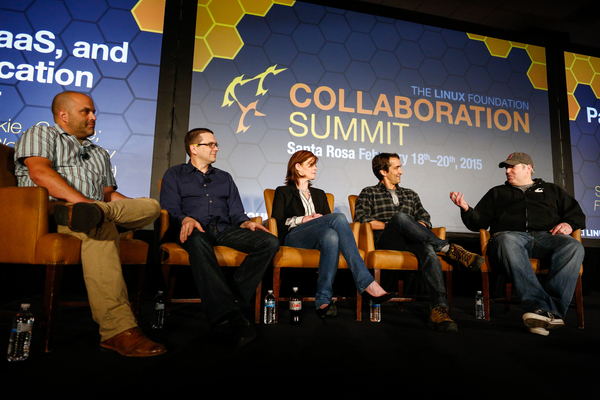
A panel of Platform as a Service and container experts at Collaboration Summit Wednesday didn’t agree on many things – including the relative importance of PaaS and containers, which is more useful for developers, and how the ecosystem will evolve. But they all agreed that the PaaS ecosystem relies on open source to remain relevant and useful.
Here are some of the best quotes from the panel, which included (from left to right in the photo, above) Steven Pousty, Red Hat; Craig McLuckie, Google; Lauren Cooney, Cisco; Sam Ramji, Cloud Foundry Foundation; and moderator Stephen O’Grady, RedMonk.
1. “VM’s are the icebreaker for containers. People got used to running on virtualized hardware… and because of that containers can say, “We’re going to run multi-tenant on your machine” and you say, “ok.” Oh, and you’re going to be lighter weight than a VM? Awesome. I’m all about containers now.” – Steven Pousty, Red Hat.
2. “This containers revolution is changing the basic act of software consumption. It’s redefining this much more lightweight, portable unit, or atom, that is much easier to manage… It’s a gateway to dynamic management and dynamic systems.” – Craig McLuckie, Google.
3. “If you’re an application developer you should be playing with PaaS now. (Organizations) are doing your developers a disservice if they’re not playing with PaaS.” – Steven Pousty.
4. “If you think about Andreesen’s “software is eating the world” you can take that a step further and say, if you’re not available in the cloud, if you only have APIs, you don’t exist. It’s like not having a website in 1995.” – Sam Ramji, Cloud Foundry Foundation.
5. “Organizationally… there are massive silos across the board when you look at networking, storage and compute and up the stack, and then where does security fit in? It’s not just like, “oh, I can use a PaaS platform and it’s magic.” There’s all of this underlying stuff that has to go into it and people don’t recognize that.” – Lauren Cooney, Cisco.
6. “I can’t personally separate container and PaaS anymore.” – Craig McLuckie.
7. “I don’t see how this (PaaS) ecosystem can exist without open source.” – Steven Pousty.
8. “It took convincing to do a cloud service open source – I’m so glad I did… Anyone trying to build a mainstream product is going to be at a massive disadvantage to the open source community.” – Craig McLuckie.
9. “Interoperabily with existing systems will be extremely important with open source to make sure there’s the right plugins or drivers that can enable applications to run across multiple environments and also support multiple PaaS platforms.” – Lauren Cooney.
10. “The amount of app development that needs to be done is unprecedented. We are never going to have enough app developers to meet the demand.” – Sam Ramji.
NetUP Inc. fully open sourcing firmware for DVB card – NetUP Dual Universal DVB CI. License is GPLv3. Sources is VHDL for Altera FPGA EP4CGX22CF19C8 and can be compiled with Altera Quartus II (free edition).
The latest thing you can watch on YouTube or Twitch, a site where you can watch other people play video games, isn’t a League of Legends match or a Starcraft championship. Instead, it’s a dude, sitting in his house in Russia, staring at a black screen, writing thousands of lines of Python as he tries to create a new search engine.
Welcome to the ​world of Watch People Code, a premise which couldn’t possibly be any more straightforward and is exactly what it sounds like. It’s an idea that hasn’t exactly taken off yet, but that has at least gotten a bit of a following. The associated subreddit that it grew out of has garnered nearly 5,000 subscribers in less than a month, and at any given time, you can, well, watch someone code.
We have to admit that today’s flash sale of Ubuntu phones was a successful one, especially because we managed to get one too and because we saw a lot of happy people posting tweets about purchasing the first ever Ubuntu-powered smartphone. The Ubuntu Phone flash sale is now over, as announced by BQ on their Twitter account, and confirmed by Canonical.
This was the second Ubuntu Phone flash sale to date, after the February 11 one, which ended leaving many disappointed users who tried to purch… (read more)
The arrival last week of Linaro’s open source 96Boards specification — ARM’s first pseudo-official SBC form factor standard — shows that ARM is serious about bringing order to the chaotic ARM hacker board scene. 96Boards is a preemptive attempt to consolidate Linux and Android development before a new wave of ARMv8 hacker boards hits the scene later this year.
Linaro’s 96Boards.org developer community and standards organization has defined a 96Boards Consumer Edition (CE) spec for ARM single board computers running Debian, Android, and other Linux-based distros. The spec defines either an 85 x 54mm or 85 x 100mm footprint, as well as standardized 40- and 60-pin expansion connectors for stackable boards. A higher-end Enterprise Edition (EE) spec will follow in the second quarter.
Meanwhile, BeagleBone manufacturer CircuitCo has announced a flagship CE-compliant board called the HiKey. Available for $129 from Arrow and Avnet, the HiKey appears to be the first 64-bit, ARMv8-based SBC to reach market. It runs on a new octacore Cortex-A53 Kirin 620 system-on-chip from Huawei’s HiSilicon processor division, the only other Linaro Core Member aside from ARM. Marvell and Action Technology are also prepping 96Boards SBCs, and AMD is developing a server-oriented product.
ARM sells a Juno Versatile Express board with its own generic octacore Juno SoC design with ARMv8 Cortex-A57 and –A53 cores, but this is a pricey, high-end development platform.
In October, Allwinner tipped a Nobel64 development board based on an upcoming ARMv8 Allwinner H64 SoC, but it has yet to reach market.
That leaves the HiKey alone for a moment as the only ARMv8 hacker SBC.
96Boards starts with ARMv8
The not-for-profit Linaro, a development firm that builds standardized, open source Linux and Android tools for ARM processors, is overseeing 96Boards.org via a new Linaro Community Board Group (LCG) that will help it certify boards for compatibility. Linaro, which was founded by ARM and its key licensees, boasts some 200 engineers and 29 members, including major vendors like Qualcomm, and is one of the top upstream contributors to the Linux kernel.
In recent years, Linaro has helped to clean up the chaotic and fragmented ARM Linux code base. Their progress has been remarkable, although compared to the x86 world, ARM Linux developers still face a more confusing array of platforms, options, and out-of-date code. Now, Linaro is aiming to standardize the community-backed SBC scene where over 40 different boards from dozens of projects and companies have created their own fragmented landscape marked by many different SoCs and expansion interfaces.
It’s no accident that the first 96Boards SBC is based on a 64-bit ARMv8 SoC. The ARM single board computer scene will continue to be dominated for several years by low-cost ARMv7 boards like the Raspberry Pi, BeagleBone, and Odroid SBCs. Yet, 64-bit ARMv8 boards based on Cortex-A53 and Cortex-A72 — ARM’s newly announced Cortex-A57 replacement — are on the way this year, starting with the HiKey.
Following x86 lead toward standardization
Embedded board standards are relatively new to the ARM world. As commercial embedded vendors have added more ARM-based boards to their collections, they have largely turned to x86-oriented standards, but community-backed SBCs go their own way and come in all shapes and sizes.
The most successful SBC specs have come not from Intel, but from relatively tiny Via Technologies, a maker of x86, and now ARM-based processors and boards. Before Via came up with the 6.7 x 6.7-inch Mini-ITX form factor over a decade ago, there were already common x86 form factors like EPIC or 3.5-inch formats. Via followed up with progressively smaller Nano-ITX and 100 x 72mm Pico-ITX form factors. A number of ARM-based Pico-ITX SBCs have reached market in recent years, but the main focus is still on x86.
SBC form-factors have never been as widely adopted in the x86 world as computer-on-module (COM) standards, such as COM Express and QSeven. The typical x86 approach is to match a standardized COM with a carrier board, and then develop a custom embedded board. By contrast, the ARM world is dominated more by SBCs than COMs, although many ARM-based COMs have arrived in recent years, including several based on an ARM-oriented SMARC form factor.
The Raspberry Pi has been the clear SBC leader, but has never quite reached the point of becoming a de facto standard. This is mostly because it has trailed on the processor side. Only recently has it come up to ARMv7 with the arrival of the quad-core Pi 2.
The popularity of the Pi, however, has inspired a number of semi-clones such as the Banana Pi and Orange Pi, which have adopted its 26-pin and new 40-pin expansion connectors. Although the 96Boards spec calls for a 40-pin connector, it appears to be incompatible with that of the Pi. This is another sign that ARM is now looking to lead the SBC scene instead of follow.
Will hackers follow?
There’s no guarantee, however, that the SBC community will follow ARM. The 96Boards announcement lacked promises of support from major SBC projects or embedded firms.
No doubt, more projects will join in the effort, but many are likely to balk at the spec’s restrictions. Granted, they’re pretty loose – most boards are going to already have the required minimums of 512MB RAM (1GB for Android), as well as a microSD slot, WiFi and Bluetooth 4.0, HDMI or DisplayPort connections, dual USB host ports, and an OTG port. However, it’s unclear if board vendors will go for all the specified pin assignments on the expansion connectors, or agree with the size and power requirements.
ARM and Linaro do, however, make a compelling case, as presented in Linaro CEO George Grey’s 96Boards presentation at last week’s Linaro Connect Hong Kong (see video below). By standardizing on size, expansion connectors, and basic features, 96Boards enables faster time to market, as well as the potential for a robust add-on market ecosystem, said Grey. Meanwhile, software developers can benefit from a single community website for common Linux and Android builds, as well as other downloads.
If nothing else, ARM has given itself a chance for success by getting out in front of the ARMv8 deluge rather than following the unruly masses of ARM hackers. It remains to be seen whether they will follow or cry “Standards? We don’t need no stinking standards!”

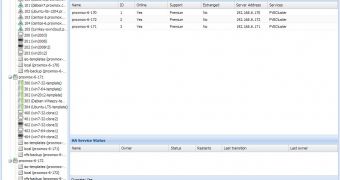 Proxmox Server Solutions GmbH proudly announced on February 19, 2015, the immediate availability of version 3.4 of its powerful, open-source, and reliable server virtualization management computer operating system, Proxmox Virtual Environment (VE). The release brings a number of new features and improvements, including NUMA support (non-uniform memory access), ZFS storage plug-in, hotplug support, as well as the latest and greatest ZFS file system.
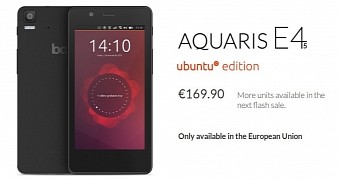 We have to admit that today’s flash sale of Ubuntu phones was a successful one, especially because we managed to get one too and because we saw a lot of happy people posting tweets about purchasing the first ever Ubuntu-powered smartphone. The Ubuntu Phone flash sale is now over, as announced by BQ on their Twitter account, and confirmed by Canonical.
 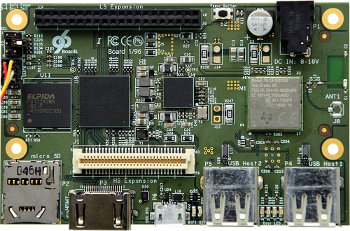 The arrival last week of Linaro’s open source 96Boards specification — ARM’s first pseudo-official SBC form factor standard — shows that ARM is serious about bringing order to the chaotic ARM hacker board scene. 96Boards is a preemptive attempt to consolidate Linux and Android development before a new wave of ARMv8 hacker boards hits the scene later this year.