Home Blog Page 1207

Ninja Blocks Home Automation Solution Now Supports Ubuntu Snappy Core

Ninja Blocks, a new kind of smart home controller that got funded through Kickstarter already, has announced that it will provide support for Ubuntu Snappy Core and it will make it feel right at home in the “Internet of Things.”
Internet of Things is a new concept that gathers all the smart devices that can connect online under a single roof. As you can imagine, there is a lot of competition on this market and everyone wants to have operating systems ready for this new trend that’s been foret… (read more)

Read more at Softpedia News

GNOME Boxes 3.16 Will Bring a Cool Welcome Screen and Numerous Improvements

As we’ve reported earlier today, the GNOME development team is hard at work to bring you the latest GNOME 3.16 desktop environment, due for release on March 25, 2015. GNOME Boxes, the default virtualization software of GNOME based on QEMU, will also be part of the forthcoming release of the graphical environment, bringing a number of enhancements and new features. The first Beta version of GNOME Boxes 3.16 is now available for testing.

The first thing users will see when opening the GNOME Bo… (read more)

Read more at Softpedia News

​500,000 Raspberry Pi 2 Model B Boards Sold

Within two weeks, the Raspberry Pi Foundation has shifted 500,000 of its new Raspberry Pi 2 Model B boards, helping make it the fasted selling British computer.

Read more at ZDNet News

Lenovo Installs Adware on Its Computers That Could Let Hackers Steal Private Data

A vulnerability has been discovered in a piece of software that ships pre-loaded onto Lenovo computers that could grant hackers access to a user’s secure browser data, allowing third parties to potentially collect passwords, bank details, and other sensitive information.

Superfish, an adware program that Lenovo admitted in January it included as standard on its consumer PCs, reportedly acts as a man-in-the-middle” so it can access private data for advertising purposes. The adware makes itself an unrestricted root certificate authority, installing a proxy capable of producing spurious SSL certificates whenever a secure connection is requested. SSL certificates are small files, used by banks, social networks, retailers such as Amazon, and…

Continue reading…

Read more at The Verge

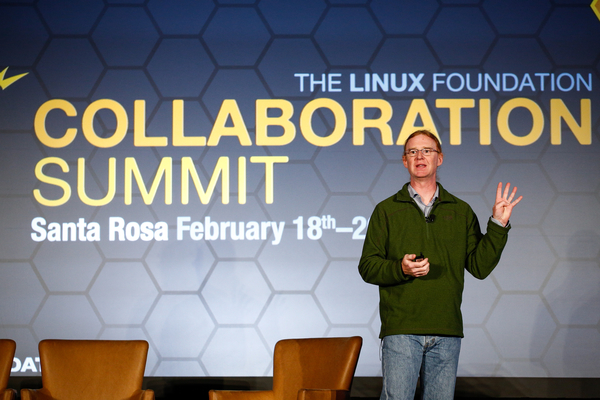
10 Highlights of Jon Corbet’s Linux Kernel Report

Jon Corbet

In his keynote talk at Collaboration Summit, kernel contributor and LWN Editor Jon Corbet elaborated on the results of the Who Writes Linux report, released today, and gave more insights on where kernel development is headed over the next year, its challenges, and successes. Here are 10 highlights (watch the full video, below): 

1. 3.15 was the biggest kernel release ever with 13,722 patches merged. “I imagine we will surpass that again,” Corbet said. “The amount of changes to the kernel is just going up over time.”

2. The number of developers participating is going up over time while the amount of time it takes us to create a kernel is actually dropping over time. It started at 80 days between kernel releases some time ago, and it’s now down to about 63 days. “I don’t know how much shorter we can get,” he said.

3. Developers added seven new system calls to the kernel over the past year, along with new features such as deadline scheduling, control group reworking, multiqueue block layer, and lots of networking improvmenets. That’s in addition to hundreds of new hardware drivers and thousands of bug fixes.

4. Testing is a real challenge for the kernel. Developers are doing better at finding bugs before they affect users or open a security hole. Improved integration testing during the merge window, using the zero day build bot to find problems before they get into the mainline kernel, and new free and proprietary testing tools have improved kernel testing. But there is still room for improvement.

5. Corbet’s own analysis found 115 kernel CVE’s in 2014, or a vulnerability every three days. 

6. The kernel has roughly 19 million lines of code, and over 3 million lines haven’t been touched in 10  years. The problem with old, unmaintained code is that it tends to harbor some really old bugs. “We have millions of systems out there running Linux and milions of people relying on security of a system on which the Linux kernel is the base,” Corbet said. “If we’re not going to let those people down, we need to be more serious about security.”

7. The year 2038 problem – the year the t value runs out of bits in the kernel’s existing time format – needs to be fixed sooner rather than later. The core timekeeping code of the kernel was fixed in 2014 – the other layers of the kernel will take more work.

8. The Linux kernel is getting bigger with each version and currently uses 1 MB of memory. That’s too big to support devices built for the Internet of Things. The kernel tinification effort is re-thinking the traditional Linux kernel, for example getting rid of the concept of users and groups in the kernel, but it faces some resistance. “We can’t just count on the dominance of Linux in this area unless we earn it” by addressing the needs of much smaller systems, Corbet said.

9. Live kernel patching is coming to the mainline kernel this year.

10. The kdbus subsystem development – an addition coming in 2015 that will help make distributed computing more secure – has been a model of how kernel development should work.

https://www.youtube.com/watch?v=brZ8m0ku1YA” frameborder=”0

Twitter’s Aurora and How it Relates to Google’s Borg (Part 1)

The information jobs for the remainder of the 21st century will not be managed by operating systems. Today, we perceive Twitter as one of a very few examples of services that run at “Internet scale” — at a scale so large that the size of its domain is meaningless. Yet Twitter is actually an example of what one day, within most of our lifetimes, will be considered an everyday job, the sort of thing you expect networks of clustered servers numbering in the tens of thousands to do.

Twitter is building a service automation platform called Aurora. It isn’t done; its current version number is 0.7. It is a job control system of sorts, but rather than controlling the server that runs the job — as operating systems used to do back when they were in command of the data center — it controls the job that indentures the servers.

But unlike the premier “Internet-scale” service Google, Twitter is building Aurora in the open.

Read more at The New Stack

Systemd Gets An Fsck Daemon/Service

The newest addition to systemd just a day after landing its new EFI boot manager is systemd-fsckd. This new addition was done by Ubuntu developers…

Read more at Phoronix

Sony Taps Linux Robot Car Tech for Self-Driving Car Project

Sony is developing self-driving car technologies with ZMP, which sells autonomous RoboCar development platforms with Linux-based control and sensor systems. Sony has turned to fellow Japanese company ZMP to develop a self-driving car, says the Financial Times (FT). Sony also invested 100 million yen ($842,000) in ZMP for a 2 percent share. The partners are […]

Read more at LinuxGizmos

Korora Comes Bursting With Extras

Korora, a Linux distro based on Fedora, the community version of Red Hat Enterprise Linux, just keeps getting better. When I reviewed Korora 19, released in July 2013, I said it had the potential to grow in popularity among users looking for a better, more user-friendly Linux distro that reaches beyond Fedora’s enterprise appeal. The latest release, Korora 21, provides even more assurance of that statement’s accuracy. Korora is packed with lots of additional packages besides those provided by the Fedora community.

Read more at LinuxInsider

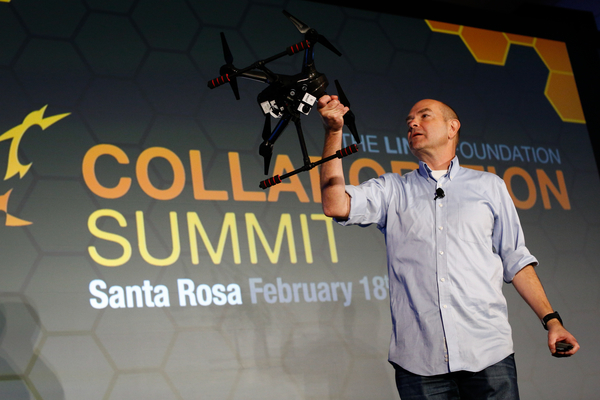
Dronecode: Taking the Internet of Things to the Skies

Chris Anderson

In 2007 former Wired Magazine Editor Chris Anderson built a Lego mindstorms robot with his kids in an effort to get them interested in science. Two years later he founded 3DRobotics, now the largest personal drone company in North America.

The initial toy wasn’t that interesting to his kids who were raised on Hollywood robots, he said in a keynote talk Wednesday at Collaboration Summit in Santa Rosa. So they undertook a more ambitious project to build a Lego autopilot and ended up building the first Lego drone – now in the Lego museum – at a time when drones were largely only built by the aerospace industry for military purposes.

“What we essentially did was weaponize Lego with my children around the dining room table,” Anderson said.

It was through this experience – building something he shouldn’t have been able to build on his own – that Anderson had a realization. The same market forces that enabled Lego mindstorms now represented an opportunity to disrupt an entire industry. While the aerospace industry was busy making military drones, no one was building commercial drones for consumer use, he said. 

“I got chills. And the last time I got chills was the first time I used the Web,” Anderson said. 

But what were the forces enabling a geeky dad to build a drone with off-the-shelf components? The growing smartphone market was making mobile components including MEMS sensors, ARM processors, GPS, camera sensors, wireless modules, and batteries, more accessible and affordable. At the same time, the DIY and maker communities were taking off — sharing ideas and open source hardware designs online. 

In short, “hardware was starting to look like software,” Anderson said.

The combination of open innovation and accessible components created an enormous opportunity and 3D Robotics has blazed the trail to a new commercial drone industry. The startup now has venture capital backing and around 200 employees. 

Drone technology has also reached a maturity level that the embedded Linux, ROS (Robot Operating System) and drone communities are converging, Anderson said. Dronecode, a Linux Foundation Collaborative Project, is designed to bring these various communities together to work on a common open source platform for Unmanned Aerial Vehicle (UAV) technology.

“We’re the Android in our industry,” Anderson said. They’re taking on competitors not with their software or their hardware, but with their openness. 

The Dronecode project includes contributions from companies such as Intel and Qualcomm, which are innovating in ways that 3DRobotics couldn’t on its own, Anderson said. And companies like Google and Amazon are using the platform as the basis for their own drone projects. 

“Drones aren’t just drones anymore,” said Anderson who envisions a cloud of autonomous sensors in the sky, collecting information and effectively digitizing the physical world.  “Drones are sensors in the sky. Drones are big data. Drones are ways to send the Internet into the skies.”