
The company is working on a new Android version that will power a car’s entertainment and navigation systems, connect it to the Internet and more.
Read more at eWeek
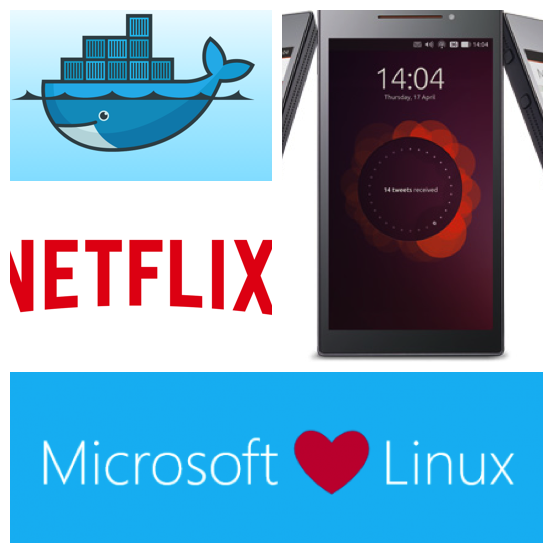
Two Thousand and Fourteen was an exciting, tumultuous and rather funky year for Linux.
Great consumer news, forks, death threats, hardware delays and… something truly unthinkable just a few years ago. Truth be told I’m still trying to wrap my head around, what feels like, the zaniest year of Linux shenanigans I have ever seen.
Here are the 5 stories that, I feel, best sum up what happened with Linux (and the related Open Source world) in 2014.
Netflix has promoted the use of open source software for years now – yet their ability to stream TV and Movies to Linux desktops has remained elusive. Annoyingly so.
Did Netflix support a wide range of Linux-powered devices? You bet. Android, Chromecast, Roku and many other Linux-powered set-top boxes have been supported for quite some time. Just not traditional Linux desktops. Users of Ubuntu, openSUSE and the rest were simply… out of luck. It was beginning to feel like official Netflix support for Linux was becoming the unicorn of the Linux world. A glorious creature, capable of shooting rainbow colored lasers from its eyes, that seems like it ought to exist – like it should exist – but nobody has ever actually seen one in the wild.
All that changed in October of this year when it was announced that – if you use Google Chrome – you could now stream videos from Netflix on Linux. No hacks. No fancy trickery. Just install Chrome, go to Netflix.com, and watch the live-action version of The Tick (and maybe some other show after you’ve finished The Tick).
Boom. Unicorn. With rainbow-eye-lasers and everything.
The saga of systemd didn’t begin in 2014 – its origins date back to March of 2010 – but 2014 is the year that this little init system replacement (okay, so it does a lot more than that) made the Linux world lose its collective marbles.
Adoption of systemd has been rapid. GNOME and multiple Linux distributions adopted it during a fairly short period of time. But all was not hunky dory in Linux-land.
A “boycottsystemd.org” website went up (and has since gone away – here is the archived copy) with the following statement:
“systemd flies in the face of the Unix philosophy: ‘do one thing and do it well,’ representing a complex collection of dozens of tightly coupled binaries1. Its responsibilities grossly exceed that of an init system, as it goes on to handle power management, device management, mount points, cron, disk encryption, socket API/inetd, syslog, network configuration, login/session management, readahead, GPT partition discovery, container registration, hostname/locale/time management, mDNS/DNS-SD, the Linux console and other things all wrapped into one. The agenda for systemd to be an ever-growing and invasive middleware for GNU/Linux was elucidated in a 2014 GNOME Asia talk2. Keep it simple, stupid.”
And this stance wasn’t only held by one guy with a (now-gone) website. This disdain for systemd was so rampant, in 2014, that when the Debian project decided to make systemd the default init system… a group of people decided to fork Debian (a project that is now called “Devuan”) and remove systemd entirely.
This systemd hatred even caused Lennart Poettering (one of the developers, and original author, of systemd) to believe that people on the Internet were “collecting Bitcoins to hire a hitman” for him and declared the open source community a “sick place” – putting some of the blame on Linus Torvalds himself.
Even if we don’t all agree on the viability and quality of systemd, I think we can all agree on one thing. That somewhere in 2014… things got a bit wacky.
Call it “Ubuntu Touch” or call it just plain “Ubuntu”. Whatever you call it, the promise of running a full blown Debian-based system on a shipping, supported cell phone is exciting to so many of us. Even those of us that tend to run Linux distros other than Ubuntu are pretty pumped about the prospect.
The first shipping phones were slated to start appearing back in October of 2013. Then, in February of 2014, it was announced that devices would be available (internationally) “later in 2014”. It is now the end of 2014, and word is that we’ll start seeing Ubuntu-powered phones shipping (in a modified form called “Flyme OS”… think of it like a re-spin distro based on Ubuntu Touch) some time in first quarter of 2015. Considering the “Ubuntu Phone” project hit RTM (“Release To Manufacturing”) phase back in September of this year… it sure seems like it can’t be too far off. I hope.
But Canonical isn’t the only company that failed to ship expected Linux-powered devices in 2014.
Valve announced their “Steam Machine” game console concept back in September of 2013. These boxes were set to be powered by SteamOS (based on Debian) – and were scheduled to begin shipping in 2014.
That didn’t happen. But, hey, better to be late and high quality than to be on time and rushed, right? Valve is now suggesting the first units will arrive some time in 2015.
The Internet has its collective fingers cross for you, Canonical and Valve. Because… well… we want new toys. Thankfully, we can turn to Jolla’s new Sailfish OS phone and Samsung’s Tizen-based Gear S smartwatch to keep us occupied in the meantime.
Docker and OpenStack. It’s hard throw a stick without hitting a news story about one of these two (rather excellent) projects – which are setting the trend for how “The Cloud” is built and run over the next several years.
OpenStack, for what it’s worth, isn’t new. It kicked off back in 2010, with the first commercially backed OpenStack distribution (SUSE Cloud) following in mid-2012. Red Hat followed a year later, in mid-2013, and Canonical began promoting using Ubuntu in conjunction with OpenStack earlier this year. But 2014 is definitely when the tech journalists of the world really stood up and took notice.
As much as we’ve heard about these technologies in 2014… I (personally) expect to hear even more in 2015.
I saved this one for the end… because it made my brain explode.
Microsoft’s CEO, Satya Nadella, proclaimed that “Microsoft Loves Linux”.
Yep. The same company that brought us such gems as “Linux is a cancer!” has fallen in love with our wonderful little Open Source system. There could be manyreasons for this change of heart but, whatever the cause, I like it.
Don’t get me wrong. My brain – literally… the whole brain – exploded when I saw this. But… hell… I’m a lover, not a fighter. So I’m cool with it.
All-in-all, 2014 was a bit of a roller coaster. High highs and low lows. And, I tell ya, it was a blast. I can only hope 2015 is equally crazy.
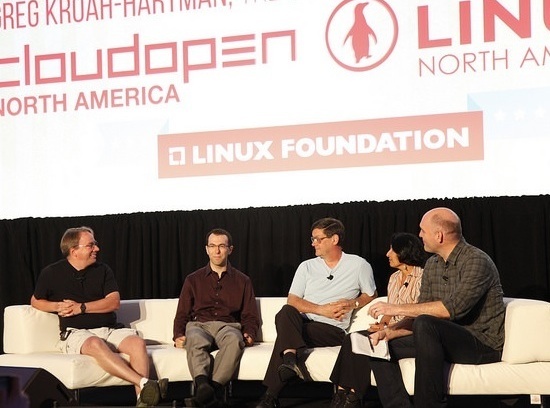
Linux is a dominant player in almost every industry segment, minus one: desktop. We heard Linus Torvalds’ pain when he uttered these words at LinuxCon North America this year, “I still want the desktop”.
What’s holding desktop Linux back? There are many factors including marketing, pre-loaded Windows, support for hardware, and availability of applications. Linus, the creator of the Linux kernel, doesn’t offer executables aka binaries of his own software Sub Surface for Linux desktop even though he does offer binaries for Mac OSX and Windows.
Why doesn’t the creator himself support his own kernel? The answer is simple: packaging applications for Linux desktop is extremely painful for app developers. He said, “You don’t make binaries for Linux, you make binaries for Fedora 19, Fedora 20 maybe there is even RHEL 5 from 10 years ago.”
He then talked about problems with Debian systems, “…you don’t make binaries for Debian stable because Debian stable has libraries that are so old that anything that was built in the last century doesn’t work.”
It looks like Canonical is trying to address this issue and they believe that the solution is just one ‘Click’ away.
Click is a new packaging format for Ubuntu mobile applications which irons out the complexity of delivering an application to a user. Developers can bundle all additional dependencies into the package without worrying about the dependecy resolution. It makes life easier for both users and developers. Developers can use latest libraries and technologies to distribute their software independent of the release cycle of a distribution. It will directly benefit their users.
Martin Albisetti of Canonical told me, “I think Linus’s main pain points are a lot of the same ones that drove us to work on Click packages. To some extent, it’s the same problem to support an app across different Ubuntu versions than it is across different Linux distros: main dependencies tend to be very sensitive to version changes, filesystem paths change and it’s hard to express dependency chains. You end up having to build your app slightly differently for each distro and version.”
Canonical developer Michael Hall explains it to me, “To some extent Click moves us a little closer to the Windows and Mac model, where anything your program needs outside of the default OS install it needs to ship in the same package, so Subsurface will need to ship it’s own copy of libmarblewidget in a Click package, just like it does for Windows and Mac, but not current Ubuntu debs. The user-space guarantee that he’ll get with Clicks are in the framework definitions, if his package says it’ll work with the “ubuntu-sdk-14.04″ framework, then it will be installable and run on Ubuntu 14.10, because 14.10 is (at least supposed to be) binary compatible with that framework.”
However, we should not get over excited because Click may not solve the problem for ‘Linux’ in general, even if it is the right solution.
The political and technical differences may stop other projects from adopting it. The latter can be easily addressed; we have seen companies adopt solutions by arch rivals: whether it was Red Hat adopting Canonical’s Upstart and then Canonical moving to Red Hat’s (not strictly) systemd.
The former, political difference, will be hard to overcome. There is an exception though. Political issues may remain a strong deterrence for community driven projects, but business driven products will incorporate everything that makes the lives of their customers easy.
Albisetti is aware of the real world and admits, “We aren’t trying to solve cross-distro installation at the moment, it’s been tried and failed before and given the current competitive environment is unlikely to get any traction. This is, however, a step in that direction.”
The problem lies in the fact is there is no ‘Linux OS’. Each distro is an OS in its own right which may be compatible with other distros. Hall says, “Nobody would expect a binary built for FreeBSD to just work on Debian, but for various reasons it’s a common belief that a binary built for Fedora could (and should) just work on Ubuntu.”
We have seen collaborative efforts within competing desktops. If distributions agree over Click can there be ‘one’ Click for ‘Linux’ that can be used on any distribution? Not likely. Click won’t change any of the current situation magically.
Hall admits, “…you’re still going to have to build separate Click packages for different OSes (Ubuntu, Fedora, Debian, etc) because each one will have it’s own framework definitions that they will offer and guarantee. So you’ll build one Click binary for Ubuntu-sdk-14.10, another for Fedora-21, and another for Debian-jessie frameworks.” However, distros can solve this easily by promising backward binary compatibility with frameworks.
Theoretically it is possible for ‘Click’ to work for everyone but the current state of Linux affairs is not very encouraging.
Hall says, “Now, it’s theoretically possible for all of the various Linux-based OSes to agree on a common framework definition, and have them all support and guarantee its availability. But that’s been attempted before in the form of LSB, and I think history has proven that it’s not going to work. Distros are too different, they evolve and grow at different rates and along different paths.”
The truth is that Canonical is not aspiring to shove the solution down the throat of everyone else. They are trying to solve a problem in a way which can be easily adopted by those willing.
In its current state, Click is targeting Ubuntu phones. It aims to offer an apk-like solution to developers so they can easily package software for Ubuntu.
Since Mir and Unity 8 is going to be the future of Ubuntu, Click will trickle down to the desktop eventually – most probably by the version 15.04 or 15.10. Canonical won’t be offering Click packages for Unity 7.x or XOrg because they can’t be fully confined.
Click is not going to replace the traditional applications; it’s not designed for that goal in mind. Developers need not worry because Canonical is not going to lock-out traditional desktop apps. Both traditional and Click applications will run on the same system. If Click makes life easier for app developers and their users they may start moving to it.
Click is in the very early days so it’s hard to say what it holds for the desktop; it’s certainly the future for Ubuntu mobile. Whether developers will adopt it or not, whether other distros will embrace it or not, lies in the realm of future. We can’t see it. What we can see is that once again Canonical is trying to solve a problem that plagues the desktop Linux.
I only wish the year of desktop Linux was a ‘Click’ away!
Open sourcing .NET to take it cross platform means shifting to a modular design that Microsoft can develop in an agile way; and that means a better .NET. But making sense of the change means thinking about both the new technology and the strategy that’s behind it.
Twelve years since the release of the first .NET framework, developers have ended up with multiple, fragmented versions of .NET for different platforms. From the .NET Compact Framework to Silverlight, Windows Phone and Windows Store applications, every time Microsoft has taken .NET to a new platform, the supposedly ‘common’ language runtime has ended up with a different subset: each time, there’s a different runtime, framework and application model, with different development being done at each layer and APIs that go back to a common code base but haven’t always stayed common.

Read more at The New Stack