Home Blog Page 1268

Global Cloud Computing Virtualization Market Strategies, Shares & Forecasts 2016

Virtualization of software and servers creates ways to create more effective automated control of business process. The on-demand deployment model depends on the implementation of cloud computing. The ability to deploy virtual application images on any platform at any time has increased significantly. Business software as a service SaaS applications and cloud computing models have matured and adoption has become an issue for every IT department.

Private cloud systems provide security, response time, and service availability. Applications, platforms, and infrastructure are evolving separately. SaaS software as a service application is widely known by the salesforce.com computing model. Platform as a service (PaaS) and infrastructure as a service (IaaS) complement SaaS as compelling aspects of cloud computing and infrastructure services. An organization’s application development team and the application portfolio need to be managed as a piecemeal part of the IT infrastructure. It is generally managed on an application by application basis. Applications represent a major source of IT value and are a large IT cost component.

Markets depend on virtualization to make information technology delivery a utility. On demand systems scale to meet the needs of users and users only pay for the capacity they use. Strategies relate to different ways to position software, hardware and services for the most effective product set. The 2010 study has 736 pages, 231 tables and figures.

The popularity of the on-demand deployment model has increased significantly. Systems provide security, response time, and service availability. SaaS software as a service application is widely known by the salesforce.com computing model illustrates. Business applications and computing models have matured and adoption has become an issue for every IT department. Platform as a service (PaaS) and infrastructure as a service (IaaS) have joined SaaS as compelling aspects of cloud computing applications and infrastructure services.

The IBM mainframe has the reliability, scalability, security, large block of memory, shared workload capability, and remote support capability needed in cloud computing. These are called the ity features. IBM mainframe leads enterprise cloud computing. IBM mainframe strategy seeks to permit users to utilize data, applications and services from any device and from any location based on open standards.

The IBM mainframe is able to virtualize new workload. The IFL virtualization provides a stable secure hosting environment for thousands of application images. IBM SOA cloud software is the leading integration system with 72% market share of a rapidly growing systems architecture. The code modules provide a way to make flexible systems that respond to changing market conditions.

Cisco virtualization is delivered through Unified Computing. As a premier networking company, Cisco has designed a compelling architecture that bridges the silos in the data center. A unified architecture uses industry standard technologies. Key to Cisco’s approach is the ability to unite compute, network, storage access, and virtualization resources. A single energy efficient system can reduce IT infrastructure costs and complexity. It is used to extend capital assets and improve business agility.

Hewlett Packard High-performance computing (HPC) markets are powered by the adoption of Linux clusters. High-performance computing (HPC) markets are powered by the adoption of Linux clusters. Cluster complexity is rampant hardware parallelism: systems averaging thousands of processors, each of them a multi-core chip whose core count doubles every 18.24 months.

Hardware parallelism trend the additional issues of third-partysoftware costs, weak interconnect performance, the difficulty of scaling many applications beyond a single node, storage and data management, power, cooling, and facility space.

Cluster complexity quickly begins to skyrocket. Hewlett-Packard (HP) has the HPC cluster market share leadership position. Competitive advantage has been achieve principally by working to alleviate cluster complexity through a coordinated strategy of investment and innovation, HPC-centric product planning and design, external partnerships, application expertise and focus.

System integration, sales, and support are part of the HPC cluster solution. HP havs dominated the market by focusing on alleviating this complexity for datacenter administrators and end users. HP’s broad product portfolio for HPC also leverages the company’s innovations for the mainstream enterprise IT market and advances from HP Labs.

HP has taken a customer-centric, technology-agnostic approach that offers buyers a wide range of technology and product choices. The company has amassed the inhouse domain expertise needed to act as a trusted advisor to HPC users. HP has an innovative approach to the HPC market. The company is positioned to sustain its strong presence. The ability to exploit near-term growth trends depends on continuing to grow out the cluster capability leveraging virtualization.

The major management objectives for this critical area of applications implementation include improving service-oriented architecture (SOA) adoption, increasing Software Development Life Cycle (SDLC) efficiency, improving cost management, and reducing ineffective spending.

Get Sample Copy of Global Cloud Computing Virtualization Market Report @ http://www.marketresearchstore.com/report/cloud-computing-virtualization-market-strategies-shares-and-1075

The fundamental aspect of cloud applications implementation relates to flexibility. The ability to be responsive to changing market conditions is central to the modern IT management task. The desire for systems that support flexibility is anticipated to spur rapid growth of cloud computing. Cloud computing markets at $20.3 billion in 2009 are anticipated to reach $100.4 billion by 2016.

Linux Ruled 2014, Codenames, and Steam Linux Sales

tuxThere were lots of interesting tidbits in today’s Linux feeds. Silviu Stahie wonders if Linux’s advancements in 2014 were enough to finally declare it the “year of Linux.” Elsewhere, Larry Cafiero laments Fedora’s decision to forgo codenames and Kevin Fenzi explains what happened to Fedora servers yesterday after release. Jack M. Germain reviews How Linux Works: What Every Superuser Should Know and GOL explains how Steam computes Linux sales.
Today in Linux news Silviu Stahie from Softpedia.com today wrote that Linux made a lot of progress in 2014, but was it enough to declare it the year of Linux on the desktop? That phrase has been used so many times by now that it’s lost its effectiveness. But what is the criteria and who decides the winner? Nevertheless, Stahie says that with all the big companies using Linux and all the games being ported, that “yes” we can say 2014 was the year of Linux on the desktop. He concludes, “The Linux desktop totally ruled in 2014.”


Read more at Ostatic

Intro to Enterprise Cloud Storage, Part 2: How to Access a Cloudant Database

In the previous tutorial, I talked about how to create an account with Cloudant and from there create a database and new document. Now let’s see how to access the database programmatically. In order to do so, you need a CouchDB driver for your particular language. In this example, I’ll use node.js and the nano driver. But the concepts will carry over to any other language.

Remember that with Cloudant your documents are JSON objects. Because node.js uses JavaScript for its language, these documents can easily be copied between Cloudant and your node.js program. Let’s first retrieve the document created last time. To do this, you’ll need your Cloudant login information, your database name, and the document’s _id field. The _id for the document in my database is the string ‘d795ad9029793255261aba9fe045ac4f’. (Yours will be different; you can see it when you look at the document in the Cloudant web console. Its field name is _id.)

Here’s an entire node.js app that retrieves the document and prints it out. You’ll need to replace the login information, database name, and _id with your own. Note also that the username and password are the same that you use for logging into the Cloudant web console.

var nano = require('nano')({
    url: 'https://username:password@username.cloudant.com'
});
nano.use('linux_com_demo').get(
'd795ad9029793255261aba9fe045ac4f', function(err, doc) {
    console.log(doc);
});

(If you get an error message, “Cannot find module ‘nano'”, then make sure you installed nano with npm and that it’s available in your node modules path.)

When you run this, you should see the full document appear in your console:

{ _id: 'd795ad9029793255261aba9fe045ac4f',
  _rev: '3-7b7ebadc7043829cb0499a6ed70a4b9a',
  first_name: 'George',
  last_name: 'Washington',
  lived: { born: 1732, died: 1799 },
  president: 1 }

This is pretty straightforward; the call to nano.use accesses the database, returning an object that lets you call get to retrieve the document.

You’ll probably want to include some error handling. If your document isn’t found, no exception will be thrown; instead, your document will be the “undefined” value. But you’ll also get back a full set of error information in the first parameter of the callback function. I’ll change the _id to something non-existent, and then print out the error message I get back. To do so, I’ll change the callback function as follows:

if (err) {
    console.log(err);
    return;
}
console.log(doc);

Because of space limitations, I’m not going to show the full error object here. But err is an object with several members. Here’s part of what I got back:

{
  name: 'Error',
  status_code: 404,
  'status-code': 404,
  error: 'not_found',
  reason: 'missing'
}

These members give a good description of what error occurred.

Uploading a document

Next, let’s look at uploading a new document. This is where things get tricky, because CouchDB (and hence, Cloudant) uses revision numbers on documents, which I’ll explain shortly.

First, uploading a document is easy. Here’s a complete program that’s separate from the previous:

var nano = require('nano')({
    url: 'https://username:
 This e-mail address is being protected from spambots. You need JavaScript enabled to view it
 '
});
var mydoc = {
    first_name: 'John',
    last_name: 'Adams',
    lived: { born: 1735, died: 1826 },
    president: 2
};
nano.use('linux_com_demo').insert(mydoc, function(err, doc) {
    if (err) {
        console.log(err);
        return;
    }
    console.log(doc);
});

When I run this, here’s the response I see:

{ ok: true,
  id: 'b6fa8c64f64dbfdd40631b5ad7b922b2',
  rev: '1-e03edf9c7815a64cc1df4063d9a2fd6b' }

The id field in this response is the _id Cloudant assigned to the document, since we didn’t provide one in the original object. (Note that in the response, the field is id without an underscore, but in the stored document, it’s _id with an underscore.) We could have provided our own _id if we wanted to, instead of having Cloudant create one. In a real application, you’ll want to take both the id and rev in this response and add them to your document as _id and _rev, respectively, if you plan to continue using them in your app.

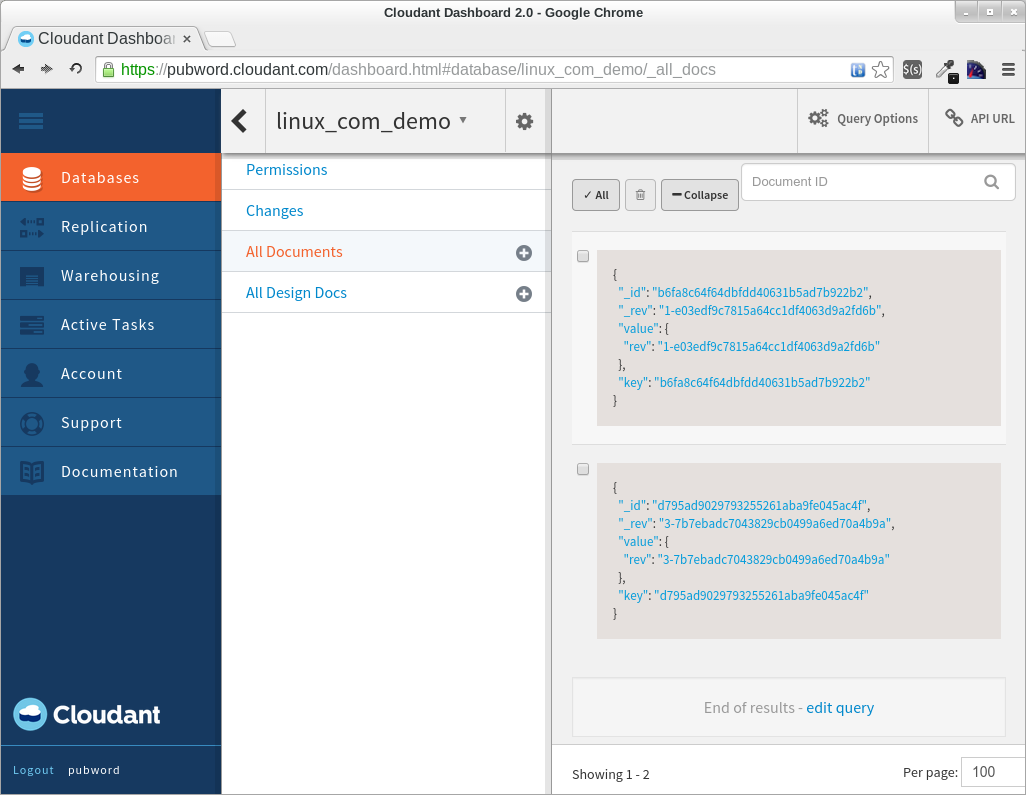
Now let’s hop on over to the web console and find the document. Log in, and click on the database name. You’ll see its current list of documents, including the one created in the previous tutorial, and the new one, as shown in the following image.

cloudant doclist

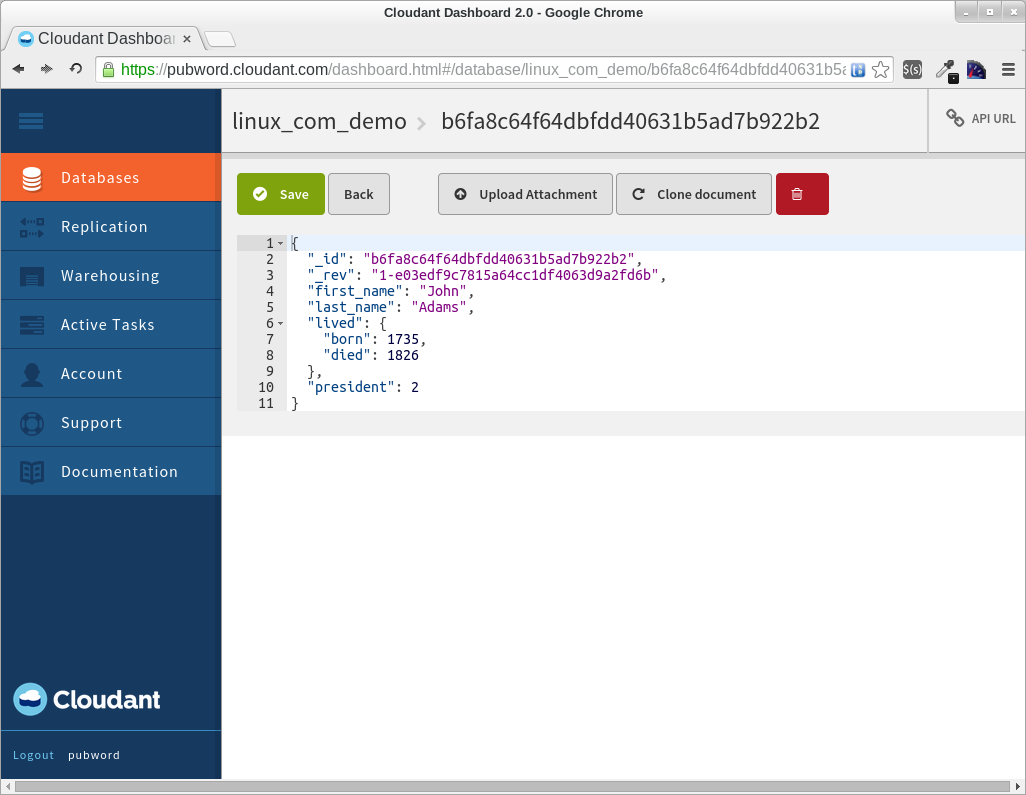
However, this view only shows brief information about each document. Float the mouse over a document, and you’ll see a little “Edit doc” button appear. Click it and you’ll see the full doc, like so:

cloudant document

Document Revisions

Now let’s talk about that field called _rev. This is the revision number of the document. If you try to write a document whose _id field already exists in the database, you need to also include the current revision number. Otherwise, the document will be rejected and you’ll get back an error. The error message will be status code 409 and message “Document update conflict.” The idea is pretty simple; when working on an existing document, just keep the _rev field around and use it to upload, and you’ll be fine. When you save the document, you’ll get back a new _rev field to use for the subsequent save.

But this has caused some headaches for people. If you have multiple people working on a document, and you want somebody to be able to override any other changes by other people that might have taken place in between retrieving and saving the document, then there’s an easy workaround (albeit not very efficient): Read the document again as a temporary document; grab the temporary document’s _rev field, copy it in the actual document, and then save. However, there’s still the potential for a race condition in case another user saved the document in the middle of this process. Then you’ll need to handle the error and try again. (But this is somewhat sloppy engineering; try to keep track of your _rev fields as much as possible.)

Conclusion

This has only been a brief look at how you can write code to access Cloudant. It’s pretty easy to do so. There are more topics you can explore by reading the Cloudant documentation, such as how to create views, do full-text searches, and more. We can cover these in future tutorials.

Also, before I go, I want to mention that the coding aspects we’ve done in today’s tutorial aren’t unique to Cloudant. You can actually use these techniques for any CouchDB database, including one installed locally. That means you can test locally if you want. However, the search and index features of Cloudant are likely to not be present in your local installation. But the general features (creating, reading, updating, deleting, and views) will be. And once you start using Cloudant, you’ll get the cloud replication features without having to manage your own servers. For small and medium sized businesses with limited resources, this can mean giving you time to focus on building your product, rather than maintaining database servers.

OpenDaylight Member Spotlight: Intel

Intel was a founding member of the OpenDaylight Project and recently increased its membership to Platinum, the highest tier. We had a conversation with Uri Elzur, Intel’s director of SDN architecture, to understand what drove the company’s decision and what we can expect to see from them in 2015 and beyond.

Uri Elzur, Intel

Intel has been a member of the OpenDaylight Project since its inception. What’s behind the decision to raise your investment in OpenDaylight?

Uri Elzur: At Intel, we have been outlining our vision for Software Defined Infrastructure or SDI over the last couple of months. This vision is taking a new approach to developing data center infrastructure to make it more agile so it works in a more automatic fashion to better meet the requirements that shape the data centers of tomorrow. Some of us fondly call the force shaping it ‘cloudification’.

SDI is uniquely meeting customer needs at both the top and the bottom line. Top line refers to greater agility and speed to develop data center-scale applications, which in turn allows accelerated revenue generation across a larger number of our customers as well as the introduction of new, cloud-centric business models. At the same time, SDI also uniquely allows for the reduction of total cost of ownership for both service providers and their end user customers. Service providers are under intense competitive pressure to reduce cost, be it the cost of a unit of compute or, at a higher level, cost for a unit of application where an application includes compute, network and storage.


Read more at OpenDaylight Blog

Fedora 21 Linux Distro Tuned for Desktop, Server, Cloud

Instead of a single monolithic release that can be tailored for multiple use cases, Fedora 21 offers three distinct products for specific deployments.

Read more at eWeek

Ubuntu Team Launches Snappy Ubuntu Core for Container, Cloud Deployments

Among Linux distributions, Ubuntu has a fairly sterling reputation as a proven operating system that developers can build around. Just witness the fact that more than half of OpenStack deployments are being built on Ubuntu, according to the OpenStack Foundation.  Google’s Chrome OS is also built around many core operating system technologies from the Canonical team.

Years ago, the Canonical team launched a stripped down version of the Ubuntu core aimed at embedded systems. And now, with container farms as the targets, the Ubuntu team is out with a new “snappy” version of Ubuntu Core. This minimalist take on Ubuntu can also serve Docker deployments and platform-as-a-service environments.

Read more at Ostatic

6-Way Winter 2014 Linux Distribution Comparison

With this week’s launch of Fedora 21, here’s a performance comparison of the new Fedora Linux release compared to the Arch-based Antergos rolling-release distribution, Debian GNU/Linux Jessie, openSUSE Tumbleweed, CentOS Linux 7, and Ubuntu 14.10.

Read more at Phoronix

Distribution Release: Alpine Linux 3.1.0

Natanael Copa has announced the release of Alpine Linux 3.1.0, a security-oriented distribution built from scratch and designed (not only) for server deployments: “We are pleased to announce Alpine Linux 3.1.0, the first release in the 3.1 stable series. This release is built with musl libc and is….”

Read more at DistroWatch

Linux Foundation IoT standardisation effort AllSeen Alliance grows to more than 100 companies

For those wo are not following IoT news all the time: you may have lost the foundation of this interesting alliance project that aims at fostering interoperability of IoT. This project is led and started by Linux Foundation and this is a great guarantee of openness and real community driven innovation. We all look forward […]

Continue Reading

 
Read more at Open Electronics

Hardkernel Launches $35 Development Board That Can Smash The RPi

Hardkernel has announced the latest ODROID ARM development board. The ODROID-C1 is a $35 single-board computer that is similar in size to the Raspberry Pi but with much greater hardware specifications…

Read more at Phoronix