
Home Blog Page 1289

Intel to Merge Mobile and PC Divisions Amid Mobile Losses

Intel is planning to merge its struggling mobile division with its PC division, and Rockchip released an ARM mobile SoC that was developed with Intel. Intel CEO Brian Krzanich recently sent an email to employees saying the company plans to merge its mobile computing division with its PC-Client group, according to the Wall Street Journal. […]

Read more at LinuxGizmos

Debian Init System Coupling Vote Results

The Debian technical committee voting surrounding a general resolution around init system coupling has ended…

Read more at Phoronix

How SanDisk is Becoming an Open Source Player

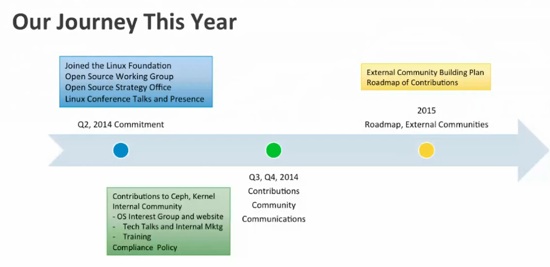
Nithya-Ruff-SanDiskEarlier this year SanDisk committed to becoming an open source player, created an open source strategy office and joined the Linux Foundation. Since then, the flash storage company has begun contributing to open source projects in the three main areas of its business: mobile, enterprise and hyperscale computing, and consumer products, said Nithya Ruff, director of the open source strategy office at SanDisk in an online presentation yesterday.

“In every single market we play in, its imperative to be in open source,” Ruff said. “So bringing together flash and open source software was a natural strategy for us.”

SanDisk has contributed more than 40 patches to the open source Ceph project’s latest release, for example, to become the 7th largest contributor. And it’s been working on flash optimization of drivers, file systems and memory with various SoC vendors and on projects such as Android, Hadoop, and Apache Cassandra, as well as contributing upstream to the Linux kernel. Such contributions put SanDisk, a newcomer to open source, on the map as a company that’s serious about working with other companies and projects, Ruff says.

“We need to be at the table, making them enterprise and flash ready, and work with application vendors so they can take advantage of flash in their applications,” said Ruff, who has worked in open source technology for 15 years and previously led embedded Linux strategy at Wind River/Intel.

Its recent acquisition of Fusion-io, a strong open source contributor to projects such as OpenNVM and btrfs has also helped SanDisk along the path to becoming an open source player, she said. Many of the developers there have become key advisors and leaders on SanDisk’s open source strategy, especially in encouraging a compliance policy that makes it easy for developers to use and contribute to software.

The road map for 2015 includes even more collaboration with key projects in the various areas of their business, including plans to become more involved in OpenStack’s block storage project Cinder, as well as some areas of compute, Ruff said.
SanDisk journey

Why does SanDisk care?

Today open source is pervasive, and it’s behind much of the cutting edge innovation in technology, Ruff said. Projects like Linux, started by Linus Torvalds in 1991, have created a model for open source collaboration in the enterprise. And industry standards are no longer decided behind boardroom doors, but out in the open and by default through the adoption of open source code.

Companies that want to be leaders in their industries, are not only consuming open source, they’re also contributing to it.

“We decided at the beginning of this year that it was no longer acceptable for us to be an observer, a consumer, we wanted to own our destiny,” Ruff said.

SanDisk hopes to realize the many benefits of using and contributing to open source, including cost savings, greater innovation, expanded ecosystems and interoperability, and shorter time to market. And it also hopes to become more influential in the open source projects that are key in the three markets it’s focused on. SanDisk plans to work with all of the players in the mobile, enterprise computing and consumer markets to help optimize their software and systems for flash.

“A lot of the software, whether in the edge, or in the cloud or in the data center was really designed to work with hard drives and the way they behave from a read/write and latency perspective,” Ruff said. “They don’t fully take advantage of the performance and efficiency of flash.”

In the coming year, we can expect SanDisk to further increase its participation in key projects. The ultimate goal is to become a major open source player that’s not only participating but leading the communities forward in various ways, Ruff said.

“We’ve always been an innovator for a long time – 25 years as a company,” Ruff said. “And we’re a key player in computing so it’s natural to be a part of this open source software revolution.”


EFF: Let’s Encrypt

The Electronic Frontier Foundation (EFF) is helping to launch a new non-profit organization that will offer free server certificates beginning in summer 2015. “Let’s Encrypt is a new free certificate authority, which will begin issuing server certificates in 2015. Server certificates are the anchor for any website that wants to offer HTTPS and encrypted traffic, proving that the server you are talking to is the server you intended to talk to. But these certificates have historically been expensive, as well as tricky to install and bothersome to update. The Let’s Encrypt authority will offer server certificates at zero cost, supported by sophisticated new security protocols. The certificates will have automatic enrollment and renewal, and there will be publicly available records of all certificate issuance and revocation.” Let’s Encrypt will be overseen by the Internet Security Research Group (ISRG), a California public benefit corporation.

Read more at LWN

SUSECon 2014: SUSE’s Open Approach Wins New Enterprise Customers

SUSECon-keynote-2014

As the lights dimmed for the keynote at SUSECon 2014 this morning, there was a sense that something special was about to take place. Had we been transported to a more Apple-inspired keynote, where speakers with rock-star status among the tech industry would “wow” us with industry buzz words and mind-blowing statistics? Would a new brand of dog and pony show arrive to finally prove to us that SUSE Linux had arrived to steal the show from anyone and everyone daring to pull the spotlight away from the masters of tech?

No. What the attendees of SUSECon 2014 were presented with was something wholly unique. But even in the clever approach to the keynote (a fun talk show setting led by the ever-charming Michael Miller) the SUSE’s half-year financial statistics spoke volumes:

  • Key performance indicators are ahead of the plan

  • YTD total bookings growth is up at +26%

  • Recognized revenue growing at +16%

  • New bookings rate +47% growth

  • New business is roughly 65% of the total. 

With the parade of enterprise and big data partners crawling from the keynote woodwork, something became very apparent ─ from the mouths of both Miller and SUSE CEO, Nils Brauckmann, the key to SUSE’s success is their commitment to being “always open.” This openness has helped SUSE to not only become an industry leader in the field of In Memory Technology, but it also led to the merger between Attachment Group (of which SUSE is an associated brand) and Micro Focus (full announcement here). This merger will go a very long way to stretch the reach of SUSE across the globe.

Miller called SUSE an “Open open source company.” A rather intriguing notion. Most companies that deal with Linux, lay claim to the tag “open.” SUSE takes this one step further by being open with their openness. Yes, they are traditional in their openness ─ they not only use open source software, but contribute a great deal back to the open source community ─ but SUSE remains quite open about their open source-ness to their clients and customers. This is most notably followed through by their refusal to lock down a company. What does this mean? Simple ─ say the best solution for a customer is not only an open source solution, but a mix of open and proprietary solutions. If that is truly the case, SUSE will not lock the customer into an all open solution ─ they keep the dialog open with the client so the perfect solution is found.

Enterprises Migrating to SUSE Linux

Another factor in the amazing success SUSE has now begun to enjoy is migration. They have discovered a vast amount of clients in need of migrating from legacy systems ─ many of which are UNIX-based or Cobalt-driven systems ─ to a more modern platform. SUSE commissioned a study from Forrester Consulting, the results of which pointed directly to the need for these massive migrations. The study uncovered that enterprise businesses are beginning to focus more importance on the need to grow ─ even beyond focusing on issues like ROI. Turns out, SUSE Enterprise Linux is an ideal platform for these migrations. Why?

One of the main ideas that brings companies like Hong Kong Jockey Club (a world-class horse racing operation and one of Hong Kong’s largest employers) to SUSE is the ability to get the maximum availability from systems. Swiss Re (a leading wholesale provider of reinsurance, insurance, and other insurance-based forms of risk-transfer) has also migrated 800 out of 1,000 servers to SUSE Enterprise Linux.

“Five years ago we began seriously looking at new platforms to replace our aging, expensive, proprietary Solaris estate,” said Alexander Turk (VP at Swiss Re). “By migrating to SUSE Linux Enterprise Server, we were able to meet our performance and availability objectives while significantly reducing platform and hardware costs.”

The respect SUSE is garnering is well earned. Their commitment to open source is paying huge dividends to both the company and the open source community. SUSE actively listens to clients, to the community, and to themselves in such a way as to bring critical improvements to the enterprise Linux experience. Being so open about who and what they are all about, will continue to help define SUSE as a leader in large-scale Linux deployments.   

https://www.youtube.com/watch?v=mcrKWnmhqj0?list=UUbkuT_ABdCbrTIrQqzVeXcg” frameborder=”0

Cray to Evaluate ARM Chips in Its Supercomputers

ARM partners Cavium, Applied Micro and PathScale also make news at SC14 as ARM continues its push into the HPC space.

Read more at eWeek

Linux Still Owns Supercomputing

In the latest Top500 supercomputer ranking, Linux once more totally dominates the fastest of all computers.

WhatsApp Rolls Out End-to-End Encryption Using TextSecure Code

The most recent update to WhatsApp’s Android app includes a surprising feature: strong end-to-end encryption, enabled by default. It’s the strongest security any major texting app has offered, even compared with similar tools from giants like Google, Microsoft, and Apple. WhatsApp partnered with Open Whisper Systems for the launch, using open source code to build in the new features. It’s unclear when the features will come to iOS, but just reaching WhatsApp’s Android users represents a huge step forward for everyday encryption use.

Continue reading…

Read more at The Verge

Introducing 300,000 People to Linux


https://www.youtube.com/watch?v=BmDricQGK6w?rel=0″ allowfullscreen=”true” frameborder=”0″ width=”325″ height=”268

Individuals inspire us. 
From the open source community to the maker community, individuals are changing the way software and hardware are built. Together they are advancing the most exciting areas of technology, from Linux to cloud and supercomputing to consumer electronics, the Internet of Things (IoT), commercial drones and much more. Hundreds of thousands of people are working today on what will be tomorrow’s biggest innovations.

That’s why access to learning is more important than ever. Training and education are essential for advancing key technologies and building careers. When equipped with the tools to create and innovate, individuals from anywhere are empowered to contribute to an ever growing technical community. In a world where the individual rules supreme, affordable, accessible training and certification opportunities become of the greatest importance for supporting the future of Linux and computing.

We’ve focused a lot of attention in recent years on making Linux learning materials more accessible to more people. This year, for example, together with our partner edX, we were able to offer our Intro to Linux course for free to nearly 300,000 people from all over the world. While the United States ranks first in the number of students taking Intro to Linux, it only represents about 30 percent of all class participants. The top geographies include the U.S., India, United Kingdom, Brazil and Spain. Linux attracted more people with this one course than the number of people who attended all seven games of the recent World Series combined.

What’s even more overwhelming is that our Intro to Linux course saw one of the highest enrollments of any class offered on edx.org this year. It’s also worth noting that while MOOCs have a reputation for low completion rates among registrants, the Linux course is ranking well above the industry average. This enthusiasm and participation bodes well for the future of Linux and the many individuals getting involved.

Through the process of bringing Linux to more people, we’ve learned quite a bit ourselves and are putting those lessons into action. For example, we just released an update to our edX course. The changes aren’t major but include technical updates and content changes to accelerate ease of learning. This is all the result of the community feedback. We also introduced in August a Linux Certification program for sysadmins and engineers. We designed this program to be accessible to anyone, anywhere in the world and to be distribution flexible. Professionals need more ways to demonstrate their knowledge, and employers want to know what they’re getting. Thousands of people have already signed up for the exams.

Individuals make up the global Linux community, and the power of the individual to advance Linux and new technologies has never been more evident. If this year is any indication of the growth of Linux and open source software, anyone who relies on this software, which is just about everybody, is in good shape for decades to come.

IT Spending to Rise, Though Growth Remains Sluggish

The outlook for 2015 is mostly positive, with innovations in mobility, business intelligence, and cloud computing, Computer Economics found.

Read more at eWeek