
Google is making the right moves to get Chromebooks into the mainstream, but some misconceptions may be preventing buyers from trying them.
Read more at Enterprise Open Source Toolkit
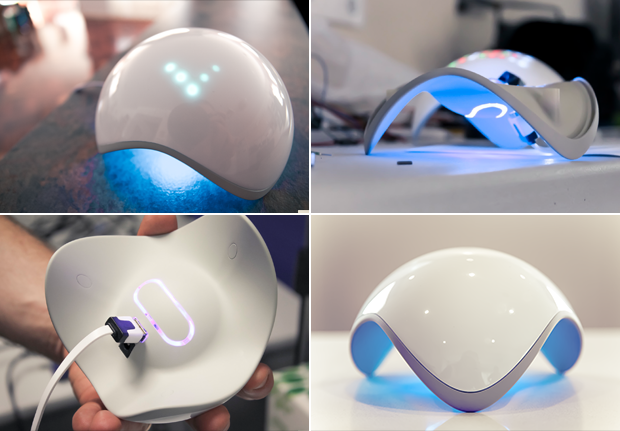
The Ninja Block Kit arrived in 2012, making it one of the first of the new wave of smartphone-connected, mostly Linux-based, home automation hubs. The Kickstarter success for this open source system helped inspire other home automation projects to give crowdfunding a try.
Sydney, Australia based Ninja Blocks has turned once again to Kickstarter for its Ninja Sphere follow-on, which is expected to ship to Kickstarter backers and other new pre-order customers by early December. In the midst of the production frenzy, CEO Daniel Friedman found time to answer our questions about the development of this unique device.
The ambitious, $329 Ninja Sphere is a bit of a gamble at a time when home automation hubs are getting cheaper. The Staples Connect and the Wink hub, which is sold at Home Depot, both sell for only $50 in an attempt to entice shoppers to buy a growing number of compatible smart devices.
On the higher end, there are now well-heeled competitors like Google-owned Nest Labs, which acquired Dropcam earlier this year, and recently acquired Revolv. Meanwhile, Samsung has acquired SmartThings. Even while startups continue to test the market, consolidation has already begun.
 Yet, Ninja Blocks has one thing many of these projects lack: a large, devoted community, and one that enjoys a little tinkering. With the Ninja Sphere, it also has one of the most interesting, not to mention attractive, home automation devices on the market.
Like the Ninja Block, the Ninja Sphere runs on Linux and incorporates an Arduino-compatible microcontroller. However, it switches from a BeagleBone Black SBC to a computer-on-module that offers much the same Cortex-A8-based TI Sitara processor and other circuitry. Instead of being limited to a 433MHz RF radio, the Sphere adds ZigBee, WiFi, and Bluetooth Low Energy (BLE), and supports Z-Wave via an add-on.
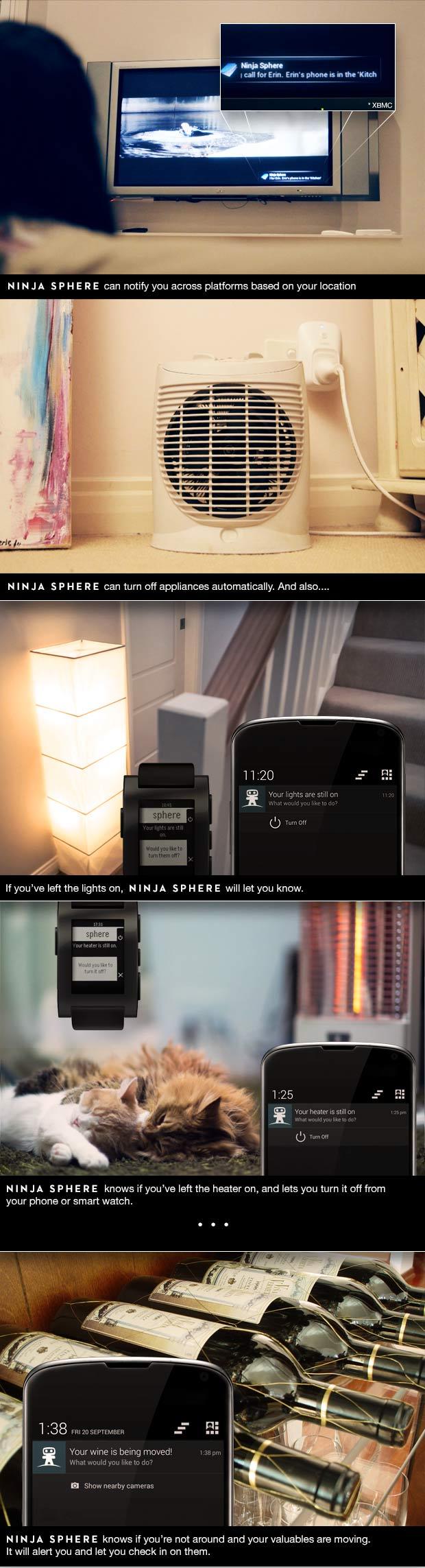
In addition to selling its own motion detectors, contact closures, pushbuttons, and temperature and humidity sensors, the Ninja Sphere offers increased support for third party smart devices. Compatible gizmos include Philips Hue, LiFX, Belkin WeMo, Sonos, Dropcam, Pebble, and more. As before, the device provides scripting for controlling devices based on triggers.
The Ninja Sphere also adds an LED display and two fairly novel features: gesture controls and smart tags. With the help of an “e-field” gesture sensor, the hub responds to touch, as well as gestures such as waving your hands. For example, a swirl gesture lets you select lighting colors. You can also track the location of smart devices, wallets, phones, pets, or people with the help of BLE-equipped smart tags and two USB-powered “waypoint” gizmos.
With the Ninja Sphere, Ninja Blocks is pushing for broader consumer success even as it listens to the needs of its community. Here, CEO Daniel Friedman explains the vision and the reality of developing the intriguing Sphere.
Q: The updated version of the Ninja Block is only a year old. Why did you need a new device so soon?
Friedman: The Ninja Block viewed the world as a flat list of devices. This was fine to accomplish our initial goal of building an ‘if this then that’ style rules engine. However, it quickly fell short. We realized we needed higher level objects in order to reason about what is and should be going on inside any home. People, pets, lamps, and washing machines all needed to exist as first class citizens.
Q: Were the new gesture and tracking features, as well as the sleek, spheroid design, added based on customer feedback or to differentiate the Ninja Sphere, or simply because they were something you wanted to try?
Friedman: We definitely felt the pressure to differentiate ourselves, but most of the design and features were far along in development before we had considered a new crowdfunding campaign. The bulk of the new features were born out of the team and community trying to live with traditional home automation systems and seeing where they fell short.
It all stemmed from the fact that we didn’t believe a smartphone app was the best way to control your home. Smartphones are great when you’re out of the house, lazy in bed, or on the sofa. However, when you’re making dinner or trying to get out of the house in the morning, pulling out your phone is a massive fail in terms of user experience.
This idea led to the gesture and LED display as another interface, and the idea that it had to be somewhere convenient, in plain sight. We knew the design had to be great — otherwise people would not want it in their home. A Sydney based agency called cocreators helped us bring our design ideas into reality.
Q: Why did you once again turn to crowdfunding?
Friedman: The Ninja Sphere was such a departure from the Ninja Block and other devices that we felt crowdfunding was the only viable option to prove demand. That is the best thing about crowdfunding: If you have a great idea and the means to create it, people can and will back you. Banks and VCs are far more risk averse compared to your average crowdfunding backer.
Q: How many of your customers are hackers? Is the Sphere targeting a more general consumer customer?
Friedman: A large portion of Ninja Block customers were weekend software hackers. We tried to not require a computer science degree in order to get the most out of the Block, but we encouraged comfort using a shell. The goal for the Ninja Sphere was to provide an easier plug and play package. Instead of requiring that you know ssh, Ninja Sphere asks only that you can set up WiFi through a web app.
Q: The Sphere uses essentially the same hardware and software foundations as the Block, including Ubuntu, Node.js, and REST. How important has that consistency been in terms of project management?
Friedman: The hardware is fairly similar to the Ninja Block, so in terms of firmware we had a win there, and we were able to develop hardware and software in tandem a bit. The BeagleBone Black was a bit big for what we wanted, so we went with a system-on-module that kept to the same fundamental architecture.
Our development process was helped by the fact that we made a lot of the hardware modular. What we needed to ensure worked well was the drivers to the radio modules, LED matrix, and gesture control chip. The Ninja Block had only one wireless transceiver, which made it incredibly simple compared to integrating WiFi and Bluetooth.
Consistency in software is very important. However, it is just as important to use the right tool for the job. We recently moved our client side stack from Node.js to Go, primarily because we found it incredibly difficult to build a micro-service oriented architecture with Node.js on an embedded device. We’ve spent quite a few months rewriting code in Go because we saw the future benefits as being greater than the short term pain.
Q: What were some of the technical challenges in building the Ninja Sphere? What took longer than expected?
Friedman: The biggest challenge was ensuring that the lower housing had enough grip. We had to ensure that if a user accidentally tapped the Sphere, it would not slide down the table. Typically, you would use an elastomer for this, but that would not have enough strength to screw the internal electronics together. We opted for a rigid plastic skeleton over-molded with an elastomer. It took a lot of work to make sure this came out perfect.
Q: How many components vendors were involved compared to the Ninja Block hub, and how did that affect supply chain management issues?
Friedman: There were quite a few more vendors required to build the Ninja Sphere. However, by moving to a system-on-module, we were able to mitigate some of the supplier risk. Generally, keeping the number of suppliers down alleviates a lot of headaches.
The Ninja Sphere is presented as a premium product, so it was important to work with the right manufacturer who understands the quality the product requires. We’ve had over 10 iterations of the design, from prototype to final design.
Q: What tradeoffs are involved in supporting multiple radios? Do you support the emerging 6LoWPAN-based Thread protocol?
Friedman: There are potential risks for crosstalk between radios on similar frequencies, but we haven’t run into any of those issues. The biggest trade-off is cost, especially with radios such as Z-Wave that have different bands in different countries.
We are looking at Thread, and intend to support it in the future. From Ninja Blocks’ perspective, we’ll continue to build drivers for devices people can actually use and get value out of, regardless of the protocol.
Q: What advice do you have for other projects looking to get certification?
Friedman: We used pre-certified wireless modules, which has dramatically reduced the complexity of certification. They are more expensive, but the benefit outweighed the costs in the initial runs. Another step we took was to undergo preliminary certification. This allowed us to see all the obvious problems ahead of time, which is far more cost effective.
Q: Are you using the CircuitCo Bluesteel Basic, or another COM/SOM, or did you build one on your own?
Friedman: We’re using a different SOM from another vendor.
Q: Is it difficult to add support for new smart devices, or is this work mostly up to the smart device manufacturer?
Friedman: We have taken great pains to make it easier to add support for new devices. We use a driver-based approach, translating a proprietary protocol on one side into a common one on the other. We will be opening up the spec, as well as all of our own drivers, so that our community can help build these things. We’ve seen great drivers being built by community members, and drivers for devices we’ve never even heard of. We think this is where our open approach will trump closed systems.
Q: How do you decide to what extent the design will be open source?
Friedman: We want to open up as much as possible, within reason. There are elements we cannot open, such as parts of the system that deal with security. We judge each component of the system by itself, and ask, “Would open sourcing this do more potential harm than good?”
Q: What are the pros and cons of doing a project like this from Australia vs. Silicon Valley?
Friedman: Australia has the same engineering excellence that Silicon Valley does, and there is also less competition. However, in Australia the access to capital needed for a hardware startup is an order of magnitude less than that of the Valley. I’m hoping this will change as the country’s startup ecosystem matures.
Q: How do you see the home automation market evolving now that Google and Samsung have entered the business?
Friedman: Ultimately, the best product will win, regardless of its developer. Crowdfunding campaigns give a small company like ours the ability to develop and distribute a consumer electronics product. I see the market right now analogous to the early days of smartphones. It’s going to be a long time before we see the maturity that we see in the smartphone market today.
 While the OpenStack Summit in Paris has generated a lot of news this week, cloud-focused company Joyent has announced that it is open sourcing its core technology. Joyent’s platform can compete with OpenStack and other cloud offerings, and facilitates efficienet use of container technologies like Docker.
Joyent has been an IaaS/PaaS cloud player worth watching, and we’ve covered the company several times. Specifically, the company has now open sourced its core products SmartDataCenter and the Manta object storage platform.