
Am I vulnerable? How serious are the attacks? The answers to these and many other Shellshock questions are here for you.
Open Source Goes Corporate at Samsung

The list of major corporations getting involved with open source communities is persistently growing, a trend evidenced by the rapidly expanding financial backing of open source foundations like the Linux Foundation. Samsung is one of these companies through its Open Source Group which was established in February of 2013. It’s part of an effort to bridge the gap between the company and the open source communities it relies on and to promote the use and development of open source technology within many sectors of the company.
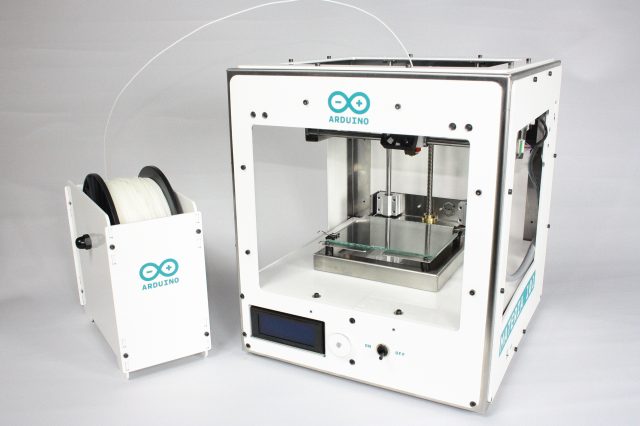
Arduino to Sell 3D Printer—$800 in Kit Form or $1,000 Pre-Assembled
Arduino, maker of the open source hardware platform of the same name, is teaming up with a startup called Sharebot to sell a 3D printer for about $1,000.
Announced today, Materia 101 will be demonstrated at the Maker Faire in Rome this weekend. An on-sale date has not been revealed.
“The printer will be available only on the Arduino Store both as a kit and pre-assembled,” the announcement said. “Official pricing of the device will be disclosed at a later date but the kit will sell for less than 600 EUR/800 USD, while the pre-assembled version will be available for less than 700 EUR/1000 USD.”
Read 5 remaining paragraphs | Comments
Intel, Cisco, HP, Others Form NFV Consortium
The OPNFV will be a project at the Linux Foundation to create an open-source reference platform for NFV.
Piston’s McKenty to Leave Company He Founded for Pivotal
Josh McKenty, founder of Piston and an early architect of what became OpenStack, announced today that he’s leaving the company he started to take on a new role at Pivotal.
McKenty will become “Field CTO” for Cloud Foundry for Pivotal, where he’ll work directly with businesses adopting the platform. He’ll also work with the Cloud Foundry product team.
Read more at The New Stack.
Chromecast Getting Competition from Firefox OS-Powered Matchstick
The streaming stick market is apparently heating up. Google, Microsoft, and Amazon all have entrants in this space, and if a new Kickstarter appeal succeeds, there will soon be a Firefox OS stick getting in on the action.
Inspired by the Chromecast, the Matchstick will plug into your TV using HDMI, connect to devices locally using Wi-Fi, and be used as a streaming media platform. Unlike Chromecast, however, Matchstick will use the open source Firefox OS as its base, making it readily accessible to developers who will be able to build HTML apps for Matchstick that leverage open Web technologies.
Read more at ArsTechnica.
Through Microservices, a Renewed Push for Simplicity and IT Minimalism
Guerrilla SOA redux? PwC consultants recommend lighter, simpler, faster services to keep up with business demands.
Ten Fastest-Growing IT Skills Offer Opportunities
If you want to move ahead in your career, it’s important to command a skill that will enable you to write your own ticket in terms of job opportunities. Whether you’re looking for greater schedule flexibility, telecommuting arrangements, an impressive title or a great salary, you’ll be in a good bargaining position if you bring to the table one or more of these fastest-growing IT skills compiled by Dice.com.
Read more at Baseline Magazine.
NVIDIA GeForce GTX 980: The Best GPU For Linux Gamers
Earlier this month NVIDIA launched the GeForce GTX 970 and GTX 980 as their highest-end offerings based on their Maxwell architecture. Since the GTX 750 series debut I have been anxious to see Maxwell succeed Kepler in the high-end space and finally last week I got hands on time with the GTX 980. As long as you are not committed to using pure open-source graphics drivers, the GeForce GTX 980 is the best you can get as a Linux gamer/enthusiast for high performance graphics for ending out 2014.
Open Sourcing Automation Tools for Testing Linux Images on Microsoft Azure
Posted by Michael Kelley
Principal Program Manager, Microsoft Open Source Technology Center
Microsoft has participated in the Linux community for several years now, contributing drivers for Hyper-V to the Linux kernel source code base, and then working with Linux distribution partners to incorporate those drivers into their distros. We’ve had great results in running a variety of Linux distros as a guest OS on Hyper-V and as a VM in Microsoft Azure, and our collaboration with SUSE has been a foundation for this work for many years.
Now we’re taking it a step further and open sourcing our test automation tools in a GitHub project, making it easy to validate Linux images for running in Azure. As noted in a recent blog post by SUSE, these test automation tools are Powershell, Python, and BASH scripts that allow Linux images to be tested for compatibility with Azure.
Read more at Openness at Microsoft Blog