Home Blog Page 1425

How DreamHost is Reinventing Itself with OpenStack

Founded in 1997, DreamHost is a seasoned internet business home to over 400,000 happy customers, 1.5 million sites and applications, and hundreds of thousands of installs of WordPress, the dominant open source CMS. Open source is in our blood, and has powered every aspect of our services since 1997. DreamHost is built on a foundation of Perl, Linux, Apache, MySQL, and countless other open source projects. In our 16+ years of existence, DreamHost has seen the realities of internet applications and hosting drastically evolve. Our journey to the cloud requires a bit of history and context, so let’s dive right in.

read more

Read more at OpenSource.com

Wine 1.7.22 (Development Version) Released – Install in RedHat and Debian Based Systems

Wine, a most popular and powerful open source application for Linux, that used to run Windows based applications and games on Linux Platform without any trouble. WineHQ team, recently announced a new development version of Wine 1.7.22. This new development build arrives with a number of new…

Read more at TecMint

Linux Foundation SysAdmin Michael Halstead’s IT Career Started at Age 15

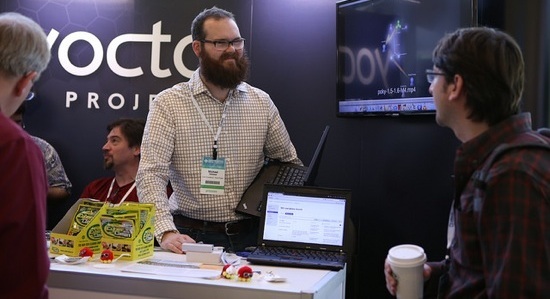
Michael Halstead at ELC 2014

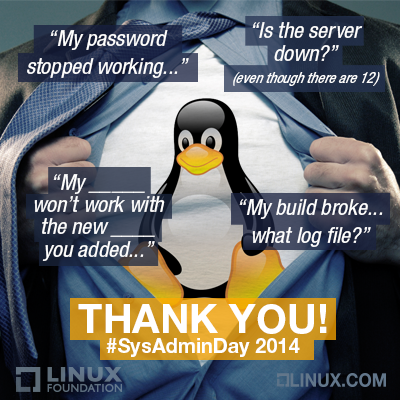
This is the third profile in a series on Linux Foundation system administrators leading up to SysAdmin Day. Do you have a super-hero sysadmin you’d like to recognize? Send your nomination to This e-mail address is being protected from spambots. You need JavaScript enabled to view it
by July 25 and enter them to win a free
ticket to LinuxCon and CloudOpen North America taking place in Chicago August 20-22, 2014. (See the full contest announcement for more details.)

Michael Halstead maintains all of the public facing infrastructure for the Yocto Project, a Linux Foundation collaborative project that provides the tools and methods for building custom embedded Linux distributions. In this Q&A he describes his typical day at work, the best part of his job, how he spends his free time, and more.

Linux.com: How long have you been a sys admin?

Michael Halstead: It’s hard to say. I’ve been administering systems since I was 15. I was the only student at my high school interested in taking over responsibility for the Red Hat systems from the student admin who was graduating that year. No one on staff had any idea how to run these systems, but our school of nearly 1,000 students depended on them for classwork, calendaring, and announcements. I was first paid to administer systems at 19 for a small health research non-profit. My job title switched from Senior Technician, to Developer, to Web Admin, but I never stopped having server responsibilities. It wasn’t until I was 30 that I actually had the job title – Systems Administrator. I’ve always loved my servers more than my code, and I’m very happy to have specialized.

When did you start at the Linux Foundation and how did you get the job?

I’ve been with Linux Foundation since January 1, 2012. Several active Yocto Project users knew they wanted to work with me. They approached the Linux Foundation and said, “Please hire Michael.” It was pretty simple and super exciting at the same time.

What do you do for the Linux Foundation? What’s your specialty?

I maintain all of the Yocto Project’s public facing infrastructure, including Yocto Autobuilders, which are based on Buildbot. I have odd specialties – such as storage and LDAP. I also used to be a Drupal developer, and will often dive in when CMS questions come up.

Will you describe a typical day at work for you?

Wake up and read e-mail, then skim the logs. Answer e-mail. Prioritize problems. Start fixing. If everything is working correctly I have several long-term projects, or low priority requests to take care of. Sometimes I’ll spend a few hours reading about OpenStack, Docker.io, or the latest hybrid volume technology to stay informed. If I’m feeling lonely, I’ll go answer questions on the mailing list, or peek at IRC.

What’s your favorite part of the job and why?

My favorite feeling is when communication just flows. Everyone is talking and typing, and nobody is interrupting. No messages get missed. When all the lines are open I can unblock people and make their day better. Our work requires a lot of quiet, focused time, so most days move at a slower thoughtful pace. When we are really chatty and moving quickly I find out about small annoyances, normally too little to mention, and I can remove them. I love making people happier about the systems they use every day.

What is your nightmare scenario? How have you prepared for it?

We have a 90TB NAS device at the Open Source Lab in Corvallis, OR. Waking up to find it offline on a holiday week would be the worst. We only have access during normal working hours so it might be days before I could get in and see what happened. I’d have to tweak the build system to keep builds running, and they would be slow. We’d lose access to our shared state files, local source mirrors, and our nightly builds for the last two months.

We’ve prepared by building in lots of redundancy. There is no reason it should go offline without plenty of advanced warning. And even if it does, we can rebuild any data there from source. We also have offsite backups of important data. Still, it’s [something I worry about].

What is your favorite sysadmin tool and how do you use it?

Today I’m going to say Wireshark. When services have really weird problems, you have to be able to see what’s sysadminday 2014actually happening on your network, and Wireshark is great.
What’s your favorite story about working at the Linux Foundation?

It’s more a feeling than a story. Everyone I work with is so good, that they aren’t afraid. Other groups worry about new technologies and it shows in their decision-making by limiting what software or distributions are allowed. Here at LF we have our preferred tools, but if someone on the team wants to test something new, nobody worries. No one is concerned, “Will they be able to figure it out?” Of course, we can learn, if it turns out to be a better approach, we’ll use it. Have you ever worked with someone who refused to use new software until they had been trained? I find that frustrating. No one here is like that. We have broad foundations of knowledge to work from. We can all read documentation, learn as we go, and adapt to changes as they come. That’s the best.

What do you do for fun, in your spare time?

I go in the woods to see the plants and animals. I visit vineyards. I learn recipes. I read about games, and stories. I attend conferences and their after-parties. I watch plays. I flash a new OS on my router or phone. I float down rivers. And I brew beer for my friends’ weddings.

Read more about Linux Foundation System Administrators:

Linux Foundation SysAdmin Andy Grimberg Loves New Tech and Snowboarding

To Linux Foundation SysAdmin Ryan Day, Elegance is the Best Tool

Imad Sousou: The Future of Linux and Intel in the New Connected World

Imad Sousou, IntelFrom new cloud platforms, to changes in virtualization and container technologies, to how data is stored and transmitted, every innovation in the data center has a Linux-based or open source component, says Imad Sousou vice president of the Software and Services Group and general manager of the Intel Open Source Technology Center at Intel.

“To a great degree… the speed with which solutions can be brought online is the result of Linux and open source in the data center,” said Sousou, who is also on the OpenStack Foundation board of directors. “The amount of collaboration around the future of the data center is very encouraging.”

In his keynote at LinuxCon and CloudOpen North America, “Linux in the New Connected World,” Sousou will share Intel’s plans to address the explosion of connected devices, as well as the services and secured data that is in demand. He’ll also discuss why open source is the best way for a powerful and diverse ecosystem to collaborate and innovate quickly.

Here, he discusses the data center transformation brought about by software-defined infrastructure and the Internet of Things, and the role of Linux in this change.

Register now for LinuxCon and CloudOpen North America, to be held Aug. 20-22, 2014, in Chicago.

Linux.com: What innovations are transforming the data center today?

Imad Sousou: The emergence of public, private, and hybrid clouds is one type of innovation we are seeing. Another is virtualization, where today compute, network, and storage can now all be virtualized on standard high-volume servers. We’ve also seen a vibrant open source ecosystem focused on the data center emerge to address the growing demand for data and services. Much of this is driven by software-defined infrastructure, or SDI, with more layers being done in software. This means you aren’t bound to a piece of fixed-function hardware and it has opened up the ability to self-administer cloud resources and specify how many virtual servers, what kind of networking, and how much storage you need. Today, developers and operational managers can get what used to take weeks or even months within the hour, which is transforming the way they work.

What role does Linux play in those changes?

Everything I talked about around innovations has an open source component and every time you use a device or connect to the Internet, you are using Linux-based open source code. With its rapid adoption in the data center, Linux and the open source culture around it has fueled innovation at every layer of the stack, from open computing to virtualization (and more recently, containerization) to orchestration. To a great degree, the promise of SDI and the speed with which solutions can be brought online is the result of Linux and open source in the data center. We are seeing new open source projects focused on the cloud and data center and the communities to support them everywhere. For example, projects like OpenStack have more than a dozen sub-projects or related projects with thousands of contributors. The amount of collaboration around the future of the data center is very encouraging.

How about the Internet of Things — what role does that play?

The Internet of Things is leading to tremendous growth in connected devices—from smartphones and tablets to wearables, boxes with RFID tags, home solutions, digital signage, medical devices and automotive. That growth is not surprisingly leading to an even bigger explosion in data, creating greater demand for data centers and services. Consider that you need a server for every 400 smartphones, every 40 connected factory tools, and every 20 digital signs. With all the data those devices are generating, you need a way to make sense of the information. This is why the open source community’s ability to produce large step improvements in areas like big data processing speed and cloud efficiency is so important. There is also a need for new analytics and web services to process and then package the data in a useful way to consumers.

What is Intel doing now to participate in and lead this transformation?

In addition to hundreds of software developers contributing to dozens of open source projects focused on the data center, Intel is in a unique position to contribute at the board or silicon level to expose new platform features to benefit projects like OpenStack, KVM, Xen, and Hadoop. These features help enable further optimizations in places such as power, performance, policy management and security. Intel has taken an active role in shaping the future of OpenStack with a seat on the Foundation Board of Directors. We are also chairing an Enterprise Working Group chartered by the OpenStack Board of Directors to help focus the community on understanding the needs and requirements of the enterprise and how these apply to an OpenStack implementation.

As general manager of the Open Source Technology Center at Intel Corporation since its creation in 2003, Imad Sousou is responsible for Intel’s efforts in open source software across a range of technologies and market segments, including enterprise Linux and related technologies, embedded market segments, and client Linux programs and related technologies. The center also focuses on operating system (OS) stacks, including the Tizen OS, Android on Intel architecture and the Chrome OS for Intel architecture; and on open source applications, user experience and Web and HTML5 technologies on top of client operating systems. Sousou joined Intel in 1994 as a senior software engineer. Before moving into his current role, he served as director of telecom software programs in the Intel Communications Group and as director of client software engineering in the Home Products Group. He began his career as a software engineer at Central Point Software working on system utilities for the Apple Mac OS. Sousou holds a bachelor’s degree in computer science and mathematics from Portland State University. He is on the board of directors at the OpenStack Foundation.

OpenStack Swift Storage Project Gets New Policies

Open-source cloud storage is set for a policy-based future. These policies enable cloud administrators to be more flexible with their storage back end.

Read more at eWeek

TFTP vs FTP application layer protocols

Q1:What’s the difference between TFTP and FTP?

A1: TFTP is a local host obtain files from a remote host but does not provide reliability or security. FTP is the standard mechanism provided by TCP / IP for copying a file from one host to another.

Q2:How to copy files from Cisco device to FTP server ?

A2: Three steps to Copy Cisco switch to FTP:
1.Define the FTP user and password
2.Find the file that you wish to upload
3.Upload the file

Installing and Activating Hyper-V Linux Integration Services

Microsoft developers have designed components that help in improving the performance of virtual machines running on Hyper-V Server. These components are designed as part of the Integration Services.

While the Hyper-V Server is intelligent enough to install and activate Integration Services for Windows virtual machines, for virtual machines running Linux distributions you’ll need to manually install and activate Integration Services. This article explains the process of installing and activating Integration Services in Linux distribution virtual machines.

Read more at ServerWatch.

CentOS 7 Comes on the Heels of Red Hat Enterprise Linux 7

CentOS provides similar technologies to RHEL 7, but is a free alternative for those who don’t need the added enterprise-grade commercial services.

Read more at eWeek

New Raspberry Pi Adds More USB Ports, Still Just $35

The Raspberry Pi Foundation has announced a hardware revision to the original Raspberry Pi Model B, the Raspberry Pi Model B+. The Raspberry Pi Foundation is quick to point out that the Model B+ is not a Raspberry Pi 2, “but rather a final evolution of the original Raspberry Pi.” The Raspberry Pi Foundation is quick to point out that the Model B+ is not a Raspberry Pi 2, “but rather a final evolution of the original Raspberry Pi.”

Read more at Mashable.

Red Hat to be a Key Contributor to and Benefactor of the Kubernetes Project

A few weeks ago, I covered the news that Google had released Kubernetes under an open-source license, which is software to manage computing workloads across thousands of computer servers and leverage docker containers. We’ve also covered Google’s announcement that some vey big contributors have joined the Kubernetes project, including IBM, Microsoft, Red Hat, Docker, CoreOS, Mesosphere, and SaltStack. They are working in tandem on open source tools and container technologies that can run on multiple computers and networks.

Red Hat is one of the key players in the Kubernetes Project and that project may help the company as it sharpens its focus on cloud computing. Here are the details.


Read more at Ostatic