Home Blog Page 1432

Building an Inter-University Private Cloud with Open Source ownCloud

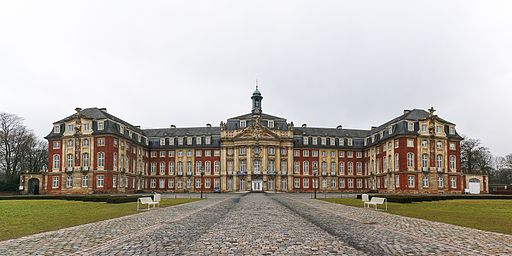
Munster

In late 2011, a lively discussion (we enjoy lively discussions here in Germany) among the IT managers of the publicly-funded research universities in Northrhine-Westfalia (NRW), Germany’s most populous federal state, started over a set of interrelated topics:

·         Endorsement or ban of public cloud services at universities: Since commercial, consumer-grade cloud services like Google Mail and Google Apps or Dropbox were growing in acceptance, also amongst researches at universities, we had to define our position on this issue. Should we endorse them as cost saving alternatives, e.g. for student mail accounts, or should we fight them, because we consider them insecure with respect to data privacy and confidentiality – a very serious matter in Germany in general and for research institutions in particular.

Raimund Vogl, director of IT at Münster University·         Need for regulation of researchers’ cloud service usage: When storing data from work (such as personal information on student work or confidential research results) in cloud services, researchers put themselves in peril of violating their office duties. But regulations imposed by a university banning the use of cloud services altogether for data protection reasons do not take into account the realities of research life – you have to be able to offer a convenient alternative. So this is what university IT service providers have to come up with.

·         Inter-university IT co-operation: With the science ministry boosting the universities’ autonomy by bailing out of direct involvement in university operations in 2007, self-organized cooperation was expected to save costs, improve quality and thereby justify the ministry’s move to grant this new freedom. Cost intensive IT projects especially were under scrutiny in times of dwindling budgets. But the discussion on possible scenarios for inter-university IT cooperation actually did stall in a quite early stage – since virtually all IT services used by university affiliates were already provided by local IT centers.

With the demand for an on-premise alternative to cloud storage services like Dropbox – a demand strongly articulated by both researchers and students, even back in 2011 long before the Edward Snowden NSA disclosures – things were different. This field was not covered yet, and here, the creation of an inter-university private cloud made perfect sense. So in Spring 2012, the council of university IT managers in NRW (ARNW) started a project for an inter-university sync & share cloud storage service and the IT center of Münster University (ZIV) was designated as the project lead.

An extensive market research and product evaluation started soon after. Even at this stage, in the summer of 2012, ownCloud, back then a complete newcomer to the open source scene, was seen as the most promising candidate for our project – envisioned to provide about 6 Petabyte of free-to-use cloud storage to 500,000 affiliates of more than 30 public research and applied science universities in NRW (the storage was ours, access to it comes via ownCloud).

For a project of this scale, with the investment of substantial public funding, an empirically well-founded decision-making process was indispensable. In collaboration with the Information Systems department of Münster University, extensive studies on user expectations, demands and projected adoption were carried out and will be continued throughout the upcoming 5 years of service operation for targeted marketing campaigns and continuous service improvement. Already, valuable scientific insights resulted from this and have been published:

  • We had a paper at ECIS 2014 (European Conference on Information Systems). The proceedings are open access and the link to our paper is here.
  • Just last week, we had a paper at HCII2014 in Session S104: “Cloud Storage Services in Higher Education – Results of a Preliminary Study in the Context of the Sync&Share-Project in Germany,” Christian Meske, Stefan Stieglitz, Raimund Vogl, Dominik Rudolph, Ayten, Öksüz, University of Muenster, Germany.

As to the sync & share software solution, the continuous market research of nearly 2 years had shown that ownCloud developed well over time. By the time of final decision-making in April 2014, it featured a software suite that was almost complete for the demands articulated by our users – with ownCloud committed to provide the add-ons still missing for a 500,000 user setup and storage locations dispersed at three university IT centers across the state.

The open source nature of ownCloud was another important argument to see this product as singled out amongst its competitors and to directly award the contract without a public tendering process. Open source creates trust by ensuring users that there are no back doors and it gives confidence that the development of new desirable features will continue for at least the upcoming 5 years our service is scheduled to run – driven by a broad community of contributors, and possibly also through student and research projects from the universities participating.

After successfully completing a peer review in early 2014, mandatory to receive the substantial funding grant from the NRW ministry of science, the project is currently in the procurement phase, with the procurement of the scale-out storage platform still being in the public tendering process. We will be tracking our progress publicly and will report back here periodically.


Chromebooks: Going Offline to Compete

Critics of the Chromebook mistakenly believe that once offline users can’t do anything. This isn’t true and Google is taking steps to make that clear.

Distribution Release: Kwort Linux 4.1

David Cortarello has announced the release of Kwort Linux 4.1, a lightweight CRUX-based distribution with Openbox and a custom package manager called kpkg: “Kwort Linux 4.1 is out. This new version is fast, stable, and simple as always. Everything has been built from scratch in a clean way…..

Read more at DistroWatch

Chrome Remote Desktop Adds Linux to Supported OS List

Drive Debian from the confines of a Chromebook

Google has tweaked Chrome Remote Desktop to let it access Linux machines.…

Read more at The Register

It’s Better to Share with Functional Programming

Share

Katie Miller is a Developer Advocate at Red Hat for the open source Platform as a Service, OpenShift, and co-founder of the Lambda Ladies group for women in functional programming. She has a passion for language and linguistics, but also for the open source way.

read more

Read more at OpenSource.com

KDE 4.14 Branched, Mix-Release Planned For December

KDE 4.14 code is getting ready while being worked on for a December debut is a mix of KDE4 and KF5 application code…

Read more at Phoronix

Development Release: Mageia 5 Alpha 1

Anne Nicolas has announced the availability of the initial alpha release of Mageia 5, the project’s upcoming version due for a final release in the second half of December: “Here is the first step towards Mageia 5. Most of your favorite software has been updated to their latest….

Read more at DistroWatch

To Linux Foundation SysAdmin Ryan Day, Elegance is the Best Tool

ryan day sysadmin

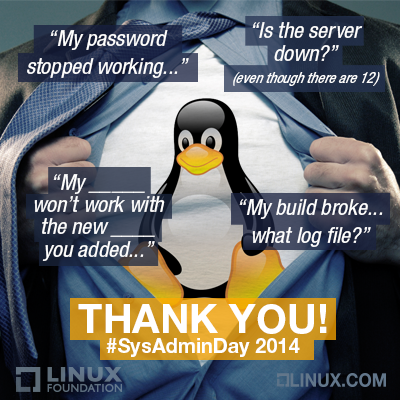
System administrators keep our lives and work seamlessly humming. They are the super heroes who often go unnoticed and unrecognized only until things go wrong. And so, leading up to SysAdmin Day on July 25, we’re honoring the hard work of our Linux Foundation sysadmins with a series of profiles that highlights who they are and what they do.

Ryan Day is one of nine Linux Foundation system administrators, and is part of the global team that supports developers working on collaborative projects. Here he describes a typical work day, talks about his favorite tools, his nightmare scenario, and how he spends his free time, among other things.

Linux.com: How long have you been a sys admin?

Ryan Day: My first paid sysadmin position was 20 years ago, but I think hooking up an Apple II to a cassette player (much longer than 20 years ago) for storage in middle school should count as sysadmin work.

When did you start at the Linux Foundation and how did you get the job?

I started with Linux Foundation in December, 2013. I was recruited by Konstantin Ryabitsev (my manager). I think he found me on LinkedIn.

What do you do for the Linux Foundation? What’s your specialty?

I’m part of the team that provides infrastructure and services for Collaborative Projects. That translates into helping developers manage their code and communicate with each other when they may be widely dispersed.

I’m a typical sysadmin in that I’m a generalist, so it is hard for me to pick an area and call it my specialty. I just like helping people use computers.

Will you describe a typical day at work for you?

I work out of my house so a typical day for me involves sitting in my basement office in front of a few computer screens. I’ll keep in touch with my team via IRC (internet relay chat). I’ll spend a lot of time reading and searching the web to find solutions for the developers I support or my team members.

What’s your favorite part of the job and why?

The best part of the job is the constant learning — getting smarter every day. And I enjoy helping people. That’s even sweeter when the greater goal of everyone is to advance the cool projects that are supported by the Linux Foundation.

What is your nightmare scenario? How have you prepared for it?

I like the saying: “Failure isn’t an option. It’s mandatory.” That’s how I think about complex systems at large scales. The individual components are going to fail in lots of different ways and the challenge is to think about how to build systems that can deal with that failure gracefully and transparently.

sysadminday2014

What is your favorite sysadmin tool and how do you use it?

I’m going to resist the temptation to say something like “tcpdump” or “puppet”, or even “the scientific method” which are pretty cool tools in my estimation. I think a much better answer is “elegance,” since each individual tool’s usefulness is not all that great when compared to a simple, elegant design.

What’s your favorite story about working at the Linux Foundation?

Having been here for less than a year, I don’t have a wealth of stories to draw on. So far, the story I like to tell the best is how I was called upon to drive a test bed vehicle that demonstrates Linux in automotive systems from Portland to a conference in San Francisco. That was pretty cool.

What do you do for fun, in your spare time?

I enjoy my time with my family. We are home-schooling our two children and that means lots of activities, projects, and outings. Eventually I suspect that will evolve into traveling more and I enjoy that a great deal, too.

Manjaro Linux Developers Experience A Mass Exodus

It seems all of the Manjaro Linux developers might have parted way with the distribution’s development except for the project leader…

Read more at Phoronix

Security Company Says Your Data Can Easily be Recovered from ‘Wiped’ Android Phones

Software maker Avast is calling the security and thoroughness of Android’s factory reset feature into serious doubt today. The company says it purchased 20 used Android smartphones online and set out to test whether personal user data could be recovered from them. Each phone had been reset prior to being sold, according to Avast, so in theory the test should have failed miserably. But that’s not what happened.

Using widely available forensic software, Avast says it was able to successfully pull up over 40,000 photos previously stored on the phones. Many of those featured children, and others were sexual in nature with women in “various stages of undress” and hundreds of “male nude selfies.” The company also managed to recover old Google…

Continue reading…

Read more at The Verge