
AMD has now revealed their newest APUs, codenamed “Beema” and “Mullins” while their Linux fate remains unclear…
Read more at Phoronix

Ken Starks writing for Foss Force asks What Would You Do to Improve Linux?, and I’m glad he did, because I have a list. Oh my do I have a list. For me, the Linux desktop has been full of promise, but the promise has always been just out of reach. It’s been full of “the next version is going to be awesome”, for every version that comes out. It’s been chasing fifty rabbits at once, and almost catching a few. Linux desktops, I think it’s time we had a talk.
Computers can be endlessly fascinating; there is an entire universe of things that can be done with one. In this fascination we can get lost, and believe that the universe we are so enthralled with is just as important to everyone else as it is to us.
Sebastian Reisse has announced the release of the “Live” edition of Zenwalk Linux 7.4 (also known as “Zenlive”, based on Slackware Linux): “I uploaded the final version of Zenwalk Live 7.4 which has updated OpenSSL packages to fix the Heartbleed issue and some other small fixes. This is….
Read more at DistroWatch
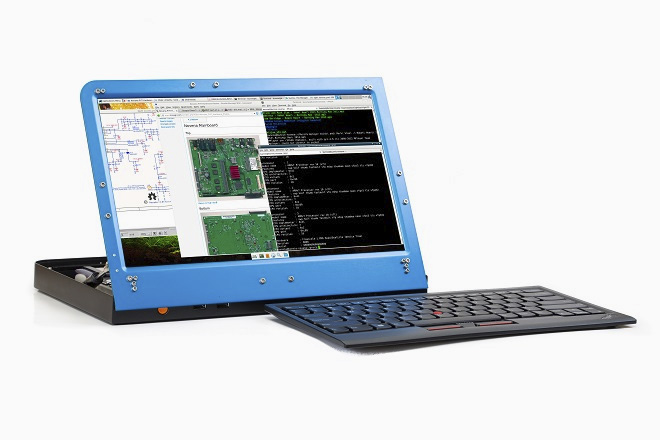
When Bunnie Huang first announced the Novena laptop back in December 2012 it was like an early Christmas present to hackers the world over. This was true even though there was only a suggestion that, given sufficient demand, a limited number maybe made available.
The idea of a laptop that is as open as practically possible and which packs sufficient compute power and capabilities to be used as a primary machine, has long been the dream of many an open source advocate. However, while an open source-friendly processor and peripheral silicon (that has documentation available without NDA) exists, integrating it – designing complex boards that carry high-speed signals and writing firmware, etc. – is not for the faint hearted. It may be business-as-usual for vendors, but they don’t tend to publish all the hardware design files and firmware source code.
Earlier this month the dream of a fully open source laptop took one step closer to becoming a reality with the launch of the Novena crowd-funding campaign. In the Myriad-RF project we’d been keenly following Novena developments for some time, and the campaign is all it took to convince us that we should adapt one of our SDR transceiver designs to enable use with the platform. And I’m happy to report that we were able to! But first, let’s take a closer look at Novena.
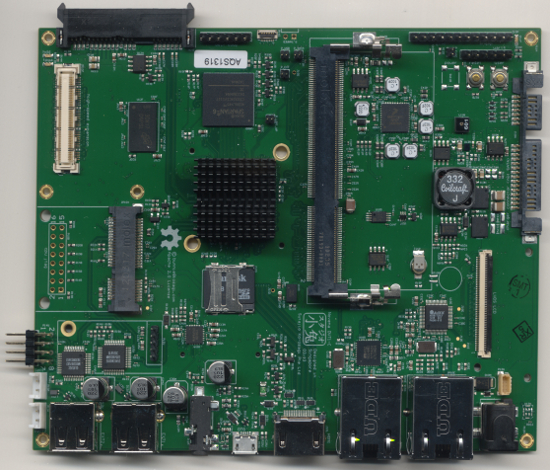 The key specifications for the Novena’s main PCB assembly are:
Quad-core ARM Cortex A9 CPU with NEON FPU @ 1.2 GHZ
64-bit, DDR3-1066 SO-DIMM slot
SATA-II (3Gbps)
Mini PCI-express slot, and UIM slot to enable mobile data card support
Dual-channel LVDS LCD connector with USB 2.0 side-channel for a display camera, plus resistive touchscreen controller
Stereo 1.1W 8 ohm speaker connectors and optional digital microphone
3-axis accelerometer
3x internal UART ports
1x Gbit Ethernet port plus 1x 100Mbit Ethernet
2x USB 2.0 plus USB OTG
Spartan-6 FPGA and high-speed I/O expansion header.
Novena is more than just an open hardware laptop; it’s designed from the outset to be a flexible compute platform that can be configured for a variety of uses and which is easily expandable.
 Backers of the campaign can pledge for the main board alone and use it to build a network appliance, as the basis for a computing device of their own design, or embed it in some other project. The All-in-One Desktop pledge level adds a hacker-friendly case and LCD, while the Laptop level builds on this to add a battery controller board and SSD. Finally, the top tier Heirloom Laptop is packaged in a hand-crafted wood and aluminium case.
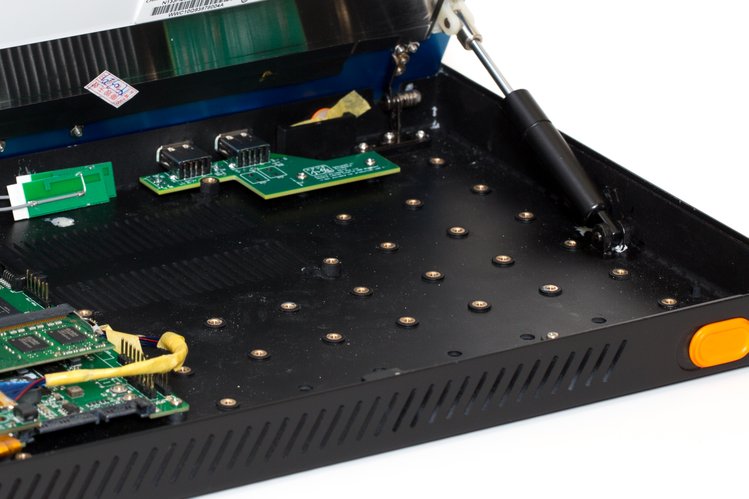
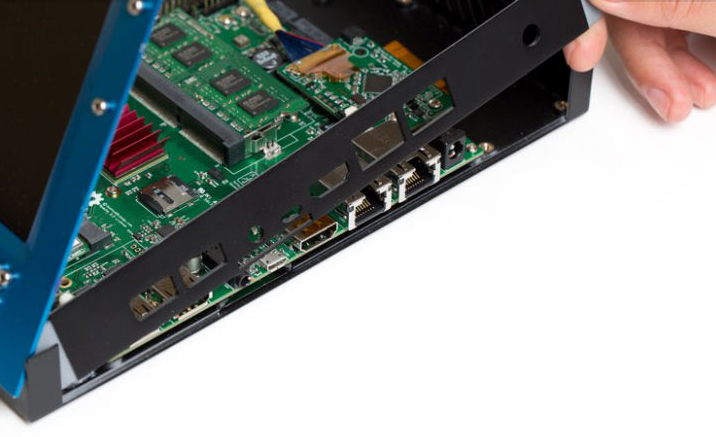
Of course, the real fun to be had is in extending the platform and this is where Novena comes into its own. In use the laptop case is opened via a slide latch and gas spring, simultaneously positioning the screen for viewing while providing clear access to the internals. One of the first things you notice is that there is plenty of space and an array of mounting holes inside the case, which is to accommodate optional, third party and user designed peripherals and components. Where these require external ports this can be accommodated by a replaceable side panel called the “port farm.”
For simple expansion USB can be overkill, while for certain more advanced applications it may introduce a bottleneck or present certain challenges. This is where the high-speed expansion header comes in, which provides plenty of general purpose I/O (GPIO), alongside an FPGA which has interfaces to the CPU that run at up to 2 Gbit/s. Within the Myriad-RF project this in particular piqued our interest, as it meant that it should be trivial to interface a software-defined radio (SDR) transceiver which is attached to the header and with “glue logic” implemented in the FPGA.
Before I get on to the Novena RF module, a quick introduction to Myriad-RF.
 Founded in 2013, the aim of Myriad-RFis to make wireless innovation accessible to as many people as possible, by providing a family of complementary open source hardware designs that can be used to develop new wireless applications and prototype new hardware platforms.
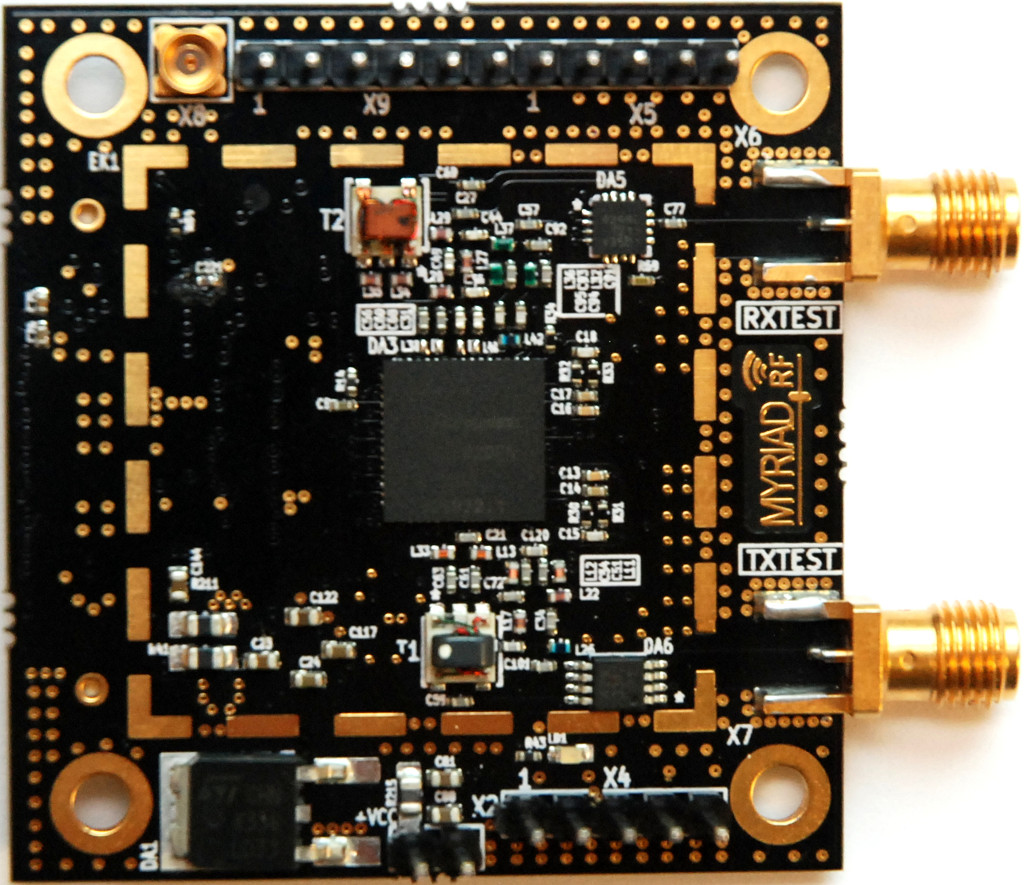
Our first design, the Myriad-RF 1, is an RF module that can be used on any frequency between 300 MHz and 3.8 GHz, with bandwidths of 0.75 to 14 MHz, which has one transmit and one receive port and with a digital interface for configuration and transferring data. This is neither an end user product or a standalone design. Instead it is intended to be embedded in other designs. The benefit being that this takes care of the trickier or more specialist RF design and manufacture aspects, leaving implementers to focus on digital design and developing software.
The Myriad-RF 1 is complemented by an interface which enables use with a DE0-Nano FPGA development system, and a new board which allows use with any system that has an FMC or HSMC header, such as the ZedBoard. Other projects include the A2300 MIMO platform which is designed for communications, position and timing applications, and the currently incubating RASDR project which is building a high performance, low cost radio astronomy receiver.
Since the design files for Novena were freely available we were able to quickly ascertain the effort involved in creating a compatible version of the Myriad-RF 1 module. By pure coincidence and much to our delight, it 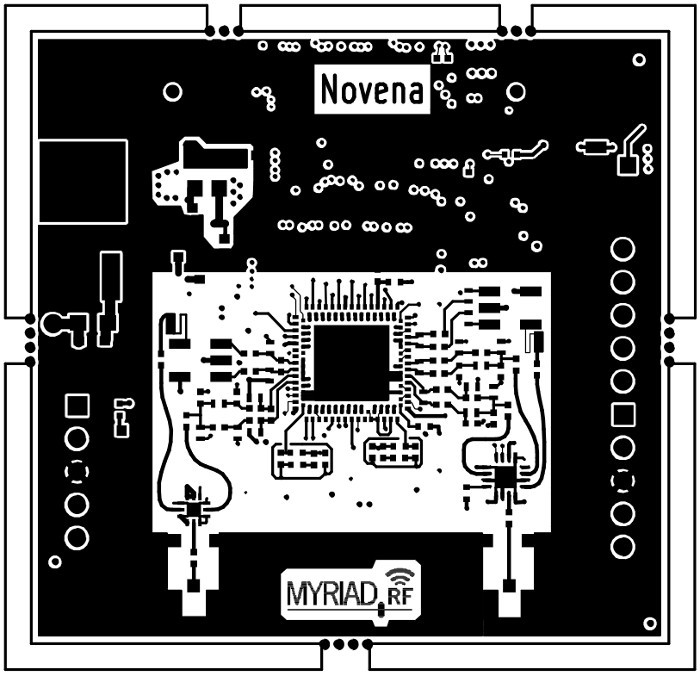 turned out that Novena and the module use precisely the same Hirose FX10-80P/8 connector; although not pin-compatible, achieving this was simply a matter of re-routing traces. We also added an on-board crystal oscillator and swapped the TX and RX SMA connectors for more compact U.FL ones, which can then be cabled to panel mounted SMA connectors.
The RF module uses a field-programmable RF (FPRF) IC, the LMS6002D, which has extensive configuration options for things such as PLLs, filters and amplifiers. Programming and calibration of this is carried out via the SPI bus, and there is a wxWidgets-based utility that provides a user-friendly interface for configuring the transceiver during calibration and debugging etc.
Further development work remains to be done, but this is mostly a matter of writing the HDL for the “glue logic” to be implemented in the Novena’s FPGA, along with a Linux device driver.
Typical SDR applications which could be supported by Novena plus the RF module include:
GSM base station
Amateur radio transceiver
Spectrum analyser
Global navigation system
Aircraft transponder receiver.
Open source implementations of all the above exist now, along with many other applications and the ability to rapidly develop new ones thanks to GNU Radio. There are even numerous efforts underway to develop open source implementation of LTE (4G mobile), such as libLTE.
At present the Novena/Myriad-RF module is little more than a design, the bill of materials, CAD and manufacturing files for which can be found on GitHub. However, when we showed this to Bunnie he was just as excited as we were and the module has now been added to the crowdfunding campaign as a stretch target: if $500,000 is raised or there more than 200 backers in total pledge for the Desktop, Laptop and Heirloom versions, each of those backers will also receive an RF module.
Due to the nature of the board and setup costs for assembly and testing, 200 is the minimum volume at which it’s viable to produce — and this is also after pulling some strings and favourable pricing from suppliers.
We’ve now got our fingers (and toes!) crossed that one of the stretch targets is met, we’re able to put the RF module into manufacture and they’re included in the rewards for the top 3 tiers. However, all is not lost if that does not turn out to be the case, since the hardware design is done and we can reassess demand later in the year once the rewards ship and Novena goes into general availability.
Andrew Back is the Myriad-RF Community Manager.
 For the first time, the Linux Foundation’s SPDX Workgroup is geared up to participate in the 2014 Google Summer of Code internship program. The goal was to engage students in open source projects, learn a bit about open source compliance, and meet open source community members. We had excellent responses in our first year, with a total of four projects accepted from three different universities.
The Software Package Data Exchange® (SPDX®) specification is a standard format for communicating the components, licenses and copyrights associated with a software package. The projects focus on the development of open source code to advance the SPDX community and specification. Specific projects, and the students who will work on them, include:
Python SPDX Parser Library
– Ahmed Hisham Ismail at the German University in Cairo
GO SPDX Parser Library
– Vlad Velici at the University of Southampton
SPDX Merge Tool
– Alex Ling at the University of Nebraska Omaha
FOSSology+SPDX Tooling
– Zachary McFarland at the University of Nebraska Omaha.
These projects help advance SPDX by connecting the specification with open source programming languages and open source license scanners. They help move SPDX into communities that can aid and benefit from the distribution of open compliance practices.
We would like to thank the Linux Foundation, specifically Till Kamppeter, for their support in the SPDX Google Summer of Code projects. We would also like to thank Google for providing the opportunity for university students to engage in these amazing projects.
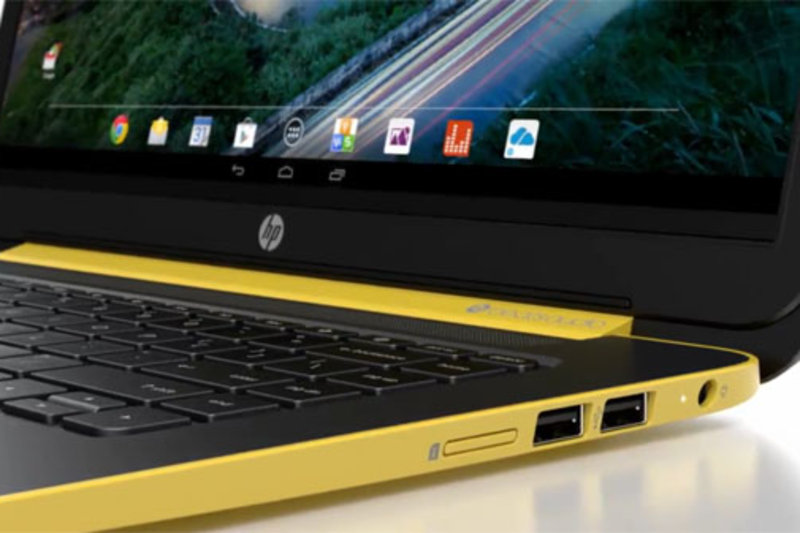
HP is joining Lenovo in the strange world of Android laptops. The company hasn’t yet officially announced the SlateBook 14, but it briefly appeared on HP’s website — complete with a video outlining the device’s key features and specs. Most importantly, the SlateBook has full access to Google Play, so any apps you’ve already purchased and downloaded on a smartphone or tablet should work here. HP says the SlateBook 14 boosts Android’s productivity thanks to its 14-inch 1080p display and full-size keyboard. The laptop also includes Beats technology, which should help it pump out loud, powerful, and likely bass-heavy audio. HP has built in 2GB of RAM and 16GB of internal storage. But since this is Android and not a Chromebook, you may be…