
Engineers at iRobot’s R&D labs are working on a technology to make robots understand and interact with their environment.
The post Roomba will make its robots more intellegent appeared first on Muktware.
Read more at Muktware
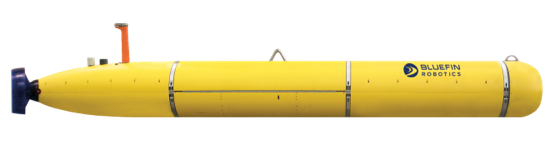
For 40 days, we’ve heard all manner of speculation as to what happened to Malaysia Airlines Flight 370 and its 227 passengers and 12 crew members, but have yet to find any answers. Now, we may yet discover the wrecked plane and its black box with the help of a Linux-driven, autonomous unmanned underwater vehicle (UUV) called the Bluefin-21.
Designed by MIT spinoff Bluefin Robotics, one of the UUVs, sometimes referred to as an autonomous underwater vehicle (AUV), was loaned out by the U.S. Navy to help continue the search. The Bluefin-21 is now being used by Australian search vessel Ocean Shield under the guidance of UK-based Bluewater Recoveries to search an area some 1,400 miles west of Perth, Australia.
Earlier this month, four different pings were recorded that appear to be consistent with the black box recorder that would have gone down in the wreckage of the plane. This helped to reduce the search area from an area the size of Texas to about 600 square miles, or roughly the size of Los Angeles, according to an April 16 Salon report.
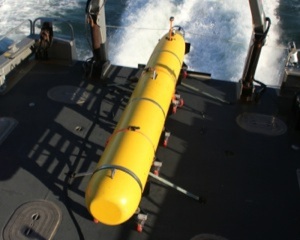 The Navy has also deployed a TPL-25 sensor array that was towed by a ship at a much faster speed than is possible with the UUV. However, this surface array is designed to identify black box signals, which have now gone silent as the batteries have presumably failed. So now, the search effort is focused on the Bluefin-21.
It could take 60 more days for the Bluefin-21 to completely search the area “lawnmower” style. On one of its first dives to the floor of the Indian Ocean, the unmanned submarine reached the limit of its 2.8-mile depth range, and was forced to return to the ship. Most of the search area on the previously unmapped Zenith Plateau appears to be within range, however. The craft spends two hours diving to the sea floor, then spends 16 hours searching, in which time it can cover a 15 square mile section of seafloor. It then takes two hours to resurface, and four hours to download retrieved data.
The Bluefin-21 navigates in a straight line about 150 feet above the sea floor at up to 4.5 knots, but that speed is limited to 2-3 knots when searching. The UUV uses side-scan sonar to build a high resolution 3D map of the searched area. If it detects an object that might indicate wreckage, it can switch to camera mode. It must get within 15 feet of an object to photograph it in the pitch black of the sea floor.
On April 16, the UUV was forced to resurface early after an unstated technical glitch, which has now been fixed. The craft has already returned to work, according to the Australian government’s Joint Agency Coordination Centre.
This week, Bluefin Robotics confirmed to Linux.com that like its smaller Bluefin-9 UUV, the Bluefin-21 runs on Linux. No other technical details were forthcoming, and the Bluefin-21 web page is short on computer details.
We have more information on the Bluefin-9, perhaps because it’s aimed more at port and harbor duty and has less involvement by the U.S. Navy. While the Bluefin-21 is primarily used by the Navy for mine detection, like other Bluefin craft it has been used in a variety of applications from anti-terrorism surveillance to oceanography and underwater archaeology.
The Bluefin-9 measures only 175 centimeters (5.7 feet) in length compared to 493 cm (16.2 ft.) for the Bluefin-21. It’s limited to 650-ft. (200 meter) depths compared to 14,763 ft. (4,500 meters) for the Bluefin-21, which is one of the deepest diving commercial UUVs around.
According to a data sheet from RTI, which furnishes the communications middleware for the Bluefin-9, the unmanned sub runs GNU Linux on a pair of Pentium processors. The UUV communicates with a Windows-based control platform onboard the accompanying surface vessel, but typically operates in full autonomous mode.
A presentation stack on the Bluefin-9 posted by Bluefin Robotics last summer about a next-generation version of the Bluefin-9 says the updated sub will dive deeper (300 meters), while maintaining the same size. Among other enhancements, it will add a modular free-flooded payload and swappable sensor payloads, much like the top-of-the-line Bluefin-21 and will, in general, offer greater commonality with the design of the Bluefin-12 and Bluefin-21.
An “Ethernet RSDM” component includes the Linux computer on a COTS carrier board, as well as a gigabit Ethernet port and switch, and a 128GB solid state drive. This computing subsystem also allows third-party Linux computers to be added to the system for additional processing tasks.
Currently, the next-gen Bluefin-9 is designed to plug a Gumstix module into the carrier board’s USB port. Presumably, this is the Gumstix DuoVero compute module, which runs Linux on a Texas Instruments OMAP4 processor. This week Gumstix, whose Linux-based modules are widely used in automated vehicles, unveiled an AeroCore board for MAVs (micro air vehicles) that mates a DuoVero module with a Cortex-M4 controller.
It would appear that the Bluefin-21 now searching the Indian Ocean offers a similar, but perhaps more powerful computing system. Bluefin lists a 4GB flash drive, plus additional payload storage. The craft also incorporates GPS, RF, Iridium, and strobe communications, and can connect via Ethernet at short range for downloading data at shipside. Other features include a dead-reckoning drift that is typically less than 0.1 percent of distance traveled.
Linux has figured in a variety of autonomous aquatic craft, including the Liquid Robotics’ solar-powered Wave Glider SV3, designed in part by Java creator James Gosling. On the low-end, you can go underwater (with a tether) with the BeagleBone Black based OpenROV UUV.
