
Don’t expect a turnaround from the PC industry just yet. Global shipments dropped between one and five percent during the first quarter, depending on varying analyst reports.
Read more at Enterprise Open Source Toolkit
Brandon Philips is CTO at CoreOS, a new Linux distribution that has been rearchitected to provide features needed to run massive server deployments.
 Containers have made huge progress in the last year with the addition of user namespaces to the Kernel, the introduction of Docker, LXC 1.0, and the maturing of Check Point Restore in Userspace (CRIU). And at the annual Linux Foundation Collaboration Summit last month there were a number of people talking about containers and their application in the Linux ecosystem.
In the hallway track I had a chance to catch up with two btrfs developers: Chris Mason and Zach Brown. With containers on my mind I asked them about two important features in btrfs and how they see them developing and being used.
First, I asked about subvolumes and snapshots; in particular the workloads that Docker puts btrfs through. Docker application containers have the very useful property that every time you start one it gets a fresh clean filesystem. A simple way to implement this would be to copy the “gold master container” into a new directory and start the new container there. If you had a lot of running containers this duplication would get expensive in both time to copy and disk space. Instead of this naive approach, Docker can use btrfs subvolumes and snapshots.
By using a btrfs snapshot of the “gold master container” Docker can make a new playground for this container with a single syscall and avoid the cost of duplicating all of that data into another directory. It sounds like the perfect use of the feature. But, I wanted to hear it from Chris himself, so I asked him what he thought of the “Docker Workload” and in his words he said: “I really want to see this use of btrfs and its features to be successful, please let me know if you run into any problems. I want Docker’s workload to work great.”
It was great to hear this sort of affirmation from the mainter of btrfs. It was icing on the cake since we had, a few weeks earlier, made the decision to make btrfs the root filesystem for CoreOS too.
The second topic was around cryptographic hashes of the filesystem data. Currently, btrfs uses CRC checksums which are great for catching data corruption. But, CRC can’t be used like a SHA hash to cryptographically verify the contents weren’t changed. Having the checksumming of btrfs extended to support this would open up interesting possibilities to mount filesystems only if they are the exact hash you expected.
Zach and Chris hope to start work on this feature this year. And said that btrfs was designed with this sort of use case in mind: the metadata space for checksums is 256bits with the possibility to expand.
This feature would be useful to ensure that your distro partition wasn’t tampered with by an attacker. Or to verify that the copy of the files you have on disk are the exact version you expect. On CoreOS this would make it very straightfoward for us to use btrfs exclusively and verify that our read-only updates were applied correctly.
With all of this progress on containers it is great to know that we have a filesystem that plans to keep up. Thanks to Chris and Zach for explaining their plans and aspirations for btrfs and container goodness.
 In this video from the Lustre User Group 2014, Andrew Usleton from Intel presents: Lustre Client IO Performance Improvements.
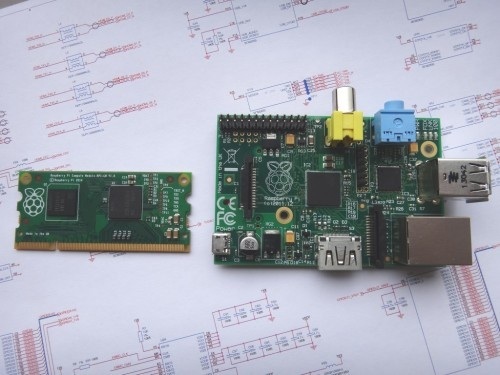 The Raspberry Pi Foundation has announced a $30 computer-on-module version of its Raspberry Pi single board computer, extending the Pi to a wider “business and industrial” market. Like other COMs, the Raspberry Pi Compute Module lacks real-world ports, but rather extends its interfaces via a standard SODIMM edge connector that plugs into a carrier board, including an “IO Board” supplied by the foundation.
Starting in June, RS and Element14 will sell both the module and IO Board together as a yet-to-be-priced Raspberry Pi Compute Module Development Kit. Later this year, the module will also sell by itself for around $30 in quantities of 100 or more, and slightly higher for single units. All proceeds will be plowed back into the foundation’s educational programs.
The Raspberry Pi Compute Module measures 67.6 x 30mm, or about a third the size of the Raspberry Pi Model B. Like the SBC version, the module is built around the ARM11-based, 700MHz Broadcom BCM2835 system-on-chip with Broadcom VideoCore IV GPU, and offers 512MB of RAM. Since the module lacks an SD slot, Raspbian Linux and a bootloader are preloaded on 4GB of soldered eMMC flash.
Embedded developers making commercial products will appreciate the fact that the Pi’s entire arsenal of interfaces is readily available via the 200-pin SODIMM connector. “You get the full flexibility of the BCM2835 SoC (which means that many more GPIOs and interfaces are available as compared to the Raspberry Pi),” writes James Adams, hardware director for the Raspberry Pi Foundation, in his blog announcement.
Unlike the Raspberry Pi Model B, there’s no Ethernet controller, nor is there one on the IO board. Andrew Back of RS-Online tried out a prototype and found that simply plugging an Ethernet adapter into one of the IO Board’s USB ports did not work. However, Back noted it would be “simple enough” to copy a new kernel or module onto the onboard flash.
Like the Raspberry Pi Model B, the IO Board includes an HDMI port, but there’s no composite RCA port or audio out jack. There’s only one USB 2.0 port, although as before you also get a micro-USB connection designed to power the 5VDC input. Slightly larger than a Pi SBC, the IO Board provides dual MIPI-CSI camera 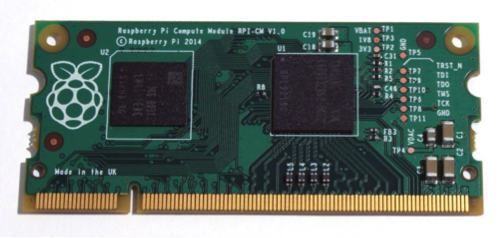 ports and dual MIPI-DSI serial display ports on the board’s coastline. There are also 120 GPIO expansion pins available via dual 60-pin headers that can be plugged into a breadboard for developing interfaces.
The Raspberry Pi Foundation has released schematics for the Compute Module and IO Board, and will offer additional documentation in the coming days and weeks. Responding to criticism that the Pi is not as open source as many community-backed hacker boards, the Raspberry Pi Foundation announced on Feb. 28 that Broadcom had finally released full documentation for its VideoCore IV GPU, as well as a complete source release of the graphics stack under a 3-clause BSD license.
The source release describes the similar BCM21553 cellphone SoC, “but it should be reasonably straightforward to port this to the BCM2835, allowing access to the graphics core without using the blob,” wrote the foundation’s founder, Eben Upton, at the time. Upton also noted: “The success of the Pi has allowed us to make substantial financial contributions to a range of open-source projects, including XBMC, libav, PyPy, Pixman, Wayland/Weston, Squeak, Scratch, and WebKit.”
Since the Raspberry Pi Foundation launched the first Raspberry Pi board in Feb. 2012, it has sold over 2.5 million devices. The project has not only found success in its central mission as an educational platform for computer education, but has expanded far beyond to academic and hobbyist hackers, robot makers, and even commercial industrial manufacturers.
The success of the Pi, and to a lesser extent the BeagleBone Black and other open hacker SBCs like the Wandboard, have changed the embedded board and module business forever. At LinuxGizmos.com where I regularly cover such products, there have been a growing number of traditional embedded SBCs offered up as open source, community-backed hacker boards. Most of these are ARM boards, such as Habey’s hackable new Freescale i.MX6-based HIO board, but even Intel has gotten into the act with its Quark-based Galileo SBC and Atom-based Minnowboard Max.
These Linux-, and in many cases, Android-ready devices are sometimes only partially open source, for example opening a daughter-card expansion design, but not the processor cores. Relatively few have generated vibrant communities with lives of their own, and a few promote themselves as being more open than they really are in order to cash in on the latest hot trend. (What’s the open source equivalent of greenwashing: openwashing?)
Still, most of these are legitimate open spec products, and they’re having a profound impact on the business. In many cases, these manufacturers have had no choice but to become more open. In order to move beyond some OEM customers to reach a broader base, they’ve found that smaller embedded developer firms are demanding more flexibility and better technical resources.
Computer modules, meanwhile, are increasingly gaining momentum as the best form-factor for wearables and small Internet of Things (IoT) devices. Open spec Linux- and Android-ready wearable/IoT modules that should appear this summer include Intel’s Atom-based Edison, Ingenics’ MIPS-based Newton, and Freescale’s i.MX6-based WaRP.
The Raspberry Pi Compute Module is sufficiently small, cheap, and energy efficient to fulfill many of these same IoT applications.

Google Glass can be used to check emails or search for information on the move. It can also apparently be used to save lives. The Boston Globe reports that Dr. Steven Horng, working at Boston’s Beth Israel Deaconess Medical Center, was wearing Glass last year while working on a man whose brain was bleeding. Dr. Horng knew that the patient was allergic to certain drugs that would arrest the bleeding, but didn’t know which ones. With no time to leave the stricken patient, Horng says he called up the man’s medical records on Google’s wearable device, found the relevant information, and stabilized his condition.