Home Blog Page 1554

How To : Install/Upgrade to Linux Kernel 3.13.9 in Ubuntu/Linux Mint Systems

     “The Linux Kernel 3.13.9 is now available for the users and all the users of 3.13 kernel series must upgrade”, announced Greg Kroah-Hartman.This Linux Kernel version comes with plenty of fixes and improvements. This article will guide you to install or upgrade to Linux Kernel 3.13.9 in your Ubuntu or Linux Mint system.


Fixes

  • x86: fix boot on uniprocessor systems
  • Input: synaptics – add manual min/max quirk
  • netfilter: nf_conntrack_dccp: fix skb_header_pointer API usages
  • drm/i915: Undo gtt scratch pte unmapping again
  • mm: close PageTail race
  • Revert “xen: properly account for _PAGE_NUMA during xen pte translations”
  • Input: mousedev – fix race when creating mixed device
  • Input: synaptics – add manual min/max quirk for ThinkPad X240
  • Input: cypress_ps2 – don’t report as a button pads
  • cgroup: protect modifications to cgroup_idr with cgroup_mutex
  • random32: avoid attempt to late reseed if in the middle of seeding
  • i2c: cpm: Fix build by adding of_address.h and of_irq.h
  • ext4: atomically set inode->i_flags in ext4_set_inode_flags()
  • net: mvneta: rename MVNETA_GMAC2_PSC_ENABLE to MVNETA_GMAC2_PCS_ENABLE
  • net: mvneta: fix usage as a module on RGMII configurations
  • xen/balloon: flush persistent kmaps in correct position


Read More at YourOwnLinux.

Leaked Android TV Screenshots Show Simplified UI

Leaked images of Google’s new Android TV user interface show a more streamlined, less ambitious approach to the big screen than Google TV. Rumors of the impending sunsetting of Google TV have been around at least since September when Sony, Google’s most stalwart partner for its struggling, Android-based Google TV, announced a Bravia Smart Stick […]

Read more at LinuxGizmos

Android TV: A Brief History of Google’s Battle for the Living Room

Android TV is old news. ‘Musk See TV’ is in. Introducing Elon Musk’s vision for the future of television. After installing your ‘Musk,’ simply sit down on your couch and let the box do the rest for you. ‘Musk See TV’ will beam directly into your eyes, allowing you to tilt your head back and rest it against the wall without missing a second of programming. The box also comes with a drool catcher allowing you to enter an almost comatose state without getting saliva on your shirt. Once the box decides that you have reached the maximum amount of entertainment your mind can handle, it releases you from its visual grasp and allows you to continue on with the rest of your bland existence. Be warned though… once you start using the box,…

Read more at The Verge

The OpenSSL “Heartbleed” Vulnerability

This page has extensive information on CVE-2014-0160, an information disclosure vulnerability in OpenSSL otherwise known as the “heartbleed bug.” “The Heartbleed bug allows anyone on the Internet to read the memory of the systems protected by the vulnerable versions of the OpenSSL software. This compromises the secret keys used to identify the service providers and to encrypt the traffic, the names and passwords of the users and the actual content. This allows attackers to eavesdrop communications, steal data directly from the services and users and to impersonate services and users.” See also this OpenSSL advisory; version 1.0.1g contains the fix.

Read more at LWN

Running Windows XP Programs on Linux Mint with CrossOver

Thanks to WINE and its commercial big brother, CrossOver, you can run some popular Windows programs on Linux.

64-bit Snapdragon 810 Sets High Bar for Mobile SoCs

Qualcomm revealed 22nm, 64-bit Snapdragon SoCs featuring Cortex-A57 and –A53 CPU cores, 4K video encoding, LTE Advanced, DDR4 RAM, and more. The fact that the new Snapdragon 810 and Snapdragon 808 system-on-chips won’t ship in products until the first half of 2015 only slightly diminishes their inspiring lineup of features. Qualcomm’s first 22nm-fabricated SoCs are […]

Read more at LinuxGizmos

LTO Support Coming To Linux 3.15, Making For A Faster Kernel

As a potentially significant performance win for the Linux kernel, when compiling the Linux kernel support for link-time optimizations (LTO) are now supported…

Read more at Phoronix

Star Conflict for Linux, Helped by Valve

Massively Multiplayer games are already low on Linux and this good looking game is going to help in bridging that gap.

The post Star Conflict for Linux, helped by Valve appeared first on Muktware.

Read more at Muktware

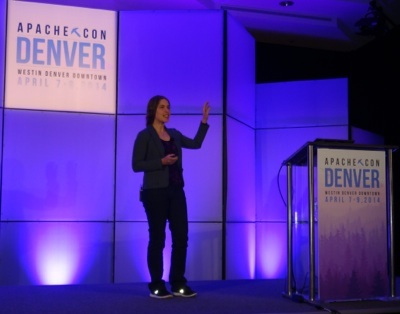
Hilary Mason’s ApacheCon Keynote: 3 Ways to Improve Data Science

Hilary Mason at ApacheCon in DenverData science still has a long way to go in developing systems that solve real-world, human problems, said Hilary Mason, data scientist in residence at Accel Partners, in her keynote at ApacheCon in Denver today. The open source community will be key to helping big data evolve into a more accessible technology, she said.

This is the key challenge facing the field of data science and a contributing factor in the rise of the professional data scientist. For the first time, math and statistics, coding, and analysis have come together into one job description with the sole purpose of making data useful, Mason said.

But the rapid evolution of computing power has outpaced the tech industry’s ability to analyze vast quantities of data now being generated, Mason said.

“Most of what we (data scientists) do is count things, or at least count them cleverly,” she said. “Deep analysis is still hard.”

The state of data science

At the turn of the last century a computer punch card could barely hold enough data to store the characters in a single Tweet in 64-bit ASCI. Back then Computing-Tabulating-Recording Company, the company that eventually became IBM, was on the cutting edge of data science with the invention of a machine used exclusively for counting people.

Today even a tiny computer the size of a Raspberry Pi can store and analyze terabytes of data and tools such as Hadoop are available to anyone via a web download. But while the tools and technologies are much more advanced, the data engineering process most companies use to analyze data is still inefficient, Mason said. A typical company repeats the following process until something useful emerges:

1. Research offline using the data you have and the problem you want to solve.

2. Do fancy math and find the analytical shortcuts to find the right approach to the problem. This involves running a job in a Hadoop cluster or playing with it in Python or R.

3. Design the infrastructure and deploy that to see where it fails.

4. Re-design to run at scale and speed.

“You end up writing a lot of code that gets thrown away just to count things, given the overhead of the infrastructure,” Mason said. 

3 Ways to Improve Data Science

Mason is, however, optimistic about the future of data science. There are already many examples of big data success including the Dark Sky app, which takes public U.S. government weather data to create a micro-forecast and send a mobile alert when it’s about to rain in the user’s location, she said. She also cited Jawbone’s use of an app that measures the number of steps and hours of sleep, to demonstrate that daylight savings time caused the average American to lose 11 minutes of sleep – or millions of hours of sleep when scaled to the entire country.

“Maybe you can learn something from these little devices we wear for personal edification… to influence policy,” Mason said.

Companies are still at the beginning of figuring out what they can do with data. Meanwhile, our technical capabilities are still growing, including advances in the infrastructure used to store and retrieve data, and the software tools that accomplish complex analyses. To build more accessible systems and improve the human side of data science, Mason pointed to three key areas of improvement:

1. Data systems should use natural language – translating computer languages into plain English and vice versa.

2. Data scientists should work more closely with hardware designers. As our sources of data expand from social media and the web into the real world and embedded systems, hardware will be increasingly important to solving problems through data.

3. The community around data science and data technology must grow. “None of this happens without a strong community.”

“Data is making us smarter and data infrastructure is making it possible so let’s make more of that,” she said.

ApacheCon is happening April 7-9 in Denver. Follow #ApacheCon on Twitter for live coverage.

Steam On Linux Use Reported At About 1.2%

Valve has updated their monthly statistics for operating system use and other system attributes via their Steam Hardware Survey…

Read more at Phoronix