
Home Blog Page 1587

30 Linux Kernel Developer Work Spaces in 30 Weeks: Jes Sorensen

Jes Sorensen is a Linux kernel engineer on the Platform Enablement Team at Red Hat, where he primarily works on Software RAID. He is also co-chairing Linux Plumbers Conference and works on WiFi device drivers when he has time.
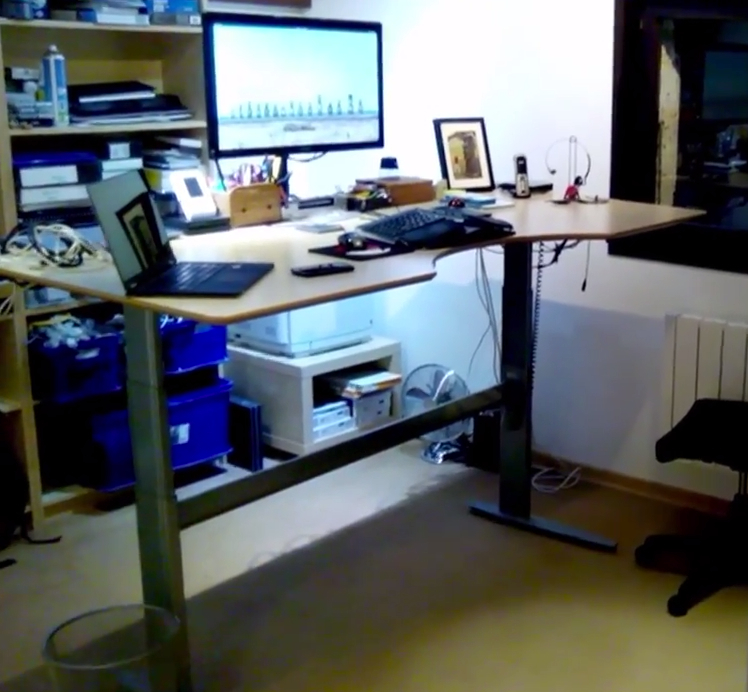
Jes Sorensen deskHe has worked on the Linux kernel and userland for more than 20 years, in areas including KVM, the kernel-based virtual machine, high speed networking, Linux/ia64, Linux/m68k, the system libraries (glibc) and high-end NUMA systems.

This is article aims to continue our popular series on kernel developer work spaces. Previous posts featured kernel developers Shuah Khan, Steve Rostedt andGreg Kroah-Hartman. Is there a particular kernel developer you’d like us to feature? Let us know in the comments, below. Thanks!

Linux.com: What do you like most about your work space?

Jes Sorensen: My electrically adjustable elevation desk, which allows stand up or sit down and work as I feel like, not having to drive out when waking up and finding a foot of fresh snow on the ground outside, and of course my Jura J9 espresso machine (no kernel developer can function without one of these).

What do you like least?
Sorensen: I am terrible at building up a mess on my desk and leaving piles of gear all over it. Obviously, my office is *always* as tidy as it shows in the video, honest!!!

What’s the oddest work space you’ve ever used?
Sorensen: I don’t remember any particular odd space, but I would probably say the basement networking electronics lab at CERN back when I wrote the first parallel HIPPI drivers. Alternatively the Linuxcare Ottawa office, when the electrician crossed some wires resulting in sparks flying out of all the electrical sockets and everybody scrambling out of there in a panic.

https://www.youtube.com/watch?v=oYfgrI55IqE” frameborder=”0

Distribution Release: Porteus 3.0

Jay Flood has announced the release of Porteus 3.0, a set of Slackware-based distributions and live CDs in five desktop flavours: “The Porteus community is overjoyed to announce the release of Porteus 3.0 (Standard Desktop edition), as well as Porteus Kiosk edition 3.0. Here is our changelog of….

Read more at DistroWatch

GLCS: A Better Version Of GLC For Linux Game Capturing

GLCS is a spin of the popular GLC OpenGL game recorder for Linux that adds in a few extra features…

Read more at Phoronix

IBM is Spending, But is it Enough to Buy the Cloud?

Big Blue appears set on a dual strategy to offload hardware businesses as quickly as possible, while snapping up software and cloud companies with equal speed.

NVIDIA Updates Legacy Driver, 304.1210 Supports New Kernels

NVIDIA released the 304.1210 legacy Linux graphics driver this morning…

Read more at Phoronix

Introduction to Linux Course Now Free, Open to All

open education resources

Almost 25 years ago a young engineer started an operating system project “just for fun” to run on his own hardware. He opened it up to the world, and through a combination of good design and good luck, Linux was born. The Internet was the fundamental enabling technology of the large scale collaboration that produces Linux. The ability to cheaply and easily share files has created a system and community that has disrupted major industries, where Linux’ impact has been felt from super computing to mobile phones.

Higher education is facing a similarly disrupting force powered by the Internet—Massive Open Online Courses (MOOC) make information available to anyone, anywhere, as long as they have a connection to the Internet.

read more

Read more at OpenSource.com

Valve Open-Sources Their Direct3D To OpenGL Translation Layer

With Valve’s Source Engine originally just targeting Direct3D, when initially porting their games to Linux and OS X they relied upon a hand-made Direct3D to OpenGL translation layer. In potentially assisting other game developers, Valve Software has now opened up this graphics translation layer…

Read more at Phoronix

Raspberry Pi: Fun With a Serious Purpose

I had almost forgotten how much fun personal computing could be; and that’s the point of this miniature device.

“Is Parallel Programming Hard?”, First Edition

Paul McKenney has announced that the first edition of his 500-page book Is Parallel Programming Hard, And, If So, What Can You Do About It?is available in electronic form; a printed version will follow soon. The entire book is available under the CC-BY-SA 3.0 license.

Read more at LWN

Introduction to GlusterFS (File System) and Installation on RHEL/CentOS and Fedora

We are living in a world where data is growing in an unpredictable way and it our need to store this data, whether it is structured or unstructured, in an efficient manner. Distributed computing systems offer a wide array of advantages over centralized computing systems. Here data is stored in a…

[[ This is a content summary only. Visit my website for full links, other content, and more! [[

 
Read more at TecMint