Home Blog Page 1604

Physical Security Market is Expected to Reach USD 125.03 Billion Globally in 2019

The worldwide market for physical security was valued at USD 48.05 billion in 2012 and is projected to reach the market size of USD 125.03 billion by 2019, growing at a CAGR of 14.9% during the period from 2013 to 2019. Some of the major factors driving the demand for physical security include rising global security concerns and increasing budget allocations for physical security by governments to prevent terrorism and crime activities. In addition, regulations imposed by governments of different countries demanding increased security levels is driving the adoption of physical security in several end-user sectors including industrial and business organizations. Continued investments in infrastructure worldwide, especially, in Asia Pacific region is expected to emerge as a significant factor behind the growth of physical security market in coming years.
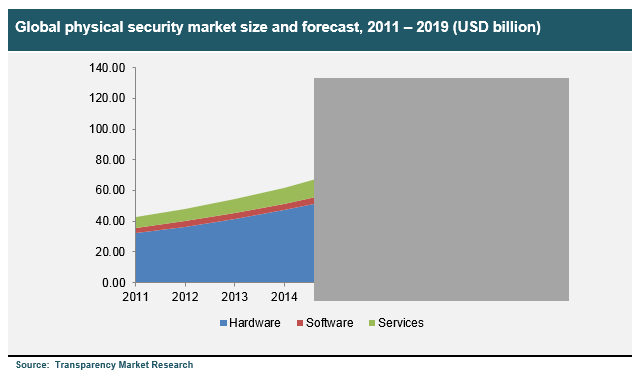
global-physical-security-market-size-and-forecast-2011-2019

The primary concern in physical security is the protection and prevention in order to serve security interests of people, equipment, and property. The increase in incidences of terror activities and crime has resulted in escalated demand for physical security solutions. It is expected that internet protocol (IP) video, sophisticated access control systems and biometric solutions would drive the demand for physical security solutions. Further, the emerging trend of convergence of logical and physical security and increased demand for integrated physical security solutions are expected to boost the growth of physical security market.

The different components of physical security include hardware, software and services. The market for physical security hardware has been further segmented into intrusion detection and prevention systems, access control systems and others (fire and life safety, visitor management and backup power). Among intrusion detection and prevention hardware products, video surveillance was the largest market and held around 72% share in 2012 and is expected to be the fastest growing segment throughout the forecast period. In access control segment, biometric access control held the largest market share of around 38% of total access control market in 2012. Physical security software market has been segmented into physical security information management (PSIM) and management, analysis and modeling software. PSIM is fast gaining market demand, driven by declining costs, increased sophistication and increasing awareness among end-users. Physical security services market has been segmented into video surveillance as a service (VSaaS), remote management services, technical support, public safety answering point (PSAP), security consulting, public alert, customer information and warning systems and others (data source, hosted access control, managed access control, alert notification, mobile security management). Among the services segments, VSaaS is expected to be the fastest growing market driven by benefits such as cost savings, simplicity, and remote access.

End-user segments of physical security include transportation and logistics, government and public sector, control centers, utilities/energy markets, fossil generation facilities, oil and gas facilities, chemical facilities, industrial (manufacturing sector excluding chemical facilities), retail, business organizations, hospitality and casinos and others (stadiums, educational and religious infrastructure, healthcare organizations). Transportation industry which includes aviation, rail, ports, road and city traffic and new start projects (including light rail, rapid rail, metro rail, commuter rail, bus rapid transit, and ferries) in transportation and logistics sector was the largest end-user of physical security in 2012. North America emerged as the largest regional market for physical security in 2012. In view of high terrorism incidences, the region has been increasing security measures across all end-use verticals. Moreover, governments in North America have significantly increased the regulatory measures for adoption of physical security. Asia Pacific is one of the fastest emerging markets for physical security, growing at a CAGR of around 17% owing to significant push from governments and the police to enhance security in view of increasing crime and terror in the region.

The market for physical security was highly fragmented in 2012 and no single player was dominant; however, Honeywell Security Group emerged as the market leader, accounting for around 5% share in 2012. Honeywell Security group was followed by Bosch Security Systems Inc, Morpho SA (Safran), Hikvision Digital Technology, Assa Abloy AB, Axis Communication AB, Pelco Inc, Tyco International Ltd, NICE Systems Ltd, and others.


Source : http://www.transparencymarketresearch.com/physical-security-market.html
Dell, NetSuite Partner Up as the PC Maker Spins Towards Enterprise

The two computing pioneers will see benefits from the relationship, not least NetSuite’s push to give Dell a better enterprise focus now it’s gone private.

Tizen Smartwatches Tip Samsung’s Ecosystem-First Strategy

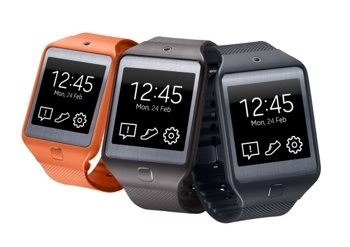
The long wait for a major Tizen OS device is finally over, and it’s a…smartwatch? At Mobile World Congress in Barcelona this week, Samsung skipped the unveiling of its first Tizen smartphone, and instead rolled out two Tizen-based wrist computers: the Gear 2 and Gear Neo. Due to ship in April, the devices are lighter and more stylish than Samsung’s Android-based Galaxy Gear.

Samsung NeoThe Gear 2 and Gear Neo will ship with 100 Tizen apps, mostly ported over from the first generation Galaxy Gear, and an open SDK is available to make more. Also at MWC, the Tizen Project announced winners of the Tizen App Challenge (see farther below).
The two watches can also act as standalone Bluetooth music players and cameras, but they are primarily billed as Bluetooth companion devices to other mobile devices. In fact, as with the Galaxy Gear, they’re restricted to syncing up with Samsung devices. While that still gives Samsung a huge market — the company just announced it has sold over 200 million Galaxy S phones alone since their 2010 launch — millions of Android and iOS users are left out of the picture.

Otherwise, there’s a lot to like here, assuming the price is right. The new phones are more stylish than the original. The Gear 2 sheds five grams off the original, weighing in at 68 grams, while the Gear Neo slims down to 55 grams. The main difference is the Gear 2’s metal enclosure and removable leather strap, compared to the Neo’s lighter plastic design.

Like the Galaxy Gear, the Gear 2 and Gear Neo offer a 1.63-inch Super AMOLED screen with 320 x 320-pixel resolution. However, they move to a faster 1GHz, dual-core processor, once again with 512MB RAM and 4GB flash. The watches provide Bluetooth 4.0 with headset and speaker support, as well as a 2-megapixel camera capable of 720p video. An IR blaster works with Samsung’s WatchOn app for controlling TVs.

Fitness features include a heart rate sensor, pedometer, accelerometer, gyroscope, and apps for running, walking, cycling, hiking, sleep, and stress monitoring. The devices add IP67 water and dust protection, and Samsung Gear Fitthe 300mAh battery is said to last longer: typically 2-3 days, or up to six days with low usage.
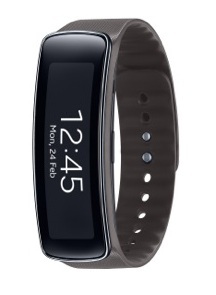
Announced alongside the Gear 2 and Gear Neo, the bendable screen Gear Fit, which runs on a real-time operating system, has only a fitness oriented subset of the apps available on the other two watches. The device is notable for its curved, 1.84-inch Super AMOLED screen, with 432 x 128 resolution. The 27-gram, IP67 protected device can last 3-5 days, and offers Bluetooth and a heart monitor.

Hands-on reports from MWC suggest the Gear Fit could be the most popular of the trio. Not only does it have the flexible screen, but it’s one of the most attractive smartwatches around and is more capable than other fitness band devices like the Fitbit or Nike Fuel Band.

Tizen phone watch continues

Two and a half years after the Tizen project was launched, Samsung’s Tizen phones were shown at MWC, according to the Wall Street Journal — but only behind closed doors. Samsung execs told the Journal that Tizen phones “could” still arrive this year, and CNET quoted Young-hee Lee, Samsung’s head of mobile marketing, as saying, “We are carefully evaluating the market needs and opportunity to introduce the Tizen-based smartphone during this year.”

Based in part on the smartphone-focused LiMo Foundation stack and Samsung’s earlier Bada OS, Tizen has principally been a smartphone project. Yet the first Tizen devices have been a development tablet from Systena , a Samsung NX300M camera, a Samsung refrigerator computer, and a Nexcom VTC 1010-IVI system.

Intel and Samsung are Tizen’s major backers, but Samsung has been the driving force for phones, or as Intel President Renee James told CNET, “They have always been the productizer.” Still, like the MeeGo project it grew out of, the Linux Foundation-hosted open source project also has sub-projects for tablets, netbooks, smart TVs, and in-vehicle infotainment (IVI). No doubt a wearables category is coming soon.

Smartwatches avoid the biggest obstacle to a successful Tizen phone launch: the lack of apps. While the Tizen hardware and OS appear solid, Samsung wants to avoid repeating the mistakes of Palm, which launched its first WebOS-based Pre phone without a competitive app library.

Samsung has already faced a few setbacks with Tizen, though the reasons are unclear. Japanese mobile provider NTT DoCoMo last month announced it was indefinitely postponing its Tizen launch. Shortly afterward Orange and Vodafone postponed their own MWC Tizen events.

Tizen App Challenge Winners announced

Samsung and the Tizen Project have tackled the app gap with a very lucrative Tizen App Challenge. On Feb. 23, the Challenge announced 54 winners of $4.04 million in prizes.

Grand prize winners earning $120,000 to $200,000 each include Silesia Games, Kidalang, Idealdimension, Laveena Samar, Loud Crow Interactive, Michal Łuszczuk, Fluid Interaction, Maciej Różański, and ProExe. Submissions were evenly split between native Tizen apps and HTML5 apps. Yet, most of the grand prize winners used the more capable native tools.

Over the last year, Samsung has been pushing HTML5 as the preferred Tizen platform, hoping that ported web apps will help accelerate app creation. By waiting another year to launch a phone, the apps could fill in nicely. Tizen may also benefit from the growing popularity of Mozilla’s HTML5-only Firefox OS, which made the biggest splash of any of the mobile Linux platforms at MWC. Apps developed for Firefox OS should be fairly easily portable to Tizen.

Yet, if Samsung waits too long, the market could decide there’s room for only one mobile OS upstart, a dilemma that also faces Ubuntu. Being the biggest mobile device manufacturer on the planet certainly helps, however.

Meanwhile, expect more Tizen-based devices, says the WSJ, which speculates that Samsung is moving to an ecosystem-first strategy. The more devices a Tizen phone can seamlessly interact with, the better chance it has for success. And with smartwatches, Samsung doesn’t have to worry about cannibalizing its popular Android devices, including its newly announced Galaxy S 5. 

If nothing else, the jump to smartwatches, cameras, and refrigerators, shows that Tizen can be just as flexible as the Gear Fit. The same could be said for other mobile Linux open source platforms. For example, LG has revamped WebOS for its smart TVs and digital signage systems. Firefox OS is making its way into a Panasonic smart TV and Via mini-PC. Proprietary platforms don’t change shape quite so easily.

Correction: The Gear Fit does not run Tizen.

MakerBot’s Creative Revolution Runs on Linux

Three dimensional printing has surged in popularity among consumers and manufacturers alike as costs come down and the range of available applications expands. In five years, the global 3D printing market is expected to reach $7.2 billion, up from $2.2 billion in 2013, according to a Transparency Market Research report released last week.

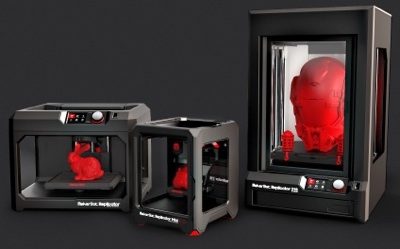
Makerbot ReplicatorsThe technology has incredible promise as companies and researchers experiment with printing everything from entire houses and cars, to synthetic meat and body parts. Just last week surgeons reconstructed a baby’s skull using a 3D printed template.
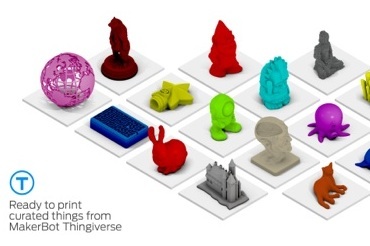
At the forefront of the 3D printing boom for consumers is MakerBot, whose Linux-based Replicator printers sell for between $1,300 and $3,000 and are small enough to sit on your desktop. Their MakerWare design software runs on any platform and the Thingiverse online community allows more than 13,000 users to download or upload designs in an open source, collaborative model for do-it-yourself manufacturing, according to a sponsored post in The Atlantic.

Though printing a hand is impressive, and increasingly a reality, MakerBot is aiming for a different kind of revolution. They want to make 3D printing more accessible and user friendly to individuals to create and model their own ideas. With wider access to creative tools also comes a philosophy of creation that emphasizes fast iteration and prototyping, failing and adapting. That drives innovation.

“Tools like Linux or the MakerBot empower people,” said Anthony Moschella, Vice President of Product at MakerBot. “Platforms like Beaglebone and the Raspberry Pi have enabled a new generation of people to start developing quickly and easily on a Linux system. MakerBot is a similar analogy in how people create physical parts. It brings a new level of accessibility to the creative community.”

Powered by Linux

It’s fitting, then, that their technology is also based on Linux. Their latest generation of Replicators, announced at CES in January (along with a new digital store), contain TI ARM9 processors running MakerBot’s own embedded Linux operating system based on TI’s Angstrom distribution.

MakerBot chose Linux for its built-in support of all of the machine’s peripherals, including ethernet, USB, a video driver for their display, and wi-fi. That significantly sped up the development process by allowing them to focus more on the rich, customer-facing features written in upper-level languages like Python, Makerbot thingiverseMoschella said.

They also get a lot of portability with Linux, Moschella said. Their middleware can be developed on a desktop and run on an embedded system or vice versa. And the available pool of talented developers who know embedded Linux was greater than with alternatives such as ROS, he said.

“It’s the right way to architect embedded systems like this. To do it otherwise is to take on a huge support program that’s going to slow your development cycle,” Moschella said. “To do it with pure embedded code on a microcontroller, or not using an operating system, is significantly magnifying your development work.”

New for this year, MakerBot is focusing on how the overall system flow works, enabled by the embedded Linux platform. Their newest 3D printers have improved connectivity, for example, so users can download objects from the digital store and content will go directly to the MakerBot, Moschella said.

“There’s so much stuff coming,” he said. “This technology is in its infancy.”

A Memory Comparison of Light Linux Desktops – Part 3

Linux kernel manages all RAM memory in your computer. Unused memory goes into a special buffering pool, where the kernel caches all recently used data. If a process attempts to read a file and the kernel already has the file cached, reading it is as fast as reading RAM.

Filesystem-heavy task, such as compiling source code, processing video files, etc. benefit from as much free memory as possible in buffering pool. It is not uncommon today to see users with powerful systems running tiling window managers in only a few megabytes of memory. Also, with the personal computer market in decline, people tend to keep their computers longer.

In this article I continue the measurements started in part 1 and part 2 of this series.

Read more at Layer 3 Networking Blog.

Ars Walkthrough: Using the ZFS Next-Gen Filesystem on Linux

In my last article on next-gen filesystems, we did something in between a generic high altitude overview of next-gen filesystems and a walkthrough of some of btrfs’ features and usage. This time, we’re going to specifically look at what ZFS brings to the table, walking through getting it installed and using it on one of the more popular Linux distributions: Precise Pangolin. That’s the most current Long Term Support (LTS) Ubuntu release.

With that said… if Ubuntu’s not your cup of tea, don’t worry! There are lots of options for running ZFS, and very little of this walkthrough will really depend on your use of Ubuntu in particular or even Linux in general. You can always visit http://zfsonlinux.org directly for help with the initial installation if you prefer RHEL or Fedora or Arch or what have you—and if you’re a BSD fan, ZFS is available from the base installer in either PC-BSD or in the latest 10.0 release of FreeBSD itself.

Read more at ArsTechnica.

Piston OpenStack 3.0 Arrives, Focused on Private Clouds

Piston Cloud Computing, which has been focused on the OpenStack cloud computing platform, today announced, in conjunction with an Intelemage customer announcement, a new release of Piston OpenStack, the company’s OpenStack distribution for orchestrating private clouds. Piston is notable for its involvement with the original cloud project that became OpenStack, and for its heavy involvement with the OpenStack Foundation and the Cloud Foundry Community Advisory Board. Piston is going so far as to call its latest release “the last OpenStack you’ll ever try.”

Piston officials are claiming that total cost of ownership (TCO) for its OpenStack distribution will be far lower than costs for other platforms. Piston OpenStack 3.0 is available now, and may be downloaded free for 90 days at http://www.pistoncloud.com/start. After the 90-day free trial period, Piston OpenStack is available through an annual software subscription license, which includes an automated, online update service and access to 24×7 customer support.


Read more at Ostatic

KDE and Google Summer of Code 2014

KDE is happy to announce that it has been accepted as a mentoring organization for Google Summer of Code 2014. This will allow students from around the world to work with mentors on KDE software projects. Successful students will receive stipends from Google.

The Google Summer of Code program offers development funding as well as mentors to students who want to work on open source software projects. The program provides students the opportunity to learn more about coding, work within structured software development environments, and push bug fixes and new features into real-world, production software. For Google and the rest of the world, the program provides improvements to the software that millions of people use on a daily basis.

    Read more at KDE.news

    SanDisk’s 128GB microSD: The Biggest, Smallest Storage on the Market

    Revealed at MWC, SanDisk’s 128GB microSD packs a punch for so small a piece of hardware.

    AMD Press Talks Up Major Open-Source Linux Driver Features

    Good news: AMD’s press / global communications team is finally talking up their open-source Linux graphics driver features. Bad news: they appear to still need lots of training over their own Linux graphics drivers. Or is there some Linux driver shake-up happening? Here’s some of what they are promoting right now with the AMD Linux graphics driver…

    Read more at Phoronix