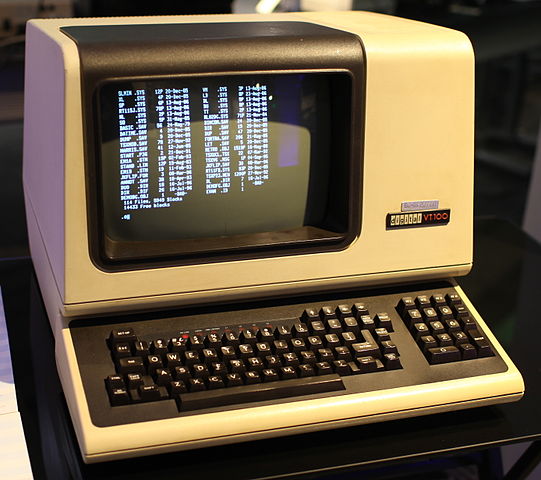
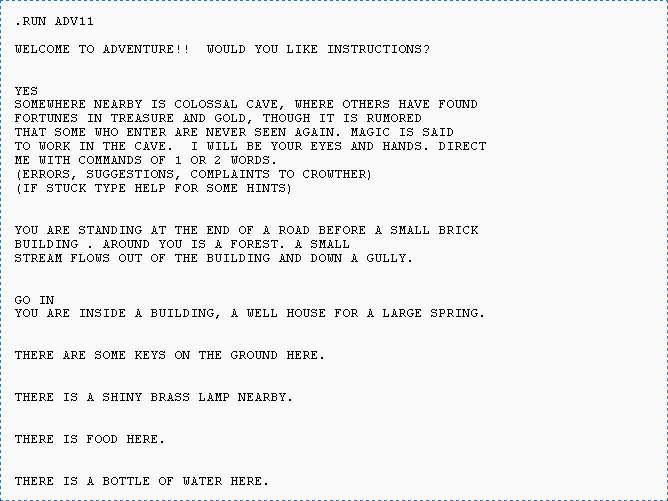
I had been playing for about 10 minutes when suddenly “Gail?” appeared on the screen.
As I was not Gail, I replied with “No, this is Leslie” which prompted a rapid fire response of questions along the lines of “Who are you? Why are you on this system?”
At this point, I figured Mom was the best person to answer these questions. And to get me back to my maze of twisty little passages, all alike.
Mom quickly discovered that I’d been talking to a colleague of hers in Europe, who wanted to share a technical pointer. Whether I should have had access to that system or no – and I probably really shouldn’t have – was no longer an issue and they chatted happily for a few minutes. My Mom’s co-worker asked how I was doing, via my Mom, who handed back the keyboard to me.
Here I was, almost 5,700 miles away from someone I’d never met who was talking to me as though we were right next to each other! I should have been fascinated, but at the time the machines were all indistinguishable from magic anyway, so I didn’t think any of this too out of the ordinary. I simply typed “Hi, it’s Leslie. I would like you to stop interrupting my game of Adventure, please.”
I returned to my game that day, and on the long drive home I happened to ask my Mom about how someone from Europe could talk to you through the computer. By the time she finished her explanation, I was enthralled. How could I find more people to talk to? Where would they be? Would they have even better games than Adventure?
 My Mom, being the wise soul that she is, noted that most people were using this stuff for work purposes only and that I was a bit young to get a full-time job. However, I continued to love Adventure, and later the MS-DOS based games a friend of mine from church had put together. I spent countless hours in our school library’s computer lab, writing simple programs and enjoying all that the glory that our Apple IIe’s had to offer, from Jumpman to The Oregon Trail. I was the only girl who hung out in the computer lab and suffered the usual barrage of anti-female teasing from my cohort, but as they were all also unpopular nerds who no one wanted to hang out with, it didn’t occur to me to let their commentary dissuade me from all the things I was doing.
Since my mother worked at a large telco, I had access to a computer ‘from birth.’ I began using the command line and vi mostly because the ASCII art Mom printed off our dot matrix printer was beautiful and I wanted to create my own. It was never much to write home about, but then again anyone attempting to illustrate song lines from The Sound of Music is not going to fare particularly well.
We also had a huge box of telephones sitting in our basement. I realize that this sounds incredibly boring, but at this time you had to rent your phone from one of the carriers and the idea of someone having a box of phones just sitting around their house was completely unheard of. It seemed a real shame to me that they were just sitting there, gathering dust, so I decided it would be a great idea to take them apart and see where all those wires were going (many places, turns out), maybe poke some holes in the diaphragms in the receiver to see what happened (things break), figure out how to put them back together (badly).
A Series of Unfortunate Events
About the same time I was learning to love gaming, programming, disassembling phones and anything else I could get my hands on – so right around 4th grade – things were getting pretty tough for my Mom at work. I don’t have the details and it has never been her way to get deep into the thick of what’s bothering her, but it was clear that things were tough. She was taking conference calls quite late in the evenings, seemed more stressed, etc. Most of what was going on was completely over my head, but I could tell all was not well. I noticed that she was less willing to let me fire up the computer in my room, though there were no explanation forthcoming. I figured out ways to turn library study time into more computer lab time, though, and thought little more about it.
Then came the fateful day. I had been out of school for a few days with the flu, and in my absence I had missed the lecture on Base mathematics. We had a few students from Stanford who volunteered at my primary school doing tutoring, so I asked for a tutoring session to cover the work I’d missed.
Requesting tutoring was a public process in class and, surprise surprise, kids are cruel. The entire classroom exploded in a series of nasty comments about how stupid I was and how I clearly only wanted tutoring because I wanted to spend time with the boys, etc. I was used to being bullied – being an overweight kid who is not allowed to say the Pledge of Allegiance will do that for you – but this outburst was unlike anything I had ever experienced. I left the classroom for this study session with my cheeks burning, fighting off tears. I didn’t hear a word my tutors said to me. I wasn’t in any space to absorb new knowledge, and kept telling them that it was great, I’d figured it out, perhaps I ought to just go back to class now.
Later that night, my Mom banged on my door and wanted to know what the fsck had happened to her box of phones. As I said, I learned how to put them back together – badly. She needed one of them to test something and was seriously unthrilled that it was non-operational. I don’t recall that conversation, to be honest, other than getting the very clear message that one does not simply walk into the basement and begin disassembling phones. Or breaking things. Or tinkering with things. In fact, just leave it all the fsck alone, thank you very much. Oh yes, and no more computer time for you. For awhile.
Two Steps Forward, Two Steps Back
That day pretty much clinched it for me. Whatever this whole thing I had been doing was, it was clearly not a good idea. I rapidly lost interest in computers and spent my time in the library reading instead of manipulating pixels. I still wanted to take things apart and truly understand how they worked, so I applied my talents to taking apart the characters in the novels I was reading, both for class and for pleasure. I wrote essays on various literary devices and the motivations of particular characters for no particular audience. I devoured books instead of bytes. Where my previous diversions had met with derision, I was consistently praised for my reading comprehension, excellent spelling and command of grammar. Unsurprisingly, I stuck with what brought me praise and affirmation and buried my other interests under the heading of Life: Failed Experiments.x
 I ended up studying Medieval English Literature at UC Berkeley, finding my love of trees and leaves well satisfied by the study of paleography and codicology. I planned to spend my days teaching English at a university and, while thrilled with the prospect of spending my days in the carrels at the Bodleian Library, I was keenly aware that my job prospects were fairly slim. After graduation, I decided the best way to move forward was to get a job and head back for graduate school after I’d amassed some savings and a bit of time in industry.
I was fortunate enough to land a job in the tech industry even though I was searching in Silicon Valley in late 2000, well into the dot com nuclear winter. My first gig was at a semi-conductor firm creating a segmentation and reassembly engine for traffic conversion between packet and cell based switch fabrics. I was fortunate enough to have an amazing first manager, who not only taught me a great deal about Intellectual Property law, but also noted that I didn’t want to be an administrative assistant my whole life and suggested I try my hand at technical writing.
Technical writing was an awesome addition to scheduling calendar appointments, filing sales orders and taking care of our company’s tradeshows, but it had nothing on our lab. I spent far more time than I needed to watching our Lab Engineer muck about with oscilloscopes. I learned how to do bring up of a PCB, but never got comfortable enough to try my hand at doing any of it myself, heading the gentle discouragement that this, too, was not for me.
Gentle discouragement, however, didn’t stop me from constantly getting my fingers coated in thermal transfer compound. Or, after I joined Google, popping my head over Matt Cutts’ screen to ask him if he thought PageRank was problematic since it meant “truth” was based on some sort of consensus reality. Or spending numerous hours asking open source developers about their projects’ architectures while managing the Summer of Code program. Or saying hello, out loud, to demeter.kernel.org every time I passed her cage in the OSU Open Source Lab. Etc.
Be Careful What You Wish For
About five years ago, I was en media res of a heart to heart with Mom when I noted that I thought it was incredibly odd that I was not a programmer, but still so delighted by technology and more than happy to spend 95% of my time with programmers. What she said in response brought me up short in a way that I cannot describe:
“Well, you were heading that way, I think. But I discouraged you from it.”
When I asked her why, her response was heartfelt and all too human:
“I’m not sure, really. I was having a tough time at work. I didn’t think you’d enjoy it. I didn’t want that life for you.”
We ended up having a good laugh at how, despite her best attempts, I was working on the high tech world anyway.
How To: Encourage Women in Computing
I’ve chosen to share this story even though I feel pretty vulnerable about how people will respond to it. In the past, I’ve been called a “woman near tech,” “not a real technical woman” or “that girl who makes sure we have beer” on enough occasions that I’m not interested in hearing such things ever again. (And, if you find these thoughts running through your head, may I direct you to Shanley Kane’s excellent piece The Gendering of Technology Work?)
Despite feeling vulnerable, I think it’s important to share this story to let folks know just how much impact their words, encouragement (or discouragement) and the overall socialization process have on young women in their pursuit of technical disciplines. If someone (who was also white, cisgendered, living in an incredibly affluent area and with access to tutors attending Stanford) who had access to a computer from infancy – and access to a Mom who had UNIX 1.0 manuals lining her home office shelves – became completely turned off from pursuing a career as a computer scientist due to the usual vagaries of life, consider what the outlook is like for young women without access to this plethora of resources.
Engineer – Human Systems
I wish I had a great closer to this story, about how I dived into programming full tilt, taught myself all the things and now have a storied career in development after a great stint as a community manager. However, that’s simply not the case – I’ve worked through all of Learn Python the Hard Way, attended many a hackathon and talked many a programmer through their blues with code and community, but I simply don’t enjoy coding.
Which is odd, considering I’m also the person who suggested the solution that one of my current employer’s engineers used to get around a tricky packaging problem for Debian two months ago. Or, as a good friend once said in his usual tactful fashion “Eh, a marketing chick who runs Mint and has a GitHub account?”
I’ve spent my career focused on the human element in development – how to make people collaborate well together, how to build redundancy into groups of people working on tasks, understanding individual’s strengths and weaknesses and how to best make sure their strengths shine and their weaknesses don’t hinder them overmuch. Though my job title has been Community Manager for more than the last half-decade, I more often think of myself as an Engineer of Human Systems. I love what I do, am eternally grateful for all the relationships I have built while bearing said job title, and have the pleasure of knowing I am well respected in my field.
I still, though, wonder what life would have been like if I’d gotten the same accolades for breaking things as I did for smoothing them over.
Editor’s Note: This is a guest blog post by Leslie Hawthorn, community manager at Elasticsearch.
We are inspired by My Nerd Story, which began as one woman’s blog post in response to an interview in The Information and has grown into a movement of women developers sharing their stories about how they got started coding. In support of women who want to share their nerd story but need a platform, Linux.com is offering to publish them in our community blog section. Linux.com registered users can upload directly to the site at https://www.linux.com/submit-an-article, and anyone can contribute by contacting editor Libby Clark, This e-mail address is being protected from spambots. You need JavaScript enabled to view it
.