
Dell’s Director of Cloud and Big Data solutions answers questions “why OpenStack?” and “Why partner with Red Hat to offer OpenStack solutions?”
Read more at Enterprise Open Source Toolkit
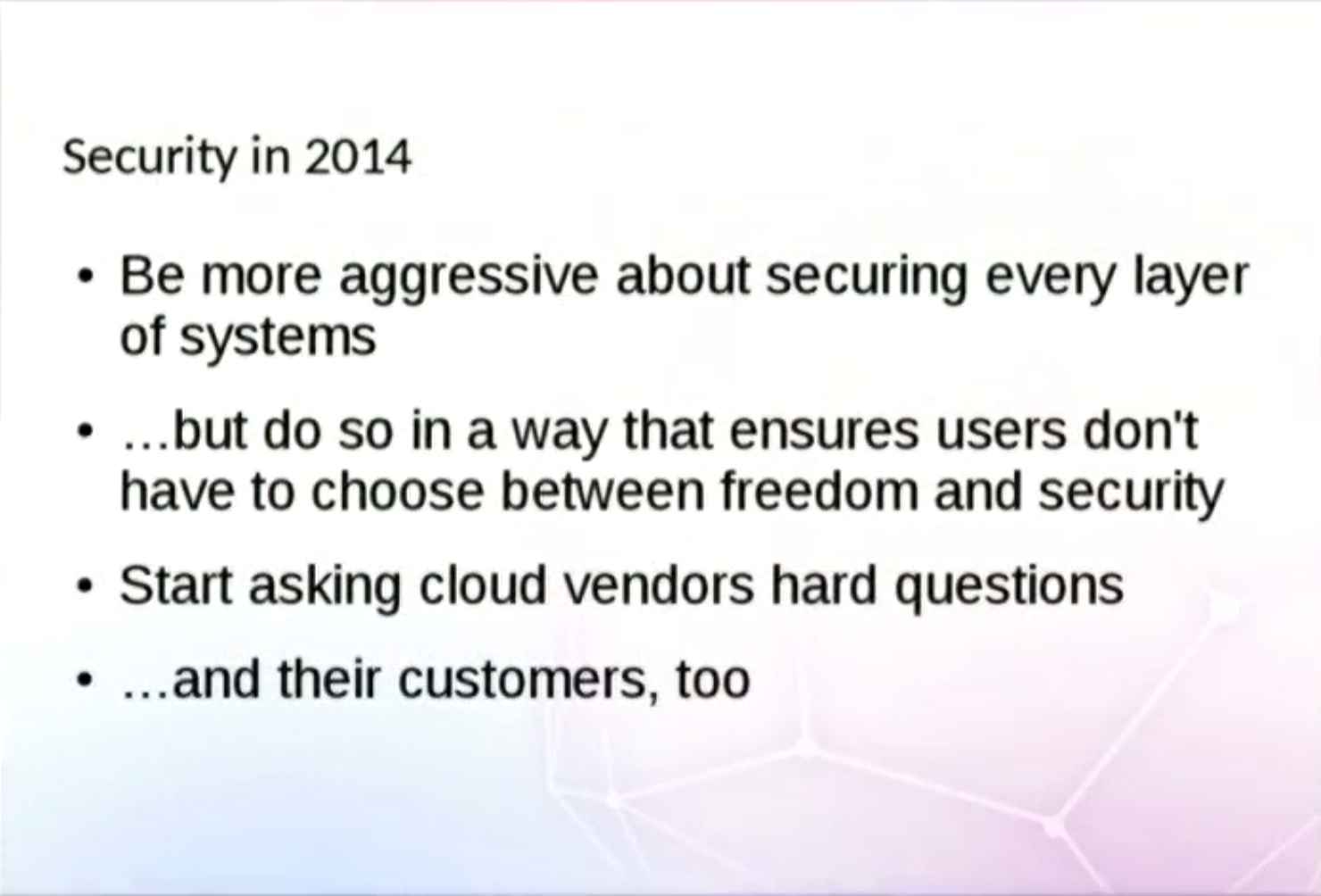
In his keynote talk at LinuxConf Australia this week, Linux kernel developer Matthew Garrett argues that the software industry can help improve security at every level of the stack – and that it’s possible to do so without sacrificing user freedom.
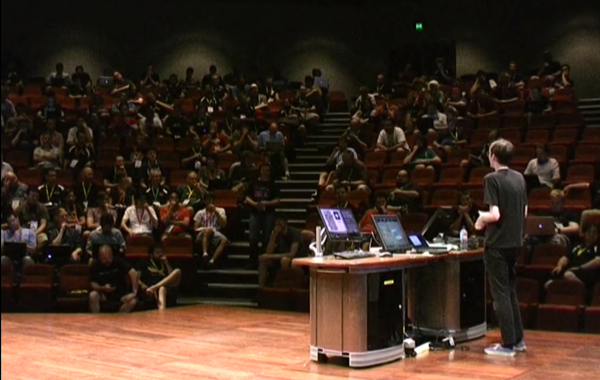 “Do not allow conversations to be about reducing user freedom in order to improve security,” he said in his concluding statements. “Challenge anyone who says this. Ensure they know it’s unacceptable.”
2013 was a big year for security in the PC industry, characterized by the mass implementation of UEFI Secure Boot, the Snowden revelations, and the openSSL website security breach, said Garrett, who works for cloud computing company Nebula and implemented UEFI Secure Boot for Fedora. Each event has changed the way the software industry views security and each provides its own lessons for Linux developers and sysadmins.
The openSSL site breach was originally thought to be the first example of a hypervisor breach, Garrett said, but it turned out the website credentials were easily guessable. However, the site breach calls attention to the larger issue: the hypervisor is still a vulnerability. It’s critical that cloud providers can ensure guests running on the same hardware remain fully separate and can’t break through the hypervisor, he said. He called on providers to be transparent about their security implementations and for customers to demand that information from their cloud providers.
“There are some difficult questions we should be asking cloud providers and so far mostly haven’t,” Garrett said.
The NSA revelations also dramatically affected how the industry views security, though perhaps not in the most productive way. Garrett implied that the magnitude and scale of the technical attacks have somewhat overwhelmed developers who don’t even know where to begin improving security for their users.
The Snowden leaks led developers to realize that technical attacks that were before only theoretically possible, were already actually happening. Yet despite the mass of information leaked, we still “don’t know what our attackers are capable of,” Garrett said.
He encouraged developers not to fixate on what intelligence agencies are capable of and to instead focus on smaller-scale vulnerabilities and what they can control. Script kiddies and organized criminal hackers looking for credit card numbers are still a far more common security threat, he reasoned.
“What can we do to protect users and protect the state of the art and make sure computer security is as good as it can be?” he asked.
He defended verified boot schemes as one method for protecting the software stack at its root. Vendors must also allow users to install their own OS, however. The industry, especially in the mobile segment, still has a ways to go in allowing users to replace the cryptographic key and/or the firmware, he said. Such freedom is critical to allowing experimentation and innovation in the tech industry.
UEFI Secure Boot “is one of the rare cases where I’m going to say Microsoft did the right thing for user freedom,” he said.
(View the original video here.)
Google’s Chrome OS is on a roll, with Chromebook sales beginning to make significant inroads into the Windows notebook share. Yet, for every new Chromebook that appeared at CES this week — including the first Chromebase all-in-one (AiO) PC from LG — there seemed to be a new Android notebook or AiO as well.
 Most of the Android-only notebooks are under-powered, 7-inch, sub-$150 netbooks aimed at the emerging nation market. They often lack touchscreens, such as the new, $100 WolVol Android Red 7″. There are also a number of Android-based transformer-style convertibles from more prominent vendors, with clip-on keyboards. Some of these are dual-boot machines with Android and Windows, such as the new, Asus Transformer Book Duet, which switches between the OSes in four seconds.
Perhaps more significantly, three touch-enabled, Android-only AiOs debuted at CES 2014 this past week from major vendors:
Acer TA272 HUL — Thanks to its Nvidia Tegra 4 processor, this $1,100, 27-inch AiO is one of the highest resolution Android devices around, with 2560 x 1440 pixels (WQHD). It runs only Android 4.2, but Windows 8 users can plug in to use it as a touchscreen monitor.
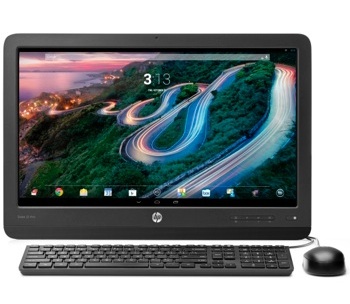
HP Slate21 Pro — The $335 Slate21 Pro AiO runs Android 4.3 on a Tegra 4, and features a 21.5-inch HD IPS touchscreen. It’s aimed at the enterprise, with features like Kingsoft Office Suite, Citrix Receiver, and its Security Enhancements for Android.
Lenovo N308— Yet another Tegra 4 based AiO, the N308 is designed for both enterprise and consumer users. The 19.5-inch Android 4.2.2 computer offers an HD+ touchscreen and a 500GB hard drive. You can detach the screen and use it for three hours as a huge Android tablet.
Why are Android PCs still a thing now that Chromebooks are finally a hit? Two years ago, when the first wave of Android notebooks arrived, and Google’s Chromebooks were struggling, some predicted that Android PCs represented Google’s true future on the desktop. That no longer appears to be the case, as Chromebooks are now outselling dedicated Android notebooks and AiOs. Yet Android’s desktop share continues to grow, too. What’s up with that?
Here are some reasons why Android PCs will continue to grow, followed by some reasons why they won’t lead the pack anytime soon.
1. Vendor freedom in a wide-open PC landscape — According to a Jan. 9 Gartner report, PC shipments dropped 6.9 percent year-over-year in the fourth quarter. As the PC business fades, so does Microsoft, and Redmond’s clout has dropped even more with the relative failure of Windows 8 compared to earlier Windows versions.
All this has freed up vendors to look around at other options like Chrome OS and Android. Manufacturers have chafed at following Microsoft’s Windows 8 guidelines, and of course, with Windows they still need to jack up the price to cover the OS. With Chrome OS, they don’t pay the OS tax, but they still run into Google’s Chromebook guidelines. Google has less control over Android hardware, giving the vendors the freedom to customize, brand, and try new ideas.
2. Big touchscreens drop in price — Microsoft has helped encourage Android computers in other ways as well: by pushing touch support in its Surface tablets and other Windows 8 based computers. In tablets, Redmond has always differentiated from Android and the iPad by encouraging larger tablets for the corporate market. Microsoft also bought Perceptive Pixel, Inc. and helped push its giant touchscreens into corporate boardrooms, museums, and other vertical locales such as the newsrooms of CNN and Fox News.
Along with the increasing volume in touchscreen sales from Android and iOS tablets, all this has helped drop the price of larger touchscreens, which is essential for Android. Although Android PC users may end up using the mouse more than their fingers, they’ll still expect and demand touch.
3. Processors boost resolution — High-end ARM processors like the Tegra 4 finally offer sufficient resolution to take advantage of the big screen. Intel CPUs have led ARM in screen resolution, but they lacked support for Android. Now that x86 offers mature Android support, more vendors will make use of that processing firepower, as Asus has done with the new Intel Core “Haswell” based Transformer Book Duet. Intel also recently announced it is working on streamlining dual-boot Android/Windows implementations.
Android still struggles at offering a fluid touch experience on screens larger than about 12 inches — the size of one of the new Samsung Galaxy Pro tablets — but it’s improving all the time. Android 4.3 added support for 640dpi screen resolution, which is available on 4k screens featuring 3840 x 2160 pixels.
4. Kiosks/signage turns to Android — Windows has long dominated the vertical kiosk and digital signage markets in areas like the hospitality industry, although Linux has made considerable inroads here as well. With its multimedia support and advanced touch UI, Android should do even better. People increasingly expect touch interaction from signage, and many are now more familiar with Android than Windows or other mobile OSes.
5. Improved security — Enterprises no longer fear Android the way they once did. Beaten down by the Bring Your Own Device (BYOD) trend, IT directors have grown increasingly comfortable with iOS and the little green robot. Recent Android releases — especially Android 4.2 and 4.3 — have gone a long way toward cleaning up Android’s security gaps, and Google has finally tightened the screws on Google Play. Meanwhile, improvements have been made on the “Android fragmentation” issue, thereby easing updates.
6. Android: the New Thin Client — With the growth of cloud-based applications, and the availability of enterprise software such as the Citrix Receiver client on Android, the OS now makes a reasonably good thin client. Chrome OS plays into same dynamic, and with fewer distractions, but Android can assume the role, too.
7. Apps and UI familiarity — In the end, the biggest reasons Android will play a role on the desktop are its huge popularity and app library. Chrome OS may be gaining recognition, but it still lacks the apps, and according to Gartner, only 1.84 million Chrome OS devices shipped in 2013 compared to 878 million for Android. Android may lack the muscular business applications found on Windows, Linux, and the Mac, which are required by many business professionals, but it now offers enough enterprise apps to meet the needs of most. It also has a huge library of mobile apps that business users use every day.
Despite these trends, unless or until Google merges Android and Chrome OS, the latter will continue to be more popular than Android on the desktop. As long as you don’t need a touchscreen, it offers a more optimized interface for the big screen, and many enterprises will prefer it since it offers better security and fewer distractions. For the near future, consumers will still prefer Android for tablets and Windows for PCs.
Yet, Chrome OS and Android have pried open the PC market. Other Linux desktop distros like Ubuntu now have an opportunity to gain market share as well, and if Apple dropped its prices, the Mac could reverse its recent slide.
 Soon I moved on to javascript, php, and mysql and made a little web application of my own. The reason for moving on to these languages was the fact that I wanted to make said application. The challenge of having a project to complete motivated me to learn more than ever before. I also realised at the time that I was the type that learned by doing.