Home Blog Page 1716

How to Manage a Linux Server with GUI

A typical Linux server runs in a command line interface (CLI) environment, preloaded with bare essential tools needed to install and configure various headless services. Compared to a full-blown GUI desktop image, such a minimal setup is advantageous in terms of security, resource consumption and speed. If you are used to GUI-based environment, however, you […]
Continue reading…

The post How to manage Linux server with GUI appeared first on Xmodulo.

Read more at Xmodulo

Open Gaming Platform Ouya Matches Funds for Game Developers

open innovation in gaming

When the hacker-friendly game console, the OUYA, was pitched as a kickstarter project in July of 2012 their tagline was “Cracking open the last closed platform.” The Android-based console raised a staggering $8.6 million during its one month campaign and sparked a flurry of interest in indy game development and open hardware.

In their latest efforts to support independent content developers, OUYA has created a $1 million matching fund for game developers at http://freethegamesfund.com, which will double kickstarter pledged funds up to $250,000.


read more

Read more at OpenSource.com

Google Expands Patch Rewards Program

Developers who can make security improvements to an important open source project get money from Google. More open source projects are now in the program.

Distribution Release: Network Security Toolkit 18-5413

Ron Henderson has announced the release of Network Security Toolkit (NST), version 18-5413, a specialist Fedora-based live DVD with a large collection of open-source network security tools: “We are pleased to announce the latest NST release: NST 18 SVN:5413. This is an interim release which includes all of….

Read more at DistroWatch

Distribution Release: Emmabuntüs 12.04.3-1.06

Patrick d’Emmabuntüs has announced the release of a minor new update to Emmabuntüs, a Xubuntu-based distribution designed for refurbished computers destined for humanitarian organisations: “The Emmabuntüs team is pleased to announce the 5th maintenance release of Emmabuntüs 2 1.06 based on Xubuntu 12.04.3. For this version 1.06 the….

Read more at DistroWatch

Salesforce.com, HP Unveil ‘Superpod’ Cloud Collaboration

Enter the “Salesforce Superpod,” a dedicated instance in the Salesforce multi-tenant cloud, which will run on HP’s Converged Infrastructure.

Top 20 Mobile Skills in Demand

Android, iOS and Blackberry top Dice’s list of top search terms used by hiring managers at the tech job posting site.

A Cloud Safe from the NSA’s Prying Eyes: Europe Begins Work on its EU-Wide System

A new project seeks to lay down some ground rules for what could become a cloud for the continent.

SUSECon Summary: Big-Time Linux is Getting Bigger

What I learned at SUSECon: large-scale enterprise Linux is huge, and its serious growth is just beginning. Consolidating the datacenter into Linux on mainframes is perfect for financial institutions and retailers, and for any workloads with large-scale transactions and database processing. Linux is also a great fit on mid-range and small servers, distributed computing, supercomputers, and well, pretty much everything.

Consolidation isn’t always this dramatic: “The servers! They stole all our servers!”

https://www.youtube.com/watch?v=T0W4izFu_WM” frameborder=”0

I must bid SUSECon 2013 a sad farewell. It’s been a great trip, and I got to meet a lot of friends I’ve never met in person before, and make new friends. Please enjoy these photos of a wonderful conference.

red flowers at SUSECon 2013

egret at SUSECon 2013

SUSECon captive


unisys at SUSECon 2013skeleton


singing thing at SUSECon 2013

fuzzy tux at SUSECon 2013 mainframe

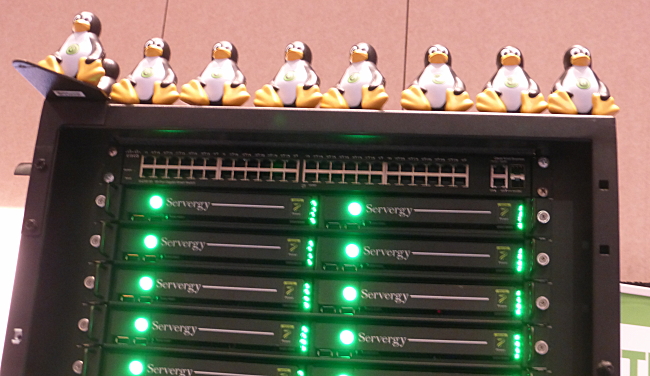
servergy

Linux is the Platform for Robotics

Robotics is a fascinating subject. It links computers to the physical world, allowing them to move around, sense their environment, and to interact with it. Building your own robot, however, has traditionally required that you spend a huge amount of time and energy to get even the most basic of robotic systems up and running. You need mechanical engineering skills to build the chassis or body, electronic engineering skills to wire up the motors and the sensors, and programming skills to animate the robot, to control its body to get it to do what you want. These barriers to entry mean that people entering into the field of robotics – either in search of a stimulating pastime, or perhaps as part of more formal research – can quickly be overwhelmed by the sheer amount of work required. The initial dreams of building a robot to fetch your beer or to walk your dog get pushed further and further back, as more and more time is sucked up just getting the basics working.

Read more at Linux User and Developer Magazine.