
IDC is expecting that a bounceback in emerging market economies will fuel IT spending growth in 2014.
Read more at Enterprise Open Source Toolkit
 In mid October, Ubuntu 13.10 arrived, featuring close integration with Havana, the latest release of the OpenStack cloud computing platform. Ubuntu development is also now being kept in lockstep with OpenStack’s development cycles, as Canonical, Ubuntu’s parent company, steadily embraces the emerging cloud toolset.
Now, taking a further step, Canonical has announced the opening of the Ubuntu OpenStack Interoperability Lab (OIL), which features some heavy-hitting tech partners including Cisco, Dell, EMC, HP, IBM, Inktank/Ceph, Intel, Juniper and VMware. The lab will focus on integration testing and more.
The 3.12 Linux kernel release this week brought with it many new features including multi-threaded RAID5 support in the MD subsystem, the addition of render nodes, and TSO sizing. But it was a fairly light release in comparison to what kernel developers have planned for version 3.13, said LWN Executive Editor Jonathan Corbet in his session at LinuxCon Europe. (See Corbet’s Linux Kernel Forecast for more highlights of the release.)
“The 3.12 kernel is a boring development cycle in a lot of ways,” Corbet said. “There’s not a huge number of exciting features.”
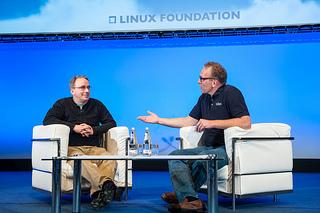 The latest kernel version isn’t nearly as light on features as the 4.0 release might be, however, if Linus Torvalds follows through on his proposal to release it with only bug fixes. Torvalds raised the possibility in his email announcement of the 3.12 release, after further considering a question that Intel’s chief Linux and open source technologist Dirk Hohndel raised on stage at LinuxCon and CloudOpen Europe in Edinburgh last month.
Hohndel had asked whether they could do a release focused on stability and bug fixes. He wondered if kernel developers were perhaps focused too much on speed and adding new features. There were, after all, 4,000 known bugs in the latest stable kernel, he said. “Should we maybe take a step back?” (Watch a video of the conversation, below.)
Torvalds replied that he was happy with the kernel development process as-is. With timed releases on a roughly three-month cycle instead of feature-focused releases, developers aren’t rushed to turn in their code. They can take their time and get it right because they know the next merge window will come quickly, he said.
“You don’t have to worry about timing. That makes things so much easier for me as a release person and I’m pretty sure it also makes it much easier for all the developers and companies that they don’t have to worry about hitting this particular date because they know if they miss that date, it’s not that big of a deal,” Torvalds said on stage.
Changing the process wouldn’t work, he argued during the conference, because developers have the attention spans of “slightly moronic woodland creatures.” They would likely stop working on bug fixes and instead skip ahead to work on features for the next version.
“I’d expect many developers would go “Let’s hunt bugs.. Wait. Oooh, shiny” and go off doing some new feature after all instead. Or just take that release off,” Torvalds wrote in his 3.12 announcement.
After thinking it over some more, Torvalds now says he may have been too pessimistic in his earlier assessment.
“Maybe it would be possible, and I’m just unfairly projecting my own inner squirrel onto other kernel developers. If we have enough heads-up that people *know* that for one release (and companies/managers know that too) the only patches that get accepted are the kind that fix bugs, maybe people really would have sufficient attention span that it could work.”
The 4.0 release could be the ideal time to try a bug-fix release, Torvalds said. He plans to keep the release numbers below 3.20 and so expects 4.0 to happen in about a year, he said, which should give developers enough time to prepare for the change.
Dirk’s question to Linus starts at 1:53 in the video, below:
antiX 13.2, an updated version of the lightweight Debian-based distribution designed for older and low-specification computers, has been released: “The antiX team is pleased to announce the second update of antiX-13 full version for 32-bit and 64-bit systems, based on Debian ‘Wheezy’. This update includes those made upstream….

Docker (previously dotCloud) made a big splash this year when they open-sourced their software for creating “lightweight, portable, self-sufficient containers” that powers their Platform-As-A-Service offering.
Developers are excited because Docker offers an easier to use alternative to Chef and Puppet for managing server environments. Instead of wrangling with configuration files, Docker allows developers to simply take an image of their system and share it with their team. When a team member makes a change to their local environment, they just create a new image (a Docker container) and share it with the team. Its like git for disk images.