Since Linux.com last surveyed the community-backed open source board scene in June 2012, some projects have faded, but a number of new boards have popped up to take their place. In fact, most of our top 10 Linux or Android-ready open source single board computers (SBCs) have shipped in the last few months.
 Not all the projects offer the same transparency or open governance, but at a minimum, they all provide open source Linux or Android code (often both), full schematics and other documentation, and at least an attempt at forums or other community resources.
Some projects more clearly show the hand of a single manufacturer, while several triangulate between the community project, an arms-length semiconductor vendor backer, and one or more third-party manufacturers and/or distributors. This is the classic model that supports the BeagleBone Black, with BeagleBoard.org, Texas Instruments (TI), and CircuitCo, playing their respective roles.
One TI-based board, the CraneBoard, has faded off the list, as has the Samsung Exynos based Origenboard. Origenboard.org at least still shows some signs of life, but appears to have been upstaged by Hardkernel’s Exynos-focused Odroid project. Meanwhile, the Igloo Community and its Snowball board has been shut down entirely, due in large part to the fact that its chip vendor and sponsor ST-Ericsson is moving toward dissolution. Snowball manufacturer Calao still has some of the Cortex-A9 boards left, however.
The only SoC manufacturers listed twice here are TI and Freescale, each represented by two different SoC models. The others each use a different processor and vendor, including Allwinner, Broadcom, Samsung, Via, and Xilinx SoCs. All these are ARM-based SoCs, but for the first time we also include an x86 board with the Atom-based Minnowboard from Intel-backed Minnowboard.org.
Common Features
Not surprisingly, more powerful processors are showing up in open source boards, including the Cortex-A15-based Samsung Exynos 5 Octa processor in the new Odroid-XU. Yet, the most popular boards continue to be modestly powered, under-$50 SBCs, in particular the Raspberry Pi Foundation’s $35 Raspberry Pi and the $45 BeagleBone Black.
Low price isn’t the only draw here. These projects’ largely transparent, user-responsive operations, lack of overbearing corporate control, and investment in education and hobbyist efforts help create large vibrant communities of developers who create a cascade of openly shared code and designs. This in turn attracts new developers and makes it easier for them to get started with essentially free tech support.
Other open board trends include increasingly smaller PCB size. Most of the boards are about the size of a modern smartphone or phablet, and several are even smaller. Most now offer HDMI ports to keep up with the otherwise modestly appointed Raspberry Pi, although most offer micro-HDMI ports instead of the Pi’s full-sized connection.
Sometimes there’s a fine line between open source, community-backed SBCs and the more prevalent commercial SBCs that offer open source Linux — and increasingly Android — builds, and in many cases full schematics. Several of these pop up every month, as seen on embedded sites like LinuxGizmos, which also offers reports on most of our Top 10 community boards. But community counts, especially if you’re not funded to build a commercial product with customers waiting with checks in hand.
There’s also something of a gray area between community boards and open platform mini-PCs from companies like CompuLab, which have been left off our list. Several of our top 10 contenders now come with optional enclosures to create a de facto mini-PC, but they also offer board-only versions.
We’ve also left off boards where Linux plays a minor role, as in the interesting new Arduino Yun board, which runs Linux on a 400MHz MIPS processor, but limits it to controlling networking functionality. In addition, there are several new open source SBCs on the horizon that didn’t make the list. These include the Xilinx Zynq-based Red Pitaya measurement and control board, which is still in Kickstarter mode.
Top 10 Open Source Boards
The following Top 10 community backed Linux boards are listed in alphabetical order, with links, price, project, and processor. They are described in more detail in the slide show below (click on View Gallery).
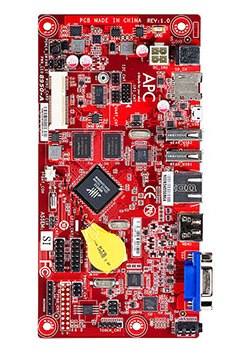
APC Rock — $79, Via Technologies, 800MHz Cortex-A9 Wondermedia
BeagleBone Black — $45, BeagleBoard.org, 1GHz Cortex-A8 TI Sitara AM3359
Cosmic+ — $65, Phytec, 500MHz Cortex-A5 Freescale Vybrid
Cubieboard 2 — $59, Wang And Tom Development Ltd. (Allwinner), Cortex-A7 dual-core Allwinner A20
MicroZed — $199, Avnet, Xilinx Cortex-A9/FPGA Zynq-7010
MinnowBoard — $199, MinnowBoard.org (Intel), 1GHz Intel Atom E640
Odroid-XU — $149/$169, Odroid Project (Hardkernel), Samsung Exynos 5410 Octa (8-core Big,Little Cortex-A15 and –A7)
PandaBoard — $182, PandaBoard.org (TI), TI 1.2GHz Cortex-A9 OMAP4460
Raspberry Pi Model B – $35, Raspberry Pi Foundation, Broadcom 700MHz ARM11 BCM2835
Wandboard Quad — Wandboard.org (Freescale), Freescale 1GHz Cortex-A9 i.MX 6Quad

 If you think Red Hat is just about Linux, then you’re mistaken. Red Hat is quite active locally sponsoring various activities and educational programs trying to give back to the community which has embraced it so enthusiastically. Most recently Red Hat employees built a 10-foot lantern for charity during CANstruction, a local event held to benefit food banks.
 For almost 15 years, some of the more interesting work in the field of robotics has been driven by open source efforts. Last year, the