Home Blog Page 1850

Hackers Wanted: Code for America Deadline for 2014 Fellowship Nears

Quit complaining and start innovating

There are only a few days left to apply. Code for America is looking for developers, designers, researchers, data scientists, and product managers for their 2014 Fellowship. It’s a chance to make a difference with code, design, data, and much more.

read more

Read more at OpenSource.com

4 Text Editors for Linux

Review of 4 text editors for Linux

This is a short list of my favorite graphical text editors for Linux that can be classified as IDE (integrated development environment). Here, I give the pros and cons of working with the following:


read more

Read more at OpenSource.com

NVIDIA’s Linux Driver On Ubuntu Is Very Competitive With Windows 8

In recent days on Phoronix I have published benchmarks showing Windows 8 beating Ubuntu Linux for Intel Haswell performance and the Radeon Gallium3D driver losing to AMD Catalyst Legacy on Windows. As some good news for NVIDIA Linux users, the performance on Ubuntu Linux can beat out Microsoft Windows 8 on modern GPUs. However, the strong Linux performance can only be found if using the closed-source NVIDIA driver and not the open-source Nouveau alternative.

Read more at Phoronix

KDE Task Manager Gets a Lot of Attention for 4.11

KDEKDE SC 4.11 is due for final release in little over two weeks with several interesting and exciting new features. However, according to Eike Hein, the task manager has received its share of work lately too. Hein says lots of bugs have been squashed and the codebase has been cleaned up, but the end-user may not notice it.

Hein said one of the reasons for rewriting the task manager was so it could keep up with the rest of KDE as it moves towards “the QML era” or Plasma 2. That’s when he said that visual and operational changes were “kept to a minimum,” instead focusing on “a regression-free port, but a leaner and meaner codebase along with QML’s designed-in flexibility.”


Read more at Ostatic

20 Great Years of Linux and Supercomputers

Today, Linux rules supercomputing. It wasn’t always that way. Here’s how Linux moved from being Linus Torvald’s hobby operating system to being the OS of choice for high-performance computing.

The Reglue $32,000 Campaign Challenge

At this point, the Ubuntu Edge Indiegogo campaign for $32 million is just north of $7 million.

At this point, the Reglue Indiegogo campaign for $32,000 is just south of $4,000.

And that’s after Mark Shuttleworth kicked in $1,000 to the Reglue campaign (a sincere thank you for that one, Mark; sincerely and seriously — no snark).

If you do the math, $32,000 is 0.1 percent — one-tenth of one percent — of $32 million. But I hate fractions and decimal points, so I’m going to round up the figure to, oh, 10 percent by throwing out the decimal point and swapping the digits instead.

With this 10 percent factor, I hereby throw down the gauntlet to each and every Ubuntu Edge contributor.

Here’s the challenge: You bought an Ubuntu Edge phone for $600 or $800 already? Great. If you can afford to spend that much on a phone, you can kick in 10 percent of that to the Reglue Indiegogo campaign to help underprivileged kids around Austin, Texas, get Linux boxes, as well as providing the upkeep and day-to-day operations of nine computer learning labs in and around Austin.

Read more at Larry the Free Software Guy

Rugged ARM Linux Touchpanel Targets Military Apps

IEE announced a Linux-based thin-client touchpanel computer for harsh military environments. The highly rugged touchpanel computer is equipped with a 1GHz ARM processor and a 10.4-inch, 1024 x 768-pixel resistive touchscreen with backlighting and high contrast, and is usable over an extended temperature range of -46 to 70° C. IEE Inc. has yet to post […]

Read more at LinuxGizmos

Report: Android Dominates Tablet Market With Over Half of Global Shipments

The iPad is no longer the infallible tablet king that it used to be, even just a year ago.

20 Years of Top500 Data Show Linux’s Role in Supercomputing Breakthroughs

Today the Linux Foundation released a short analysis paper on 20 years of data collected by the Top500.org supercomputer list. Released each June and November, the Top500 list has ranked the world’s fastest supercomputers since 1993.

The Linux community has delighted in watching Linux become the dominant OS running on Top500 machines over the past decade. And there has been no shortage of stories chronicling the rise of Linux in supercomputing. But we found the data tells another, less obvious story as well.
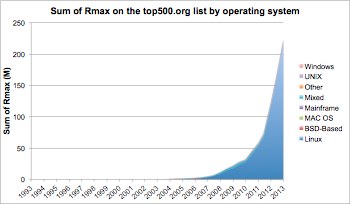
Sum of Rmax on the top500.org list by operating systemRMax, the measure by which computing power is ranked on the Top500, has grown steadily over the past 20 years with advances in hardware and system architecture starting at gigaflop/second in 1993, and increasing by a factor of three to petflop/second in 2013. But when the sum of RMax for each year is broken out by operating system over this same time period, it shows a meteoric rise of Linux as a percent of total computing power, starting in the mid 2000’s. 

As the paper explains in more detail, Unix dominated the Top500 when high performance computing systems were essentially ever-growing piles of homogenous processors. But as systems evolved to the complex hybrid technologies we see today, Linux took over as the dominant operating system. Why?

Open Source Linux Drives Supercomputing Capacity

While the silicon itself is primarily responsible for the rise of RMax, it was the flexible, low-cost, open source Linux operating system that let researchers experiment with groundbreaking system designs, without breaking the bank.

In short, to quote from the paper directly: “Linux is not only responsible for supporting the majority of supercomputers today, but it also was the single driving force behind the disproportionate growth in supercomputing capacity over the past decade.”

We’re talking, here, about computers such as IBM’s Linux-based Roadrunner machine, which broke the Petaflop/s barrier in 2008 and was used to map the neural pathways for vision in the human brain. Or Cray’s Titan supercomputer, the first CPU/GPU hybrid with a 17 Petaflop/s performance, that’s now running climate change scenarios to help avert ecological disaster.

So come November, we’ll no doubt revel again in counting the number of Linux machines on the Top500. But we’ll also feel good knowing that Linux is driving the advancement of supercomputing, and by extension, scientific research and discovery.

Download the full paper, “20 Years of Top500.org Supercomputer Data Links Linux With Advances in Computing Performance,” from LinuxFoundation.org. 

$55 board runs ARM Linux on Freescale Vybrid SoC

Phytec announced a pair of community backed single-board computers built around its PhyCore-Vybrid SOM computer-on-modules, which are based on Freescale’s Vybrid system-on-chips. The $55 Cosmic SBC uses a Vybrid SoC with a single 500MHz Cortex-A5 core, while the $65 Cosmic+ SBC provides the dual-core Vybrid SoC version, which runs Linux on its Cortex-A5 core along […]

Read more at LinuxGizmos