
Home Blog Page 1862

LinuxCon Program Announced Join the Most Technical Mardi Gras Parade In History


I’m pleased to announce the schedules for LinuxCon and CloudOpen happening this September in New Orleans. We had more submissions than ever and narrowing them down was probably the most difficult process we’ve ever had. And yes we will have a parade from the conference to one of the parties; I bet it will have more C developers marching than any other Mardi Gras parade in history.

The full schedule can be found here.

I want to thank the Linux Plumbers Conference Committee and the CloudOpen Program Committee for helping us shape this conference. For the first time, we’ve developed a joint track with the Linux Plumbers Conference committee to offer deeply technical content focused on core development. By working together we can provide great technical conference sessions at LinuxCon while Plumbers can concentrate on solving the really hard issues facing Linux and other upstream projects via its collaborative sessions.

Here are a handful of my favorites for this year:

LinuxCon North America

* The Changing Kernel Development Process, by Jonathan Corbet, LWN.net

* A Practical Tutorial to Open Sourcing Proprietary Technology, by Ibrahim Haddad, Samsung

* Will Parallel Programming Ever Become Routine, presented by Paul E. McKenney, IBM

* Case Study: Doing a Live Upgrade of Many Thousand Servers at Google from an Ancient Red Hat Distribution to Recent Debian-Based One, presented by Marc Merlin, Google

* Tutorial: High Availability Solutions for MySQL and MariaDB, presented by Max Mether, MySQL AB

* Efficient and Large Scale Program Flow Tracing in Linux – Alexander Shishkin, Intel

* Power Management in the Linux Kernel: Current Status and Future, by Rafael J. Wysocki, Intel OTC

CloudOpen North America

* Everything I Know About the Cloud, I Learned from Game of Thrones, by Joe “Zonker” Brockmeier, Citrix

* Building a Secure Cloud, presented by Matthew Garrett, Nebula

 * QEMU 2.x and Beyond: The Foundation of the Open Cloud, presented by Anthony Liguori, Open Virtualization Development Lead at IBM Linux Technology Center

* What Two DBAs Wish They had Known Before Virtualizing on OpenStack, by Mason Morris and Doug Liming, SAS

* Lessons Learned Building a Hybrid Cloud Service, by Noa Resare, Senior Engineer at Spotify Systems

* The New Cloud Factory: Building Web Scale Using Open Source on the Internet Assembly Line – Thomas Hatch, SaltStack

* The State of the Stack – Randy Bias, Cloudscaling

CloudOpen has evolved as the place to learn about all the open source projects that comprise the cloud.

We’re also hosting two new events this year to increase participation for newcomers. We’ll host a Newcomers Reception on Sunday night, the eve of opening day for both LinuxCon and CloudOpen. We also invite women attending the event to join us for the Women in OSS Luncheon. This is an opportunity for women to network and share their experiences at the event.

We’re also hoping to give back this year to our host city of New Orleans and are partnering with a local nonprofit called Fuel the Future. This group provides meals and after school programs to under-resourced kids in the New Orleans area so that they might fuel the future of their communities. You will have an opportunity to pack a bag of food or donate directly to the organization. We will be matching those donations and have committed to a $5,000 minimum donation already.

Let’s together fuel the future of Linux, open cloud and collaborative development while giving back to the city that will host this year’s work. Hope to see you there.

https://www.youtube.com/watch?v=DCxyfpet9Tk?rel=0&feature=share&list=UUfX55Sx5hEFjoC3cNs6mCUQ” allowfullscreen=”true” frameborder=”0″ width=”425″ height=”350

SourceForge’s DevShare Offers Open Source Developers Monetization

Earlier this month, SourceForge–known as a central hosting and services site for countless open source projects–unveiled a beta version of a service called DevShare. DevShare is an opt-in revenue-sharing program “aimed at giving developers a better way to monetize their projects in a transparent, honest and sustainable way.” The plan presents a way for developers of open source projects to monetize downloads and usage of their creations. After a few weeks of beta testing, some interesting reviews are coming in.
According to SourceForge’s announcement of DevShare:

“DevShare is a new partnership program designed to make it easy for SourceForge developers to offer a selection of trusted open source applications to users, turning downloads into a source of revenue that can help fund their projects. This revenue will help these projects to grow and offer additional software to our users.”

 
Read more at Ostatic

Intel Haswell On Linux: Updated SNA vs. UXA 2D Tests

Due to the incredible rate at which Chris Wilson has been pushing out new xf86-video-intel X.Org driver releases to optimize his “SNA” acceleration architecture, here are updated Intel Core i7 “Haswell” SNA vs. UXA 2D performance benchmarks…

Read more at Phoronix

How to Install Linux on the Zealz GK802: A Quad Core A9 ARM on a Stick

The Zealz GK802 looks a bit like a long, over-wide USB pen drive. Under a removable clip at one end of the stick is a male HDMI connector ready to be plugged directly into a monitor or large TV. On the other end of the stick are two USB ports: a micro USB to supply power to the GK802 and a female USB connector to let you attach peripherals like a keyboard, mouse or hub. Being a small, contained stick with an HDMI connector the obvious use for the GK802 is consuming video media.

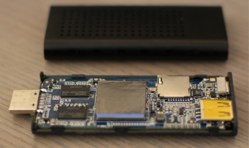
gk802 ARM boardInside the GK802 is a quad core Freescale i.MX 6 CPU at 1.2Ghz sporting 1GB of RAM and a Vivante GC2000 GPU. The GPU and video decoding acceleration of the GK802 are supported under Linux. Getting information to and from the GK802 is done over Wi-Fi and you can connect bluetooth devices to it in order to control the GK802.
Looking at the side of the GK802 you will see a microSD slot. A card clicks into place there contained well inside the GK802. If you remove the two screws near the HDMI plug you can slide the GK802 open, probably voiding your warranty in the process. Flipping over the GK802 you will see a second, internal microSD card which contains the Android image that came with your GK802. My unit came with an 8 GB Sandisk class 4 internal microSD card which contained Android 4.0.4.

How to Install Linux

In order to run a Linux distribution like Ubuntu, Debian, or Fedora on the GK802 you will likely have to open the hardware and change or modify the internal microSD card. If you want to do that you should only have to open it up once, permanently inserting a microSD card in the internal slot that instructs the device to boot from its externally accessible microSD card.

There are two parts to getting the boot to happen. First, install a customized uboot at a fixed location on the microSD card. Then setup a boot.scr file on the externally accessible microSD card telling uboot where to find the Linux kernal and start the ball rolling.

For testing I extracted the Xubuntu 12.04 root image and slightly modified the boot.cmd file to use 1080p as shown below. As you see in the example the boot.scr file is generated from the boot.cmd file using mkimage. Note that I was still booting off the internal microSD card slot. The dev/mmcblk0p1 line and the mmc and dev references in boot_normal need to change slightly if you are using this configuration on a card that will be inserted into the external microSD slot.

root@gk802:/# cat boot.cmd
setenv root '/dev/mmcblk0p1 rootwait'
setenv rootfstype 'ext4'
setenv kernel 'uImage'
setenv video 'mxcfb0:dev=hdmi,1920x1080M@60,if=RGB24'
setenv extra ''
setenv boot_normal 'setenv bootargs console=${console} root=${root} rootfstype=${rootfstype} video=${video} ${extra};  mmc dev 0; ext2load mmc 0:1 0x10800000 /boot/uImage; bootm'
root@gk802:/# mkimage -A arm -O linux -T script -n "boot" -d boot.cmd boot.scr

Testing Video Playback

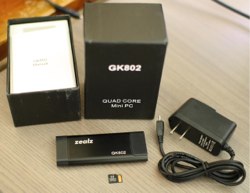
gk802 mini PC out of the boxAttempts to playback 720p video under Android 4.0.4 didn’t work using XBMC. The same 720p files played back fine under Xubuntu using Totem. To stretch things on my Xubuntu install, I played the 1080p h264 version of Big Buck Bunny. I got a few stutters initially (around where the title of the movie appears) so copied the file to a local microSD card to retest. Playing from the microSD card, after one initial stutter I got clean playback, even during fast motion scenes. The GK802 was across the room from a D-Link DIR855 access point. Clearly network configuration, distances, and caching play a role when streaming 1080p content to a GK802 over Wi-Fi.

At idle with a 1080p desktop shown, the GK802 uses 3.1 watts. With 1 core at 100% power usage jumps to 3.8 watts. Compiling openssl using 4 cores power usage went up to 6.6 watts. OpenGL was a mixed bag, much of glmark2-es2 run in about 5.5 watts. The effect2d needed 7.6 watts. Toward the end of the OpenGL test I touched the GK802 and it was very hot to the touch.

Tune in next time for benchmarks on the GK802. A special thanks to Miniand for supplying the review hardware for this article. The Linux kernel for the GK802 is available on github. And the IRC channel #imx6-dongle on freenode. Documentation for the Freescale i.MX 6 is also available.

Linus Torvalds Calls For More Linux Kernel Patches

Linus Torvalds is usually complaining about too many pull requests during the Linux kernel development cycle when past its merge window, but this time around he’s complaining about too few patches this week. He’s also proclaimed himself the Goldilocks of kernel development…

Read more at Phoronix

BBM For Android Delayed Till September

BBM for Android had been confirmed by BlackBerry to arrive this summer and considering that it’s the month of July already, we still haven’t seen any sign of it.

Read more at Muktware

Wine 1.6 Released With 10,000+ Changes

After a slew of release candidates, Wine 1.6 was officially released today. The Wine 1.6 release comes just one year after the Wine 1.4 stable release but it packs in about 10,000 individual changes…

Read more at Phoronix

Eucalyptus 3.3 arrives with additional Amazon cloud features

The open-source Eucalyptus cloud project has just released a new version that’s improved its Amazon Web Service cloud interoperability.

One Laptop Per Child Launches XO Tablet Via Walmart

A deal with Walmart gives OLPC a shot at bring educational technology to the poor in the U.S. and potentially more scale for emerging markets.

AMD Talks Up HSA Architecture On Linux ARM

Greg Stoner of AMD and representing the HSA Foundation talked last week at the Linaro Connect Europe 2013 event about the Heterogeneous System Architecture (HSA) as it concerns ARM…

Read more at Phoronix