
HP delivers its next phase of OpenStack architecture and adds public cloud services that gets it more in the ballpark with incumbent providers.
Read more at Enterprise Open Source Toolkit
The Computex show in Taiwan is still a PC show, but it’s increasingly known for debuting tablets and tablet reference designs. There have been some misfires over the years, like the thick, Atom-based Mobile Internet Devices (MIDs) shown in 2008, the “Smartbooks” of 2009, and the flawed “Honeycomb” Android tablets of 2011. Things have looked up since then, however, with the 2012 event showcasing numerous high-octane Android 4.x slates that have gone on to collectively overtake the iPad and threaten the PC market.
If smaller tablets have been in vogue over the last year, thanks to the impact of the Kindle Fire and Nexus tablets, the big slates are back in style in 2013, looking to steal even more market share from PCs. The most prominent new Android tablets were not the 7-8 inch tablets dominating sales, but rather 10-inch devices more suitable for the office, many with keyboard docking options. There were even several full-fledged Android notebooks from OEM vendors such as Allwinner to match HP’s more high-profile, Tegra 4-based SlateBook x2 Android tablet.
 Here’s a look at some of the more notable big-time tablets that shined at Computex:
Of the big three ARM Cortex-A15 system-on-chips debuting this year, Nvidia’s Tegra 4 is the first to jump to the tablet market. Samsung’s Exynos 5 Octa SoC fuels the international version of its Galaxy S 4 phone, but has yet to appear in a tablet. Last week, Qualcomm’s Snapdragon 800 made its first appearance in a reference tablet (see farther below).
Tegra 4 based 10.1-inch tablets appearing at last week’s show include an updated Asus Transformer Pad Infinity, Toshiba’s Excite Pro, and a similar, pen-ready Excite Write. All three slates tap the quad-core Tegra 4 to produce industry-leading 2560 x 1600-pixel resolution, and they all supply 2GB of RAM and 32GB of storage.
Like previous Transformers, the Transformer Pad Infinity is detachable from a keyboard dock, and Asus claims it can output 4K video via HDMI. Toshiba’s Excite Pro and Excite Write tablets feature Harmon Kardon speakers, as well as 8- and 1.2-megapixel cameras. The Write adds pen-input support.
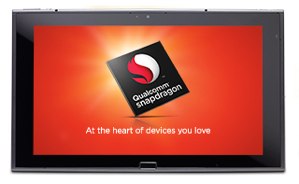
Matching the new Asus and Toshiba products for the claim of most advanced tablet on the planet is Bsquare’s Snapdragon 800 Mobile Development Platform (MDP), the official reference platform for smartphones and tablets running Qualcomm’s Cortex-A15-like Snapdragon 800. The 2.3GHz quad-core SoC is expected to appear in Android tablets and “phablets” this summer, including the rumored HTC T6 and Samsung Galaxy Note III. The SoC’s 28nm, High-K Metal gate fabricated Krait 400 core is backed up with a powerful Adreno 330 GPU and a 600MHz DSP.
The 11.6-inch tablet model supports 1080p resolution and the ability to push UltraHD/4K video to a TV via HDMI. Both 12- and 2-megapixel cameras are supplied, and the MDP is touted for features including USB 3.0 and 802.11ac WiFi.
At Computex, Samsung tipped a minor upgrade to its 8-inch Galaxy Tab 3 8, running a dual-core, 1.5GHz SoC, presumably an Exynos chip. Yet, for its Galaxy Tab 3 10.1, it tossed the industry a curve — and threw a kiss to its Tizen partner Intel — by using a dual-core, 1.6GHz Atom Z2560 Clover Trail + (CT+) processor.
The Tab 3 10.1 is the biggest Android product win yet for Intel, which has helped bring its similar quad-core Z2580 to ZTE and Lenovo smartphones. Performance should be competitive with Cortex-A15 based tablets, but the specs come nowhere close. The Android 4.2 tablet’s display is limited to 1280 × 800 pixels, and the cameras are set at 3- and 1.3-megapixels. The dimensions are reasonable at 7.95mm thick, and 510 grams, but the product’s success may hinge upon the duration of the 6,800mAh battery.
A CT+ Atom also popped up at Computex in an Asus Transformer Book Trio convertible. The hybrid combines a detachable, 11.6-inch Android 4.2 tablet running on 2GHz, dual-core, Atom Z2580 with a Windows 8 docking station. The latter uses a fourth-generation Core i7-4500U, one of the “Haswell” processors Intel announced at Computex.
 The Trio’s tablet features 1920 x 1080 resolution and up to 64GB storage, while the docking station has its own hard drive and the ability to plug into a monitor via HDMI. The ability to switch between OSes is said to occur “effortlessly,” which presumably falls somewhere between “seamlessly” and “Oh, #&%?!, not again.”
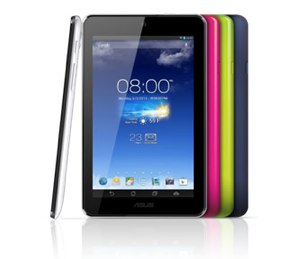
At Computex, Asus also announced a more traditional 10-inch Android tablet running on a CT+ chip in its MeMo Pad FHD. The 9.5mm slate uses a dual-core, 1.6GHz Atom Z2560, and features dual cameras, dual speakers, and 1920 x 1200 resolution.
CT+ is a stepping stone to Intel’s more power efficient, 28nm Silvermont Atom processors, starting with a tablet-focused “Bay Trail” Atom SoC due to ship in tablets at year’s end. At Computex, Intel privately demonstrated a tablet reference design based on a “Bay Trail” SoC.
Publicly, Intel said that upcoming mobile versions of Haswell due later this year will target Android tablets, and run on as little as 7 Watts, or even 4.5 Watts, depending on the report. The notebook-centric Haswell SoCs announced last week were said to offer 15 percent faster performance and 50 percent lower power consumption than the Ivy Bridge Core generation, with 15 Watt TDPs.
Finally, is there a Linux tablet in the house that does not use Android? Indeed there is, thanks to Foxconn’s announcement that it will field five Firefox OS products, including a tablet prototype that was shown at Computex. This will likely form the basis for the first Firefox OS tablet, following in the wake of several smartphones that will begin to ship from ZTE and others this month.
Foxconn (Hon Hai Precision Industry), which is notorious for skimping on safety in Chinese factories producing Apple iOS products, is reportedly looking to branch out now that iPhone sales have declined. Other potential products named in its joint press conference with Mozilla include smart TVs and digital signage systems.
In this slidecast, Scott Lasica from Rogue Wave Software describes how the company helps its customers meet the challenges of programming at extreme scale.
Developing parallel, data-intensive applications is hard. We make it easier. Rogue Wave works with many scientists performing cutting-edge research and solving Grand Challenge class problems at labs and supercomputer facilities around the world. Time and again, scientists tell us that TotalView provides them with the advanced functionality that makes it possible to quickly fix even complex bugs.”
To learn more about Rogue Wave Software, check out their booth #550 at ISC’13.
Download the MP3 * Subscribe on iTunes* Subscribe to RSS
Related posts:
The post Slidecast: Rogue Wave Software for Developing Parallel, Data-intensive Applications appeared first on insideHPC.
 While it was announced fairly quietly, the Amazon Web Services (AWS) blog recenlty confirmed that the AWS Free Usage Tier, which lets users run applications and operating systems in the cloud, now includes 750 hours of Red Hat Enterprise Linux usage.
According to Amazon: “We have supported RHEL on EC2 since November of 2007, and we launched the AWS Free Usage Tier in December of 2010. We are combining these two offerings and customers eligible for the free usage tier now have the option to run RHEL as part of the 750 hours of monthly Linux usage. You can use the AWS Marketplace (1-Click) or the AWS Management Console to launch a micro instance running RHEL.” Given that most EC2 instances run Ubuntu Linux, this could be a positive turn of events for Red Hat.
 Today the Barcelona Supercomputing Center (BSC) announced plans to deploy its next-gen ARM prototype cluster for HPC in July. Powered by ARM Cortex-A9, Nvidia Tesla K20 GPUs, and Mellanox QDR InfiniBand, the hybrid supercomputer will be named Pedraforca.
By using InfiniBand, Pedraforca enables direct GPU-to-GPU communication through RDMA on ARM. It features a low-power Nvidia Tegra® 3 (4-core Cortex-A9) to run the operating system and drive both the Tesla K20 accelerator and the QDR InfiniBand at the minimum power consumption.
Read the Full Story.
Related posts:
The post Pedraforca Cluster to be First to combine ARM CPUs, GPUs, and InfiniBand appeared first on insideHPC.