
The newly released Linux distribution uses the MATE 1.6 and Cinnamon 1.8 desktops. New additions include programs for managing package repositories and for installing AMD and NVIDIA graphics drivers.
Read more at The H
It’s a rare enterprise cloud manager today who isn’t already familiar with OpenStack, the open source Infrastructure as a Service (IaaS) cloud computing project for building public, private and hybrid clouds. Included in OpenStack are several key components dedicated to virtual machine provisioning and management, storage, virtual disk management and more, but recently a new service made its debut.
Enter OpenStack Cloud Messaging as a Service, born out of last year’s OpenStack Grizzly Summit in San Diego, is a scalable message bus designed for use in sending and receiving information among applications that run on OpenStack clouds.
 “The need for well understood intra-application messaging was one of the signs that new application design patterns beyond just the LAMP stack were needed,” explained Mark Atwood, director of open source engineering for HP Cloud, in a blog post last week.
A Developer Preview
Even as HP was “looking for a way to make its already-under-development application messaging service available to users of the HP Cloud,” Atwood wrote, the OpenStack Message Bus project was born at the San Diego Grizzly Summit in October and code-named Marconi.
“When the Marconi project appeared, HP decided that instead of splitting the developer community in a pointless API standards war, it made more sense to clone and track the public Marconi API and then contribute to the open source Marconi project itself,” he wrote.
Announced in April, HP Cloud Messaging uses the emerging OpenStack Marconi API standard and is now available as a developer preview [https://www.hpcloud.com/products/messaging-service] free of charge. Instructions for trying it out are provided in Atwood’s blog post.
A Message Bus for the Cloud
So what is this new service, exactly?
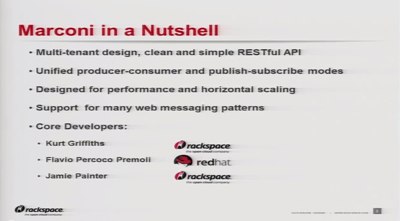
Basically, it’s a project designed to fill OpenStack’s growing need for a “robust, Web-scale message queuing service to support the distributed nature of large Web applications,” as it’s put on the Marconi wiki page. Marconi is defined as a highly available, modular, scalable message bus for the cloud.
“Our aim is to create an open alternative to SQS (producer-consumer) and SNS (pub-sub), for use in applications that run on OpenStack clouds,” the project team adds. “The project will define a clean, RESTful API, use a modular architecture, and will support unified pub-sub and job-queuing semantics.”
Users will be able to customize Marconi toward a wide variety of performance, durability, availability and efficiency goals. Use cases include distributing tasks among multiple workers, forwarding events to data collectors, publishing events to any number of subscribers, sending commands to one or more agents and requesting an action or getting information from an agent.
The video, below, from earlier this month provides a more detailed overview of the Marconi project.
‘A Key Component’
“This messaging service is another example of a key OpenStack component that is evolving quickly as more large enterprise and service providers adopt OpenStack cloud infrastructure,” Jay Lyman, a senior analyst for enterprise software at 451 Research, told Linux.com.
“While the main OpenStack components of compute, networking and storage provide the basics for building cloud computing infrastructure, most users try to integrate these and other OpenStack components with existing, legacy and other infrastructure, tooling, monitoring and management,” Lyman explained. “Identity services, for example, is another component of OpenStack that has progressed and matured relatively quickly with more large users, particularly enterprise organizations.”
Now, this new messaging service is “another example of a key component to these organizations, and I expect it will develop in similar fashion,” Lyman concluded.
Cadillac, Ford, Nissan, Jaguar Land Rover, Toyota. These carmakers are transforming their industry through software. Cars are no longer just about metal. A new car already has 5 to 15 million lines of software code that are reliant on and integrated with thousands of mechanical and electrical components. If you’re in the car business today you’re also a software maker.
I wrote in a Wired op-ed piece about the new requirements that consumer technology is putting on automakers. These companies are competing by differentiating the user experience in their cars and that means they need to know how to build software to support that user experience and they need to know how to build it fast.
The only way to acquire that knowledge, meet the pace of innovation expected from consumers, and support their cars for 10+ years per vehicle, is through collaborative development and open source software. And, we’re seeing it happen before our eyes.
 This week at the Automotive Linux Summit in Japan winners were revealed for the first-ever Automotive Grade Linux User Experience Contest. Among them is one of the world’s largest automakers, Ford, who integrated its open source Smart Device link solution into the AGL demonstrator to win in the category for Best Feature. The result is a complete software stack, consisting of the operating system, user interface and device drivers.
Reaktor won in the category for Best Visual Appearance and Tata Elxi for Best User Experience. You can read more about the submissions on the Automotive Grade Linux website.
While quick, cute solutions for user experiences hit the market (like iBeetle), the reality is that software that runs in cars has to be supported for the life of a car. Companies come and go. Investments in automotive by software providers will come and go. The Linux and open source communities, due to the collaborative development, will be supporting Linux in cars for decades to come. Furthermore, car makers don’t have to reinvent the wheel with Linux. They pick up $10B worth of R&D and a global community of thousands of developers who can collaboratively build the software with them and support it.
Transformation via collaboration.
Let me again congratulate the winners of the Automotive Grade Linux User Experience Contest. The outstanding entries demonstrate new concepts that will help define the future of cars. There is no question that Linux and collaborative development are changing the game for the car industry. And, this is just the beginning.
See what is coming next for Linux, open source and cars at the next Automotive Linux Summit.