Home Blog Page 1945

Debian 7.0 Wheezy: New Features You Need to Know About

The Debian project earlier this month put the finishing touches on their latest release: Debian 7.0, code named “Wheezy.”

Debian was an early pioneering Linux distribution, and has been a pillar of the community for nearly two decades. Today, it is well-known for its comprehensive repositories of software, its careful approach to updates, its smooth package installation and upgrade process, and its commitment to software freedom. It is particularly popular as a base for customization, with notable derivatives including Ubuntu and Linux Mint.
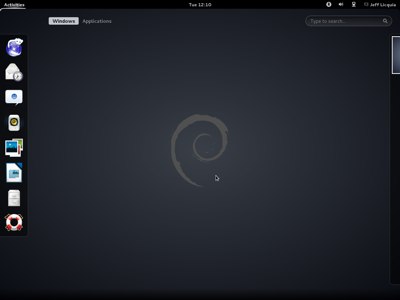
Debian wheezy desktopThis release marks the availability of two new architectures and a number of major updates and new features.

Multiarch

Debian’s new system for supporting multiple architectures (called “multiarch”) is perhaps the biggest change in this new release.

Most distributions provide some support for running compatible architectures, usually targeted at supporting older 32-bit applications on newer 64-bit operating systems transparently. Debian’s previous system for doing so involved a single large package containing a subset of the available 32-bit libraries.

The new system, in the works for eight years, moves all libraries to separate directories for each architecture, making it possible to simultaneously install every architecture’s libraries on the same system. The package manager then controls which architectures are available on a particular system. Architectures can be removed or added by changing the package manager’s configuration.

Besides the normal use case of supporting 64-bit and 32-bit architectures simultaneously, multiarch could in principle support transparent emulation of incompatible architectures, in-place upgrades from 32- to 64-bit (or the reverse), or support for other operating systems.

Architectures

While the count of official architectures remains the same, it includes two new architecture variants: ARMv7 (“armhf”) and 64-bit IBM System z (“s390x”). Both of these architectures take advantage of the new multiarch feature to support the older “armel” and 31-bit “s390” platforms.

Cloud Support

Debian has also improved its support for cloud computing. Besides the usual updates to the KVM and Xen hypervisors, the Xen Cloud Platform and OpenStack cloud suites are now available for easy installation.

GNOME 3
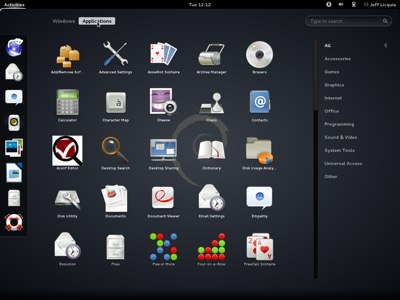
Debian Wheezy applicationsGNOME 3 makes its debut in Debian with this release, based on GNOME 3.4. It is available for easy installation and as an officially-supported live image, along with KDE 4.8, LXDE, and XFCE. Ubuntu’s Unity and Mint’s MATE and Cinnamon are not supported in this release.

New Init Systems

In keeping with its goal as “The Universal Operating System”, Debian 7.0 supports all of the major init systems, including the old System V init system (which remains the default), systemd, and upstart.

Office Suites

The recent trend among Linux distributors to replace OpenOffice.org with LibreOffice continues with Debian 7.0. KOffice continues to be supported along with the Calligra office suite.

Other Updates

Nearly the entire distribution has been updated from Debian 6.0. Some of the most notable updates include:

– Linux 3.2.0
– GCC 4.7
– glibc 2.13
– Python 2.7 and 3.2
– X.Org 7.7

Welcome to Jessie!

With the release of “Wheezy”, development has started on the next version of Debian, codenamed “Jessie”.

Where To Get Debian

Debian is available for download now at www.debian.org. Installation images are available for all supported architectures in CD- and DVD-sized ISOs, as well as network install images and a multi-arch image that supports both 32- and 64-bit Intel x86 systems. Debian also provides live images in minimal and rescue profiles, as well as the four desktops mentioned above.

Debian is also available as an AMI on Amazon Web Services in 32- and 64-bit paravirtualized images.

Users of Debian 6.0 “squeeze” can upgrade their systems in-place, as with previous Debian releases.

(Jeff Licquia is a Senior Engineer at the Linux Foundation.)

New Cloud Training Course: Open Source Cloud Platforms

There are many benefits to the open source model and we’ve recently seen a shift taking place in an emerging market: cloud computing


IBM Focuses on Linux in China, Partnered with Red Hat and SUSE

In Beijing this week, IBM has announced that it is further extending its reach into China with the opening of its first Linux innovation center there. The center will initially be focused on Power Systems clients and business partners, and will be located inside IBM’s China Systems Center. According to the company, the new center “will make it simpler for software developers to build and deploy new applications for big data, cloud, mobile and social business computing on open technology building blocks using Linux and the latest IBM POWER 7+ processor technology.”

This move is one of many so far this year that illustrates how pervasive open source technologies are becoming in China, where attitudes toward open source are friendlier than in many other parts of the world.

 
Read more at Ostatic

HPC to Enable a Smarter, Brighter Energy Future

Over at HPC for Energy, Carl Bauer writes that High Performance Computing is the key to meeting the daunting energy challenges that face the nation.

U.S. high-performance computing capabilities resident at our national laboratories can turn these challenges into an opportunity for competitive advantage. What was once only available for unique, extremely important and expensive government research projects or the largest corporations is now available to benefit society on a greater scale. Furthermore, the breadth and depth of an educated and talented work force to utilize these tools is expanding. The world-wide competitive advantage this will provide is beginning to be realized across various domestic and international industry sectors. The HPC for Energy initiative is a very important and timely program that can accelerate the realization of the benefits of better-informed deployment of HPC across all aspects of the U.S. energy supply chain.

Read the Full Story.

Related posts:


The post HPC to Enable a Smarter, Brighter Energy Future appeared first on insideHPC.

 
Read more at insideHPC

Q&A: ownCloud Provides Secure File Sharing for the Enterprise

File storage and sharing using consumer-oriented cloud services can be a security problem for companies that want to avoid sensitive data leaks. ownCloud aims to solve the issue by offering commercial cloud services installed within a company’s own datacenter. Their open source software is built on Linux and most often deployed on Linux by enterprise customers, said Markus Rex, CTO of ownCloud, via email. Here, Rex discusses where ownCloud fits into the open cloud ecosystem, what it means to be an Markus Rex, CTO of ownCloud.open source company, how to ensure security with open source software and why they recently joined The Linux Foundation.

Where does ownCloud fit into the ecosystem of open source cloud platforms?

I guess you could say we enable cloud platforms in many respects. At its heart, ownCloud is a secure cloud engine. Enterprises and users gain complete control over their sensitive data by integrating ownCloud with their infrastructure and security systems, managed through their policies. We integrate in open source platforms like OpenStack and run on highly popular OSS stacks; Linux, Apache, MySQL and PHP are preferred deployments.

How does ownCloud use Linux?

Well, to start, Linux is our main development platform, so, you know, that’s important. And keep in mind that’s as much a community statement as it is a technology statement. What I mean by that is open source is in our DNA, we are open by nature, and that is so important not just in attracting people to our unbelievably awesome community, but it enables us to fit so snugly into existing IT and to be able to quickly and easily extend our capabilities for whatever a customer needs. That’s pretty cool.
And also, the majority of our deployments are on Linux and one very convenient way to distribute and receive ownCloud is the Linux package managers – from SUSE and Red Hat to Debian and Ubuntu. Sure, we install easily on Windows – and of course our end user access tools are available on most platforms – but a lot of people in and around ownCloud use Linux.

What is the benefit to businesses of using ownCloud for the enterprise?

ownCloud helps enterprises concerned about sensitive data leakage via consumer cloud services like Dropbox deliver easy-to-use, secure file sync and share to their employees. Installed on their servers, using their storage, integrated with their infrastructure and security systems, managed to their policies, enterprises gain complete control over their sensitive data. At the same time, ownCloud provides end users simple access to the documents they need to get the job done on the devices they use daily. 

How do you ensure that open source cloud software is secure enough for enterprise use?

When it comes to security it does not matter whether a software is open source or not, although it clearly helps if you don’t hide anything.
What matters just as much is whether you trust the environment the software runs in. ownCloud is deployed in the enterprise’s datacenter, giving IT a powerful, yet easy way to integrate file sync and share capabilities right into their existing data security, monitoring and governance tools. With IT in control, instead of some third-party server farm located God knows where, they control how the data gets shared. So if there is trust in the environment – and for your own datacenter there better be! – open source software does nothing to diminish that trust.

Why did ownCloud join the Linux Foundation?

Well, as you know, I am a former CTO of the Foundation so I know all the great things you do, from education and training to networking. With a business so vested in Linux it was a no-brainer.

Join The Linux Foundation at www.linuxfoundation.org.

Qt 5.1 Beta 1 Released With Many Platform Features

The first beta release of the Qt 5.1 tool-kit is now available. As the first major update to the Qt5 platform, this release comes with plenty of new features for developers and end-users…

Read more at Phoronix

Apple Looks to Add Galaxy S4 to Samsung Lawsuit

The company says that it has evaluated Samsung’s handset and has found it to be in violation of its patents. [Read more]

Read more at CNET News

Distribution Release: Zorin OS 6.3 “Core”

Artyom Zorin has announced the release of Zorin OS 6.3 “Core” edition, an easy-to-use desktop Linux distribution based on Ubuntu’s latest LTS (long-term support) release and enhanced with a custom start menu and other user-friendly utilities: “The Zorin OS team is pleased to announce the release of Zorin….

Read more at DistroWatch

Terra and Lua Offer New High Performance Computing Strategy

A low level counterpart language to Lua offers a new way of generating high performance code and compiling domain specific languages for HPC applications

Read more at The H

Native Android Apps Now Possible With AIDE 2.0

Integration of the Native Development Kit means that the Android IDE can now be used to develop C/C++ apps for Android devices on Android devices.

Read more at The H