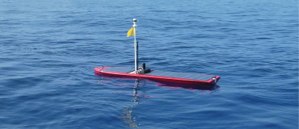
Earlier this week, Liquid Robotics unveiled the latest in its line of “Wave Glider” autonomous aquatic craft, due to ship in the third quarter, billing it as “the world’s first hybrid wave and solar propelled unmanned ocean robot.” In addition to its energy harvesting marvels, the 9.5-foot, Wave Glider SV3 is also notable for being the first Linux-powered Wave Glider. With its Linux- and Java-based Regulus operating system, the floating robot is far more adept at autonomous navigation than the Wave Glider SV2, and can now coordinate with its siblings in fleet operations.
 The SV2, which shipped in 2009, “ran on tiny embedded processors and didn’t really have an operating system,” said James Gosling, Liquid Robotics’ Chief Software Architect, in a phone interview. Gosling, the former Sun developer who is best known as the creator of the Java programming language, helped draw attention to Liquid Robotics when he joined the company in mid-2011 after a brief stint with Google.
Powered by Linux
The SV3 runs a Timesys distribution based on a Linux 3.x kernel, that is closely tailored to the craft’s single-core ARM processor, said Gosling. “OS selection is mostly driven by what works on that particular chipset,” he continued. “The ARM world is so fractured in terms of devices and board integration that kernels don’t slip in and out all that easily.” With that in mind, the flavor of Linux may change again soon. “We’ll be upgrading to a more robust multicore processor with some significant floating point on it in about six to eight months,” added Gosling.
No real-time patches were required for Regulus. “Everything moves so slowly — we’re traveling at about one and a half knots — that we don’t need real-time code,” said Gosling.
Regulus does, however, tap Linux capabilities in providing for more flexible wireless communications, and enabling multiple security features, including secure virtual containers. It also offers improved, adaptable power management for the SV3’s complex hybrid power system.
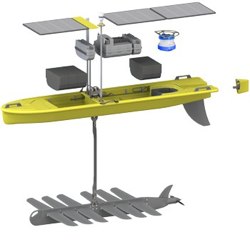
On the earlier SV2, a 112-Watt solar panel was used for powering sensors and communications, leaving navigation to the device’s underwater wave harvesting system. The SV3 adds a much more powerful, 170-Watt solar array connected to an auxiliary thruster for backing up the wave power. The latter is generated via a submarine extension with articulated wings suspended four meters below the surface.
The hybrid system increases speed and duration, while supporting more power-hungry sensors, cameras, and other equipment. When it’s sunny, the waves tend to be lighter, and vice versa, so the power sources complement each other. Just in case, the SV3’s more powerful 980 Wh battery enables travel even on cloudy, becalmed days.
Regulus integrates a cloud platform for coordinating multiple craft, downloading new apps, and acting as an intermediary between the Wave Gliders and their customers. Much of the processing, however, is done on board. “In the marine world, we’re used to having edge nodes that are pretty stupid, but we now have a lot of processing power,” said Gosling. The applications are written in Java. “The dividing line between an application and the OS gets kind of thin,” said Gosling. “The Java code controls the operation of all the devices, and Linux is primarily used for connecting the low-level drivers with the satellite, communicating via an RS232 serial connection.”
Autonomous Navigation and Swarm Intelligence
Although the Wave Glider can be controlled remotely, including via smartphone apps, it’s designed primarily for autonomous navigation. “The previous SV2 would just follow coordinate points, but on the SV3, operations are expressed more as goals to be achieved,” said Gosling. “The SV3 can also come up with its own goals. For example, if it detects a ship, it creates a goal not to crash into it. This lets it more easily weave its way around shipping traffic.” (Gosling has posted some videos about SV3 obstacle avoidance on his Nighthacks blog site.)
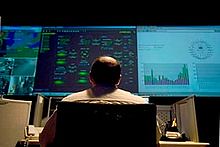
 Communications are handled via cellular and WiFi, or when out at sea, via satellite links. The Wave Glider SV3s can also communicate directly with each other within WiFi range. Whatever the network, Regulus’ swarm-savvy software helps coordinate the autonomous boats, which are tracked via GPS.
“We can give the Wave Gliders swarm-like goals,” said Gosling. “For example, if you’ve got a picket fence around a marine protected area, you can give them all essentially the same goal: Stand around this border. They can manage among themselves who goes where.”
While the SV2 broke records by crossing the Pacific Ocean in autonomous mode, the Wave Glider SV3 could theoretically travel for years without human intervention. This greater autonomy, endurance, and intelligence should be welcome to the Wave Glider’s largely scientific customer base. Some 200 SV2s now ply the seas in the service of oceanographers, meteorologists, climatologists, seismologists, and others, many of whom work for energy companies, fisheries, or the government. BP is using the floating robots to check water quality around oil rigs in the Gulf of Mexico, and the U.S. Navy is now evaluating the SV3 for surveillance tasks, according to Wired.
Onboard Data Analysis
Customers not only pay $300,000 per craft — up from $175,000 for the SV2 — but must also purchase expensive Iridium satellite connections, which are required beyond cellular range. “At about dollar a kilobyte, you can’t send very much data,” said Gosling. “So we do an immense amount of data reduction.”
Instead of sending raw sensor data, Regulus can analyze and summarize the data onboard. For example, if the craft is carrying a hydrophone to listen underwater, and if customers can’t wait to retrieve the recordings later, Regulus can instantly report key findings.
“One big application has been in marine mammal monitoring around oil rigs,” said Gosling. “If a marine mammal is in the area, they have to shut down. So instead of sending an expensive acoustic signal, the SV3 can run the processing algorithms onboard and then simply report that it has detected a whale.”
Despite the increased onboard processing, which Liquid Robotics refers to as “datacenter@sea” technology, “there’s no way that the role of the cloud is diminishing,” said Gosling. “When you do more processing on the vehicle, the answers that come back may be smaller, but they are more precious. We don’t have a ‘big data’ problem like a DNA sequencer cloud application might have, but what we have is data that is really important, that needs to be quickly streamed to whatever customer cares about it.”
For now, Regulus remains proprietary. “We might open source parts of it, but mostly it doesn’t make any sense because no one has a device vaguely like this one,” says Gosling.
Meanwhile, Linux developers who want to get their feet wet in open source aquatics should soon have access to a new Raspberry Pi- and Arduino-based Ziphius aquatic drone. The comparatively modest Ziphius has been accepted into Engadget’s “Insert Coin” competition, and is expected to go live on Kickstarter in the next month or so for a few hundred dollars.